Review Italian question words, numbers, telling time, ordering at a bar and shopping with a recap table, practice drills and a ten-question quiz.
You have now covered the everyday toolkit: questions, numbers, time, and the language of cafés, restaurants and shops. This review puts the whole chapter on one page, shows the patterns side by side, and tests you with a longer quiz. If you get a question wrong, follow the link back to the lesson that explains it.
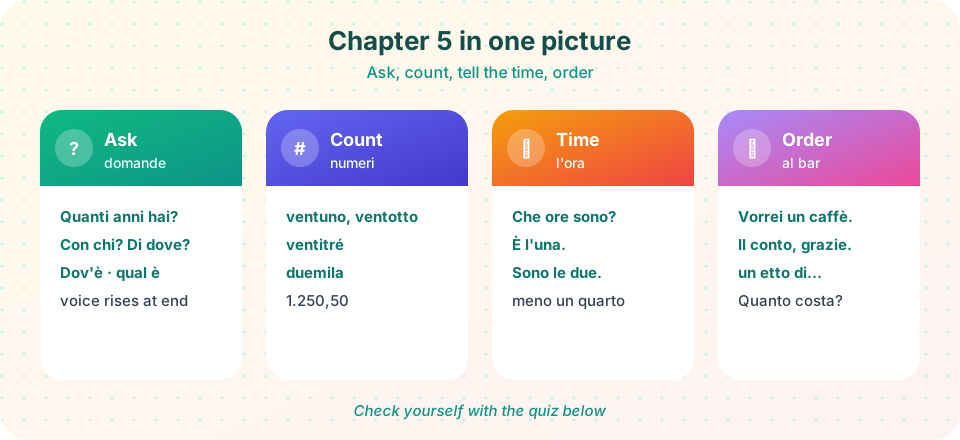
Chapter 5 in one picture: ask with a question word, count with the number rules, tell the time with sono le, and order with vorrei.
"I can skip the accents." Accents change meaning and stress: è (is) versus e (and), sì (yes) versus si (oneself), perché, ventitré, lunedì. Spell them correctly.
"Numbers in Italian are written with spaces like in English." They are joined into one word: trecentocinquanta, duemila.
Spend the first two days on questions: write ten of your own, say them aloud and answer each one. Spend the next two days on numbers and time: read the clock aloud every time you look at it, say prices in shops, and read dates from a calendar. On day five, rehearse a café or restaurant dialogue with yourself or a partner: order, ask the price, ask for the bill. On the weekend, retake the quiz and note which questions you still miss. The goal is not a perfect score but a clear list of what to revisit.
First, mix everything: a gap-fill drill with questions from all three lessons.
Chapter 5 mixed drill
<metacharset="utf-8"><style>*{box-sizing:border-box}body{margin:0;padding:14px;font:16px system-ui,-apple-system,'Segoe UI',sans-serif;color:#1e1b4b;background:linear-gradient(135deg,#f0fdfa,#ecfeff)}.card{background:#fff;border-radius:18px;padding:18px;box-shadow:0 10px 26px rgba(13,148,136,.18)}.n{color:#0d9488;font-size:14px;font-weight:600}.q{font-size:20px;margin:10px 0;min-height:30px}.h{color:#64748b;font-size:14px;min-height:20px}input{font:inherit;padding:8px 12px;border:2px solid #99f6e4;border-radius:12px;width:min(100%,22em)}button{font:inherit;font-weight:600;border:0;border-radius:12px;padding:9px 15px;color:#fff;background:linear-gradient(135deg,#14b8a6,#6366f1);cursor:pointer;margin:4px 4px 0 0}button.alt{background:linear-gradient(135deg,#f59e0b,#ef4444)}button.ghost{background:#e0f2fe;color:#075985}.ok{color:#047857;font-weight:600}.bad{color:#b91c1c;font-weight:600}.face{min-height:120px;display:flex;align-items:center;justify-content:center;text-align:center;font-size:30px;font-weight:700;border-radius:16px;background:linear-gradient(135deg,#ccfbf1,#e0e7ff);padding:14px;cursor:pointer;margin:10px 0}.note{color:#475569;font-size:15px;min-height:22px}.cols{display:grid;grid-template-columns:1fr 1fr;gap:10px}.cols button{display:block;width:100%;margin:0 0 8px;background:#f1f5f9;color:#1e1b4b;border:2px solid #cbd5e1;text-align:left}.cols button.sel{border-color:#6366f1;background:#e0e7ff}.cols button.done{border-color:#10b981;background:#d1fae5;color:#065f46}.cols button.wrong{border-color:#ef4444;background:#fee2e2}</style><divclass="card"><divclass="n"id="n"></div><divclass="q"id="q"></div><divclass="h"id="h"></div><inputid="a"autocomplete="off"autocapitalize="off"spellcheck="false"aria-label="Your answer"><buttonid="b">Check</button><pid="m"class="note"></p></div><script>const items=[["___ abiti? (Where)","dove",""],["___ due euro e cinquanta. (It is 2.50)","sono","Sono due euro e cinquanta."],["Sono le sei ___ un quarto. (5:45)","meno",""],["___ caffè, per favore.","un",""],["Oggi è il ___ maggio. (the first)","primo","only date with an ordinal"],["Quanti ___ hai? (years)","anni",""],["Un ___ di formaggio. (100 g)","etto",""],["___ di dove sei? (Where from, with preposition)","di","Di dove sei?"]];let i=0,score=0,checked=false;const$=id=>document.getElementById(id);constnorm=s=>s.toLowerCase().replace(/[.,;!?]/g,"").replace(/[\u2018\u2019]/g,"'").replace(/\s+/g," ").trim();conststrip=s=>norm(s).normalize("NFD").replace(/[\u0300-\u036f]/g,"");functionrender(){const it=items[i];$("n").textContent="Question "+(i+1)+" of "+items.length+" - score "+score;$("q").textContent=it[0];$("h").textContent=it[2]?"Hint: "+it[2]:"";$("a").style.display="";$("a").value="";$("m").textContent="";$("m").className="note";$("b").textContent="Check";checked=false;$("a").focus();}functionact(){if(i>=items.length){i=0;score=0;render();return}if(checked){
i++;if(i>=items.length){$("n").textContent="";$("h").textContent="";$("q").textContent="Finished! Score: "+score+" / "+items.length;$("a").style.display="none";$("m").textContent="";$("b").textContent="Try again";return}render();return;}const opts=items[i][1].split("|"),g=norm($("a").value);if(!g){return}if(opts.some(o=>norm(o)===g)){score++;$("m").className="ok";$("m").textContent="Corretto! "+opts[0]}elseif(opts.some(o=>strip(o)===strip(g))){$("m").className="bad";$("m").textContent="Almost - watch the accent: "+opts[0]}else{$("m").className="bad";$("m").textContent="Not quite. Answer: "+opts.join(" / ")}$("n").textContent="Question "+(i+1)+" of "+items.length+" - score "+score;
checked=true;$("b").textContent="Next";}$("b").onclick=act;$("a").addEventListener("keydown",e=>{if(e.key==="Enter")act()});render();</script>
Second, a flashcard deck of chapter highlights.
Chapter 5 review cards
<metacharset="utf-8"><style>*{box-sizing:border-box}body{margin:0;padding:14px;font:16px system-ui,-apple-system,'Segoe UI',sans-serif;color:#1e1b4b;background:linear-gradient(135deg,#f0fdfa,#ecfeff)}.card{background:#fff;border-radius:18px;padding:18px;box-shadow:0 10px 26px rgba(13,148,136,.18)}.n{color:#0d9488;font-size:14px;font-weight:600}.q{font-size:20px;margin:10px 0;min-height:30px}.h{color:#64748b;font-size:14px;min-height:20px}input{font:inherit;padding:8px 12px;border:2px solid #99f6e4;border-radius:12px;width:min(100%,22em)}button{font:inherit;font-weight:600;border:0;border-radius:12px;padding:9px 15px;color:#fff;background:linear-gradient(135deg,#14b8a6,#6366f1);cursor:pointer;margin:4px 4px 0 0}button.alt{background:linear-gradient(135deg,#f59e0b,#ef4444)}button.ghost{background:#e0f2fe;color:#075985}.ok{color:#047857;font-weight:600}.bad{color:#b91c1c;font-weight:600}.face{min-height:120px;display:flex;align-items:center;justify-content:center;text-align:center;font-size:30px;font-weight:700;border-radius:16px;background:linear-gradient(135deg,#ccfbf1,#e0e7ff);padding:14px;cursor:pointer;margin:10px 0}.note{color:#475569;font-size:15px;min-height:22px}.cols{display:grid;grid-template-columns:1fr 1fr;gap:10px}.cols button{display:block;width:100%;margin:0 0 8px;background:#f1f5f9;color:#1e1b4b;border:2px solid #cbd5e1;text-align:left}.cols button.sel{border-color:#6366f1;background:#e0e7ff}.cols button.done{border-color:#10b981;background:#d1fae5;color:#065f46}.cols button.wrong{border-color:#ef4444;background:#fee2e2}</style><divclass="card"><divclass="n"id="n"></div><divclass="face"id="f"tabindex="0"role="button"aria-label="Flip card"></div><divclass="note"id="note"></div><buttonid="flip">Flip</button><buttonid="know"class="alt">I knew it</button><buttonid="again"class="ghost">Again later</button><buttonid="say"class="ghost">Listen</button><pclass="note"id="m"></p></div><script>const items=[["Che ore sono?","What time is it?","Sono le due e mezza."],["Quanto costa?","How much is it?","costano for plural"],["Vorrei...","I would like...","polite request"],["alle otto","at eight o'clock","all'una for one"],["ventitré","twenty-three","accent on the 3"],["un po' di","a little (of)","un po' di zucchero"],["il primo maggio","the first of May","only date with an ordinal"],["qual è","what is / which is","no apostrophe"]];let deck=items.map((_,k)=>k),flipped=false,known=0;const$=id=>document.getElementById(id);functionrender(){$("n").textContent="Known "+known+" of "+items.length+" - "+deck.length+" left";if(!deck.length){$("f").textContent="Tutto fatto! All cards known.";$("note").textContent="Press Again later to restart.";deck=items.map((_,k)=>k);known=0;flipped=false;return}const it=items[deck[0]];$("f").textContent=flipped?it[1]:it[0];$("note").textContent=flipped?(it[2]||""):"Tap the card to see the English.";}functionflip(){flipped=!flipped;render()}$("f").onclick=flip;$("flip").onclick=flip;$("know").onclick=()=>{deck.shift();known++;flipped=false;render()};$("again").onclick=()=>{deck.push(deck.shift());flipped=false;render()};$("say").onclick=()=>{try{if(!deck.length||!("speechSynthesis"in window)){$("m").textContent="Speech is not available in this preview.";return}const u=newSpeechSynthesisUtterance(items[deck[0]][0]);u.lang="it-IT";window.speechSynthesis.speak(u);$("m").textContent="";}catch(e){$("m").textContent="Speech is not available in this preview."}};render();</script>
Third, try a sentence builder. It is a simulation that assembles polite requests from parts you choose; change the lists and run it.
JS
Polite request builder
const openers =["Vorrei","Prendo","Mi dà"];const items =["un caffè","un cappuccino e un cornetto","una bottiglia d'acqua","due etti di prosciutto"];const closers =["per favore.","grazie.","se possibile."];
openers.forEach((o, i)=>{const item = items[i % items.length];const closer = closers[i % closers.length];
console.log(`${o}${item}, ${closer}`);});
console.log("--- all combinations (3 x 4) ---");for(const o of openers)for(const it of items) console.log(`${o}${it}.`);
Press Run (or Ctrl + Enter) to see the console output here.