


















Lesson 2 of 50 · Getting Started
Italian and Italy: the language and its world
Where Italian comes from, where it is spoken, how standard Italian relates to dialects, and why English speakers recognize so many Italian words.
Before you learn to speak a language, it helps to know what kind of language it is. Italian is a Romance language, which means it grew out of Latin, the language of ancient Rome. It is a close cousin of Spanish, French, Portuguese and Romanian, and a more distant cousin of English, which borrowed an enormous number of words from Latin and from French.
This lesson gives you the short story: where Italian comes from, where people speak it today, why there is a "standard" Italian and also dozens of dialects, and why you already know hundreds of Italian words without having studied.
What you will learn
- How Latin turned into Italian, and what role Dante played.
- Where Italian is an official or widely spoken language.
- The difference between standard Italian, regional Italian and dialects.
- How to use English-Italian look-alike words, and which ones to avoid.
Key terms
Romance language: a language that developed from Latin. Italian, Spanish, French, Portuguese, Romanian and Catalan are Romance languages.
Vernacular: the everyday spoken language of a region, as opposed to Latin, which was the language of writing and learning in medieval Europe.
Cognate: a word in two languages that comes from the same source and looks and means roughly the same, such as English music and Italian musica.
False friend (falso amico): a word that looks like an English word but means something different.
From Latin to Italian
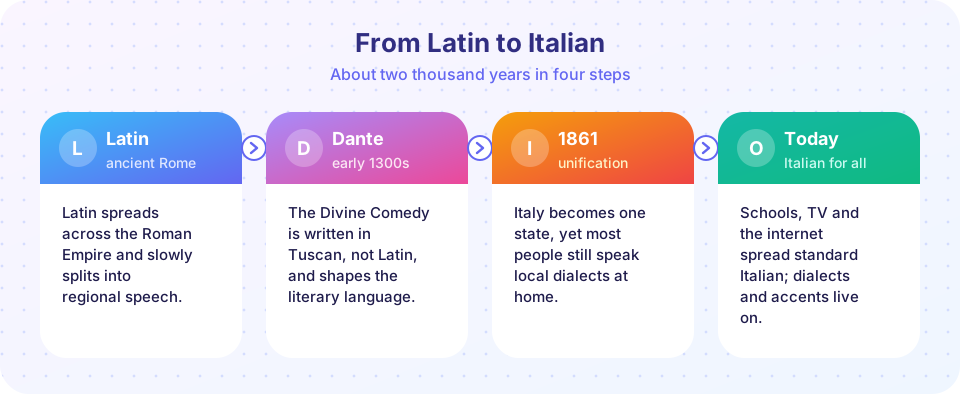
Latin was spoken across the Roman Empire, but ordinary people did not speak the Latin of books. Over centuries, the spoken form drifted in every region: vowels changed, endings were dropped, and new words came in. By about the year 1000, people in Italy spoke local varieties that were very different from classical Latin, and from each other.
Writers at first kept using Latin for serious work. The turning point came in the early 1300s, when the poet Dante Alighieri wrote his masterpiece, the Divina Commedia (Divine Comedy), in the vernacular of Tuscany, the region around Florence. Because the poem became so famous, and because later Tuscan writers such as Petrarch and Boccaccio were also admired, the Tuscan form of speech slowly became the model for written Italian. This is why Italians sometimes call their language la lingua di Dante (the language of Dante).
Italy only became one country in 1861. Before that it was a patchwork of kingdoms, duchies and city states, and ordinary people spoke local dialects at home. For a long time, standard Italian was mostly a written language that a small minority of educated people also spoke. Two forces changed that in the twentieth century: compulsory schooling, and mass media, especially radio and television. Today almost everybody in Italy speaks standard Italian, and many also speak a dialect.
Where Italian is spoken
Italian is the official language of Italy, San Marino and Vatican City. It is one of the four national languages of Switzerland, spoken mostly in the canton of Ticino and parts of Graubünden. It also has official status in some areas of Slovenia and Croatia where Italian communities live.
Because millions of Italians emigrated in the nineteenth and twentieth centuries, there are large Italian-descended communities in Argentina, Brazil, the United States, Canada, Australia, Germany, France and elsewhere. Italian is spoken by roughly 60 to 70 million people as a first language, and many more as a second or foreign language. It is a major language of music (the words allegro, forte, piano and crescendo in sheet music are Italian), art history, food, fashion, design and Catholic Church history.
If you want to practice with real people, look for Italian conversation groups in your city, Italian-language clubs at universities, or online tutoring. Italy's neighbors in Ticino and the large diaspora communities also mean that Italian is easy to meet in many parts of the world.
Standard Italian, regional Italian and dialects
When you hear "Italian," three different things can be meant.
- Standard Italian (italiano standard) is the shared language of schools, books, news and official documents. This is what this course teaches.
- Regional Italian (italiano regionale) is standard Italian spoken with local pronunciation and a few local words. A Milanese, a Roman and a Sicilian speak the same language, but you can hear where they come from. Even the word for "to eat breakfast" or "the small bread roll" can change from region to region.
- Dialects (dialetti) are separate local languages with their own grammar and vocabulary, such as Neapolitan, Sicilian, Venetian, Lombard, Sardinian and many more. Linguists note that most of them developed directly from Latin, in parallel with Tuscan, rather than from standard Italian. Some are very different from the standard; two speakers of different dialects may not understand each other.
As a learner, you do not need to learn dialects. You will, however, hear them, and Italians are often proud of their local speech. Do not be discouraged if a friend from Naples or Venice sounds different from the recordings you studied: that is normal.
You already know a lot of Italian
English borrowed many Italian words, mostly from music, art, food and finance: piano, opera, soprano, studio, balcony, fiasco, graffiti, pizza, pasta, espresso, cappuccino, gelato, bank (from banca), ghetto, lottery, umbrella (from ombrella). Many more look similar because both languages took words from Latin. Here are some everyday cognates:
| English | Italian | Notes |
|---|---|---|
| music | musica | Same root; stress on the first syllable |
| family | famiglia | The gli is pronounced like "ly" |
| restaurant | ristorante | Four syllables: ri-sto-ran-te |
| station | stazione | -tion in English is -zione in Italian |
| important | importante | Many English words in -ant or -ent match |
| possible | possibile | English -ble becomes -bile |
| telephone | telefono | No ph in Italian |
A useful rule of thumb: English words ending in -tion often correspond to Italian -zione, words in -ty to -tà (university is università, city is città), and words in -ous to -oso (famous is famoso). This will give you a big vocabulary very quickly.
False friends
Some look-alikes are traps. Learn these early so that they do not catch you.
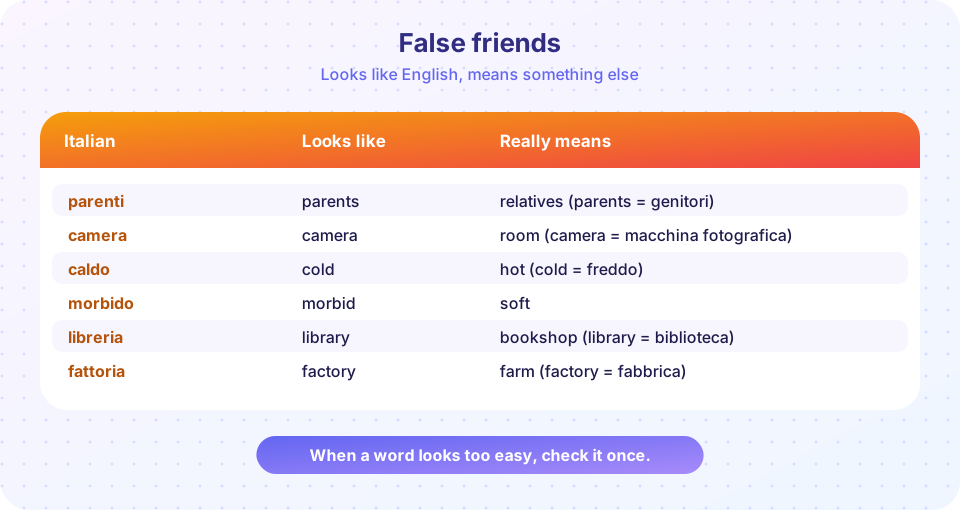
A few more: attualmente means "currently" (not "actually", which is in realtà), pretendere means "to demand" (to pretend is fingere), and eventualmente means "if necessary" or "possibly" (not "eventually", which is alla fine).
Common misconceptions
"Italian dialects are just bad Italian." They are not mistakes. Most of them grew from Latin independently, centuries before standard Italian reached everyone, and many have their own literature and songs.
"All Italians sound the same." Accents vary a lot. A learner should aim for clear standard pronunciation and accept that real conversations include many accents.
"Cognates always mean the same." Most do, but false friends exist. When a word looks too easy, check it in a dictionary the first time.
Try it
Practice the look-alike words. These are real cognates; notice how they are similar to English and how they are not.
Now test yourself on false friends. Choose the true meaning of each Italian word.
Check your understanding
Quick check · 5 questions
of 5 answered You scored / 5 · perfect!
-
1. Which language family does Italian belong to?
Italian developed from Latin, so it is a Romance language like Spanish and French. -
2. Which writer's work did most to make Tuscan the model for written Italian?
Dante wrote the Divine Comedy in the Tuscan vernacular in the early 1300s. -
3. In which of these is Italian an official or national language?
Italian is one of Switzerland's four national languages, along with German, French and Romansh. -
4. English words ending in -tion often match Italian words ending in what?
Station becomes stazione and nation becomes nazione. The ending -tà matches -ty and -oso matches -ous. -
5. What does the Italian word 'firma' mean?
A firma is a signature. A company is an azienda or a ditta.
Summary
- Italian is a Romance language descended from Latin; Dante's Tuscan shaped the written standard.
- Italy unified in 1861; schools and mass media then spread standard Italian.
- Italian is official in Italy, San Marino and Vatican City, a national language of Switzerland, and spoken by large diaspora communities.
- Standard Italian, regional Italian and dialects are three different things; this course teaches the standard.
- Cognates give you free vocabulary (-tion = -zione, -ty = -tà), but false friends such as parenti, camera, caldo and libreria need care.
Track your progress
Create a free account to tick off lessons and pick up where you left off on any device.
of Italian for Beginners lessons completed