


















Lesson 18 of 50 · Present Tense Verbs
Essere and avere: to be and to have
Learn the Italian verbs essere (to be) and avere (to have) in the present tense, their many uses, expressions like ho fame, and c'è and ci sono.
Two verbs appear in almost every Italian conversation: essere (to be) and avere (to have). Both are irregular, which means that their forms do not follow the regular patterns, so you simply learn them by heart. Fortunately, you will use them so often that they stick quickly.
In this lesson you will learn their present tense forms, the situations in which each is used, and the many expressions where Italian uses avere although English says "to be" (ho fame, "I am hungry"). You will also learn c'è and ci sono ("there is" and "there are").
What you will learn
- The present tense of essere and avere.
- What each verb is used for: identity, description, location, time, possession, age.
- Expressions with avere (hunger, thirst, fear, and more).
- How to say "there is" and "there are" (c'è, ci sono).
- How to make negative sentences and questions with these verbs.
Key terms
Irregular verb (verbo irregolare): a verb whose forms do not follow the regular pattern of its family.
Copula: a linking verb such as essere that connects a subject to a description: Marco è alto.
Auxiliary verb (verbo ausiliare): a helper verb used to build compound tenses. Essere and avere are the two auxiliaries; you will use them for the past in Chapter 6.
Idiom: a fixed expression whose meaning is not word-for-word, like ho fame.
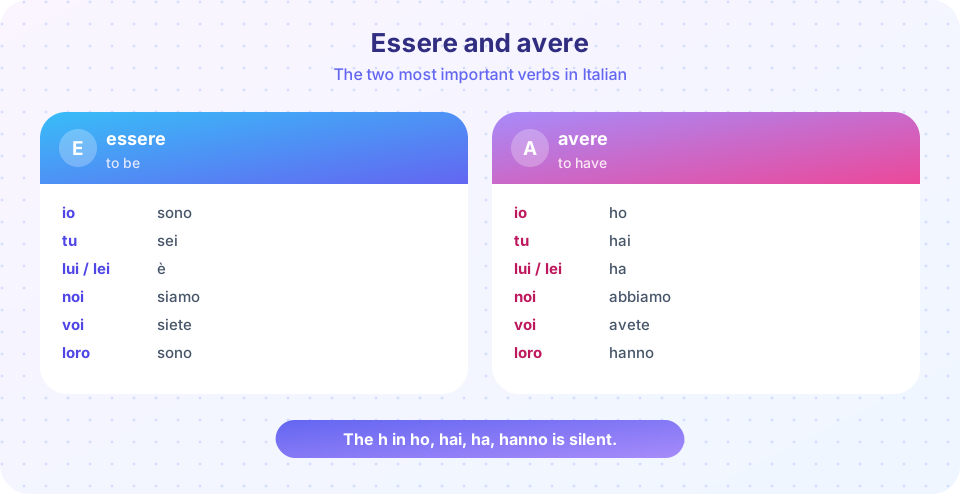
Essere: to be
| Person | Form | Example | Meaning |
|---|---|---|---|
| io | sono | Sono Anna. | I am Anna. |
| tu | sei | Sei stanco? | Are you tired? |
| lui / lei / Lei | è | Marco è italiano. | Marco is Italian. |
| noi | siamo | Siamo a casa. | We are at home. |
| voi | siete | Siete pronti? | Are you ready? |
| loro | sono | Sono amici. | They are friends. |
Pay attention to two things. First, sono means both "I am" and "they are": the context (and the pronoun, if present) tells you which. Second, the third person singular è has an accent to separate it from e (and).
What essere is used for
- Identity and profession: Sono Luca. Sono insegnante. (I am a teacher.) Note: no article before the profession.
- Nationality and origin: Siamo italiani. Sono di Napoli. (I am from Naples.)
- Description: La casa è grande. I ragazzi sono simpatici. The adjective agrees with the subject.
- Location: Il libro è sul tavolo. Siamo a Roma. (We are in Rome.)
- Time and date: Che ore sono? Sono le tre. È l'una. Oggi è lunedì. (What time is it? It is three o'clock. It is one o'clock. Today is Monday.)
- Possession: Il libro è di Marco. (The book is Marco's.)
There is, there are: c'è and ci sono
For "there is" and "there are", Italian uses ci + essere:
- C'è un gatto in giardino. There is a cat in the garden.
- Ci sono due gatti in giardino. There are two cats in the garden.
- Non c'è latte. There is no milk.
- Ci sono molti studenti? Are there many students?
Ecco is a handy cousin that means "here is, here are, there it is": Ecco il treno! (There is the train!), Ecco la mia casa. (Here is my house.)
Avere: to have
| Person | Form | Example | Meaning |
|---|---|---|---|
| io | ho | Ho un gatto. | I have a cat. |
| tu | hai | Hai una penna? | Do you have a pen? |
| lui / lei / Lei | ha | Ha due fratelli. | He has two brothers. |
| noi | abbiamo | Abbiamo tempo. | We have time. |
| voi | avete | Avete fame? | Are you hungry? |
| loro | hanno | Hanno una macchina. | They have a car. |
The h is silent, but it is written: it separates ho, hai, ha, hanno from words that sound alike:
- ho (I have) / o (or): Ho un gatto o un cane? Do I have a cat or a dog?
- hai (you have) / ai (to the, plural).
- ha (he has) / a (to, at): Lui ha una macchina, va a Roma.
- hanno (they have) / anno (year): Hanno un anno di tempo.
What avere is used for
- Possession and family: Ho una sorella. Hanno una casa al mare. (I have a sister. They have a house by the sea.)
- Age: Ho venti anni. Quanti anni hai?
- Physical states and feelings (idioms): see the table below.
- As an auxiliary for most past tenses, which you will learn in Chapter 6.
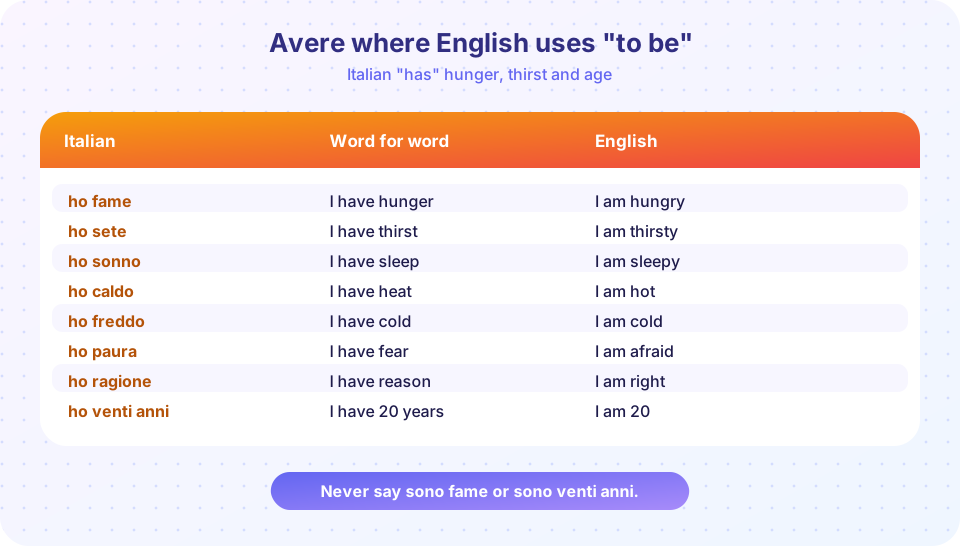
More expressions: avere bisogno di (to need): Ho bisogno di aiuto (I need help); avere voglia di (to feel like): Ho voglia di un gelato (I feel like having an ice cream); avere fretta (to be in a hurry); avere torto (to be wrong); avere mal di testa (to have a headache) and mal di gola (a sore throat).
Negatives and questions
Put non before the verb: Non sono stanco. Non ho fame. Non c'è problema. (I am not tired. I am not hungry. There is no problem.)
For a question, keep the word order and raise the pitch at the end, or put a question word first:
- Sei italiano? Are you Italian?
- Hai fame? Are you hungry?
- Dov'è la stazione? Where is the station?
- Com'è la tua casa? What is your house like?
- Chi è? Who is it?
- Quanti anni ha? How old is he/she (or you, formal)?
A short dialogue
- Sara: Ciao Luca! Sei stanco?
- Luca: Sì, un po'. Ho sonno e ho fame!
- Sara: Ecco un panino. Hai sete?
- Luca: Sì, grazie! Dov'è l'acqua?
- Sara: È sul tavolo. Ci sono anche due mele.
Translation: Sara: Hi Luca! Are you tired? Luca: Yes, a little. I am sleepy and hungry! Sara: Here is a sandwich. Are you thirsty? Luca: Yes, thanks! Where is the water? Sara: It is on the table. There are also two apples.
Common misconceptions
"I am hungry" is sono fame. Say ho fame. The same goes for ho sete, ho sonno, ho caldo, ho freddo, ho paura and age: ho venti anni, never sono venti anni.
"I am hot" translates literally. Sono caldo is not how you say you feel hot. For temperature, use ho caldo.
"È and e are the same word." È is the verb "is"; e is "and". Marco è alto e Anna è bassa.
"Sono always means I am." It also means "they are". Sono italiano (I am Italian) versus Sono italiani (They are Italian): the adjective gives the clue.
"Ho is pronounced HO." The h is silent: ho sounds like "o".
Try it
First, practice the forms. Press a button for essere or avere to see the table, or type another verb. Then try to say the forms aloud without looking.
Second, decide between essere and avere.
Third, translate and spell. The checker accepts masculine or feminine endings where both are right.
Check your understanding
Quick check · 6 questions
of 6 answered You scored / 6 · perfect!
-
1. What is the 'noi' form of essere?
Noi siamo means we are. Siete is voi and sono is io or loro. -
2. How do you say 'I am thirsty'?
Italian uses avere for thirst: ho sete. -
3. What does 'Ci sono tre libri' mean?
Ci sono is the plural of c'è: there are. -
4. Which sentence is correct?
Use essere to describe a state, and the third person singular is è. -
5. Which pair differs by the silent h?
Ho (I have) and o (or) sound the same; the written h tells them apart. -
6. How do you ask 'Where is the station?'
Dov'è = dove + è.
Summary
- Essere: sono, sei, è, siamo, siete, sono. Avere: ho, hai, ha, abbiamo, avete, hanno.
- Essere is for identity, profession, nationality, origin, description, location, time and possession (di).
- Avere is for possession, age and many body states: ho fame, sete, sonno, caldo, freddo, paura.
- C'è and ci sono mean "there is" and "there are".
- Negative: non + verb. Question: raise the voice or add a question word (Dov'è...?).
Next: Regular -are verbs
Track your progress
Create a free account to tick off lessons and pick up where you left off on any device.
of Italian for Beginners lessons completed