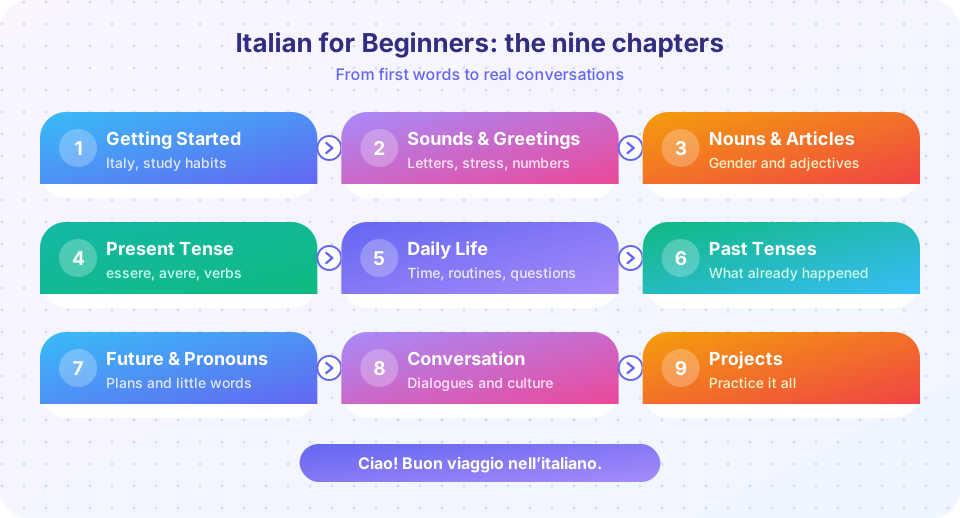
Start here: who this Italian course is for, what each of the nine chapters teaches, how to study it, and what a course can and cannot do for you.
Welcome to Italian for Beginners. This course takes you from "I know how to say ciao and pizza" to holding simple conversations about your day, your family, your plans and your past. It is written for English speakers, so every rule is explained in English, and every Italian example comes with a translation.
Italian is one of the friendliest languages to start with. Its spelling is very regular, so once you know the rules you can read any word aloud. Many of its words look like English words you already know. And it is sung, quoted, cooked and argued about all over the world, so you will find reasons to use it quickly.
The whole course on one page: nine chapters, each one building on the one before.
Italiano standard: the standard, shared form of Italian taught in schools and used on television and in books. This is the Italian you learn here.
Dialetti (dialects): the many regional languages of Italy, such as Neapolitan or Venetian. They are separate local traditions and are not the same thing as regional accents.
IPA: the International Phonetic Alphabet, a system of symbols that records speech sounds exactly. We show IPA between slashes, for example /ˈtʃao/ for ciao.
Respelling: a simple English-style spelling of a sound, such as "chow" for ciao. We use it next to IPA so that you can start without learning IPA first.
You do not need any earlier knowledge of Italian, or of any other foreign language. If you can read English, you can follow every explanation. Some previous contact with Spanish, French or Latin will make some words feel familiar, but it is not needed.
The course suits several kinds of learners:
Travelers who want to order food, ask directions and be polite.
Students who need a first year of Italian for school or university.
Heritage learners who grew up hearing Italian at home but never studied the grammar.
Curious adults who simply like languages, music, art or cooking.
Chapter 2, Sounds, Greetings and Basics teaches the alphabet, the pure Italian vowels, the consonants that change before e and i, double letters, stress and accents, the greetings you will use every day, and the numbers.
Chapter 3, Nouns, Articles and Adjectives introduces gender (every noun is masculine or feminine), plurals, the many forms of the and a, and adjectives that change to agree with their noun.
Chapter 4, Present Tense Verbs is where sentences come alive: essere (to be), avere (to have), the three regular verb families, and the most useful irregular verbs.
Chapters 5 to 9 carry on from there with daily life and questions, the past tenses, the future, pronouns and a first taste of the subjunctive, real conversations with cultural notes, and finally projects and practice that mix everything.
Every lesson has the same shape, so you always know where you are:
What you will learn lists the outcomes.
Key terms gives short definitions of new words.
The body explains the idea with Italian examples and translations.
Common misconceptions warns about the mistakes English speakers make most often.
Try it has interactive flashcards, drills and games.
A short quiz checks your understanding, followed by a summary.
Italian examples appear in italics or in code-style blocks, followed by the English meaning in plain text, for example: Mi chiamo Anna. means "My name is Anna."
A course like this one can teach you the grammar, the vocabulary and a reliable way to say things. It cannot replace speaking with real people. Conversation is a skill, like swimming or playing the guitar: you only get good at it by doing it.
There is also no audio on this site. Pronunciation is taught with IPA symbols and plain respellings, and some exercises offer an optional "Listen" button that uses your own browser's voice, if it has an Italian one. That button may be missing or silent in some browsers, so nothing in the course depends on it. To train your ear, listen to Italian radio, songs and films, and find a tutor or a conversation partner as soon as you can say a few sentences.
Say every example out loud, even if you are alone. Your mouth needs practice with sounds like the rolled r and the double consonants, and reading silently does not train it.
"Italian is just Spanish with a different accent." The two are close relatives, and they share a lot of vocabulary, but pronunciation, spelling and many grammar details differ. Treating Italian as accented Spanish produces the mistakes that sound most foreign.
"I need to learn all the grammar before I can speak." You do not. Start with phrases, speak imperfectly and let the grammar explain what you are already saying.
"Everyone in Italy speaks English, so it is not worth it." In big tourist areas many people do. But everywhere else, and in every friendly moment, an effort in Italian is warmly received and opens doors that English does not.
Warm up with twelve first words. Flip each card, say the Italian aloud, then mark the ones you already know.
First twelve words
<style>*{box-sizing:border-box}body{margin:0;padding:14px;font-family:system-ui,'Segoe UI',Arial,sans-serif;background:linear-gradient(135deg,#faf5ff,#eff6ff);color:#1e1b4b}.wrap{max-width:640px;margin:0 auto}.card{background:#fff;border-radius:20px;box-shadow:0 10px 24px rgba(67,56,202,.15);padding:18px}.big{font-size:30px;font-weight:700;color:#312e81;text-align:center;min-height:44px;margin:14px 0 4px}.sub{font-size:16px;color:#64748b;text-align:center;min-height:22px}.row{display:flex;gap:8px;flex-wrap:wrap;justify-content:center;margin-top:14px}button{font:inherit;font-weight:600;border:0;border-radius:999px;padding:9px 16px;cursor:pointer;color:#fff;background:linear-gradient(135deg,#6366f1,#a78bfa)}button.alt{background:#eef2ff;color:#3730a3}button.ok{background:linear-gradient(135deg,#10b981,#14b8a6)}button:disabled{opacity:.5;cursor:default}.meta{font-size:14px;color:#6366f1;text-align:center;margin-bottom:4px}.opt{display:block;width:100%;text-align:left;margin:8px 0;background:#eef2ff;color:#1e1b4b;border-radius:14px;padding:11px 14px}.opt.good{background:#d1fae5;color:#064e3b}.opt.bad{background:#fee2e2;color:#7f1d1d}.fb{min-height:24px;margin-top:10px;font-weight:600;text-align:center}input[type=text]{font:inherit;width:100%;padding:11px 14px;border:2px solid #c7d2fe;border-radius:14px;margin-top:10px;background:#fff;color:#1e1b4b}table{border-collapse:collapse;width:100%;margin-top:10px}td,th{padding:8px 10px;text-align:left;border-bottom:1px solid #e0e7ff;font-size:16px}th{color:#4f46e5;font-size:14px;text-transform:uppercase;letter-spacing:.04em}.mt{margin-top:10px}</style><divclass="wrap"><divclass="card"><divclass="meta"id="meta"></div><divclass="big"id="front"></div><divclass="sub"id="back"></div><divclass="row"><buttonclass="alt"id="prev">Back</button><buttonid="flip">Show English</button><buttonid="next">Next</button></div><divclass="row"><buttonclass="alt"id="shuf">Shuffle</button><buttonclass="alt"id="say">Listen (if your browser can)</button><buttonclass="ok"id="got">I knew it</button></div><divclass="fb"id="fb"></div></div></div><script>constDATA=[["ciao","hi / bye (informal)","chow"],["buongiorno","good morning / good day","bwon-JOR-no"],["buonasera","good evening","bwoh-nah-SEH-rah"],["arrivederci","goodbye","ar-ree-veh-DEHR-chee"],["grazie","thank you","GRAH-tsee-eh"],["prego","you are welcome","PREH-go"],["per favore","please","pehr fah-VOH-reh"],["scusi","excuse me (formal)","SKOO-zee"],["sì","yes","see"],["no","no","noh"],["mi chiamo...","my name is...","mee KYAH-mo"],["come stai?","how are you? (informal)","KOH-meh STAH-ee"]];let order=DATA.map((_,i)=>i),pos=0,shown=false,known=newSet();const$=id=>document.getElementById(id);functiondraw(){const c=DATA[order[pos]];$('meta').textContent='Card '+(pos+1)+' of '+DATA.length+' | known: '+known.size;$('front').textContent=c[0];$('back').textContent=shown?c[1]+(c[2]?' ('+c[2]+')':''):'';$('flip').textContent=shown?'Hide English':'Show English';}$('flip').onclick=()=>{shown=!shown;draw()};$('next').onclick=()=>{pos=(pos+1)%DATA.length;shown=false;$('fb').textContent='';draw()};$('prev').onclick=()=>{pos=(pos-1+DATA.length)%DATA.length;shown=false;$('fb').textContent='';draw()};$('shuf').onclick=()=>{for(let i=order.length-1;i>0;i--){const k=Math.floor(Math.random()*(i+1));[order[i],order[k]]=[order[k],order[i]];}pos=0;shown=false;draw()};$('got').onclick=()=>{known.add(order[pos]);$('fb').textContent=known.size===DATA.length?'You know them all. Bravo!':'Marked as known.';draw()};$('say').onclick=()=>{try{const u=newSpeechSynthesisUtterance(DATA[order[pos]][0]);u.lang='it-IT';speechSynthesis.cancel();speechSynthesis.speak(u);}catch(e){$('fb').textContent='Speech is not available in this preview.';}};draw();</script>
Now a first guessing game. You will see an Italian phrase and pick its meaning. Even if you have never studied Italian, many answers can be guessed from English.
Can you guess?
<style>*{box-sizing:border-box}body{margin:0;padding:14px;font-family:system-ui,'Segoe UI',Arial,sans-serif;background:linear-gradient(135deg,#faf5ff,#eff6ff);color:#1e1b4b}.wrap{max-width:640px;margin:0 auto}.card{background:#fff;border-radius:20px;box-shadow:0 10px 24px rgba(67,56,202,.15);padding:18px}.big{font-size:30px;font-weight:700;color:#312e81;text-align:center;min-height:44px;margin:14px 0 4px}.sub{font-size:16px;color:#64748b;text-align:center;min-height:22px}.row{display:flex;gap:8px;flex-wrap:wrap;justify-content:center;margin-top:14px}button{font:inherit;font-weight:600;border:0;border-radius:999px;padding:9px 16px;cursor:pointer;color:#fff;background:linear-gradient(135deg,#6366f1,#a78bfa)}button.alt{background:#eef2ff;color:#3730a3}button.ok{background:linear-gradient(135deg,#10b981,#14b8a6)}button:disabled{opacity:.5;cursor:default}.meta{font-size:14px;color:#6366f1;text-align:center;margin-bottom:4px}.opt{display:block;width:100%;text-align:left;margin:8px 0;background:#eef2ff;color:#1e1b4b;border-radius:14px;padding:11px 14px}.opt.good{background:#d1fae5;color:#064e3b}.opt.bad{background:#fee2e2;color:#7f1d1d}.fb{min-height:24px;margin-top:10px;font-weight:600;text-align:center}input[type=text]{font:inherit;width:100%;padding:11px 14px;border:2px solid #c7d2fe;border-radius:14px;margin-top:10px;background:#fff;color:#1e1b4b}table{border-collapse:collapse;width:100%;margin-top:10px}td,th{padding:8px 10px;text-align:left;border-bottom:1px solid #e0e7ff;font-size:16px}th{color:#4f46e5;font-size:14px;text-transform:uppercase;letter-spacing:.04em}.mt{margin-top:10px}</style><divclass="wrap"><divclass="card"><divclass="meta"id="meta"></div><divid="q"style="font-size:19px;font-weight:700;margin:8px 0"></div><divid="opts"></div><divclass="fb"id="fb"></div><divclass="row"><buttonid="next"disabled>Next question</button></div></div></div><script>constITEMS=[{"q":"What does 'grazie' mean?","options":["please","thank you","sorry","hello"],"a":1,"why":"Grazie means thank you. It shares its root with English 'grace' and 'gratitude'."},{"q":"Which word do you say when you leave a formal shop?","options":["arrivederci","prego","ciao","scusi"],"a":0,"why":"Arrivederci is the polite goodbye. Ciao is more informal."},{"q":"What does 'buonasera' mean?","options":["good morning","good night","good evening","good luck"],"a":2,"why":"Sera means evening, so buonasera means good evening."},{"q":"'Prego' is the usual answer to which word?","options":["ciao","grazie","sì","scusi"],"a":1,"why":"Prego (you are welcome) answers grazie (thank you). It has other uses too, which you will meet later."}];let i=0,score=0,done=false;const$=id=>document.getElementById(id);functionshow(){const it=ITEMS[i];done=false;$('meta').textContent='Question '+(i+1)+' of '+ITEMS.length+' | score: '+score;$('q').textContent=it.q;$('opts').innerHTML='';$('fb').textContent='';$('next').disabled=true;
it.options.forEach((o,k)=>{const b=document.createElement('button');b.className='opt';b.textContent=o;b.onclick=()=>pick(k,b);$('opts').appendChild(b);});}functionpick(k,b){if(done)return;done=true;const it=ITEMS[i];const bs=$('opts').children;if(k===it.a){score++;b.classList.add('good');$('fb').textContent='Correct! '+it.why;}else{b.classList.add('bad');bs[it.a].classList.add('good');$('fb').textContent='Not quite. '+it.why;}$('meta').textContent='Question '+(i+1)+' of '+ITEMS.length+' | score: '+score;$('next').disabled=false;$('next').textContent=i===ITEMS.length-1?'See result':'Next question';}$('next').onclick=()=>{if(i===ITEMS.length-1){$('q').textContent='Finished: '+score+' out of '+ITEMS.length;$('opts').innerHTML='';$('fb').textContent=score===ITEMS.length?'Perfetto!':'Try again to improve your score.';$('next').textContent='Start again';i=-1;score=0;$('next').onclick=()=>{$('next').onclick=null;location.reload();};return;}i++;show();};show();</script>