Review Chapter 3: Italian noun gender, plurals, definite and indefinite articles, adjective agreement, bello and buono, with a recap table and a ten-question test.
This chapter introduced the central idea of Italian grammar: agreement. A noun has a gender and a number, and the articles and adjectives around it change their endings to match. If you can build a short phrase such as una casa piccola e bella or i libri nuovi without hesitation, you have understood the whole chapter.
Use this review to check your memory, read a short descriptive text, and test yourself with ten questions.
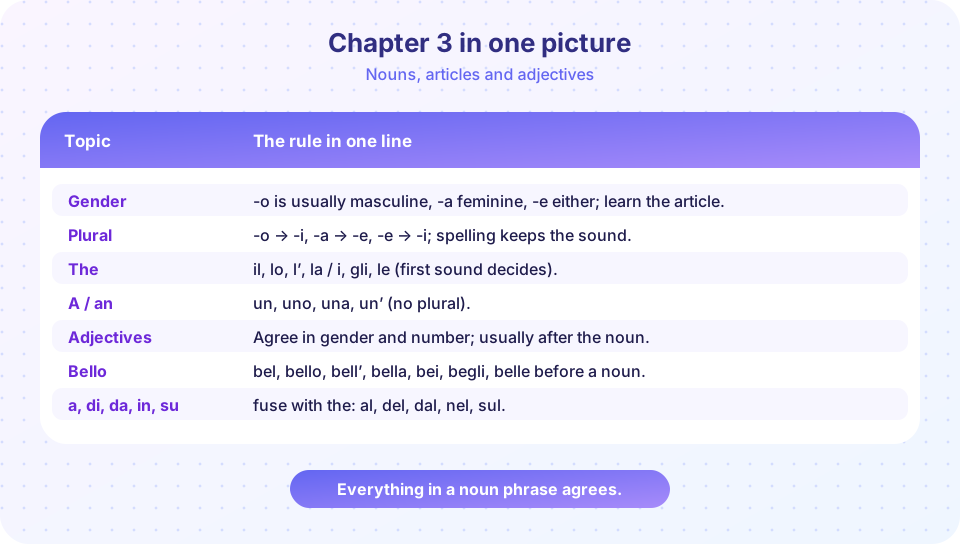
Chapter 3 in one picture: every word in a noun phrase agrees.
-o usually masculine, -a usually feminine, -e either. Exceptions: la mano, il problema. Plurals: -o → -i, -a → -e, -e → -i. Spelling follows sound: amica → amiche, lago → laghi, arancia → arance. Invariable: la città, il film. Irregular: uomo → uomini, uovo → uova.
The: il, lo, l', la, i, gli, le. A: un, uno, una, un'. Choice depends on gender, number and the first sound of the next word. Prepositions fuse with the: al, del, dal, nel, sul.
Four forms for -o adjectives, two for -e, one for invariable (blu, rosa, viola). Position: usually after the noun; bello and buono before a noun change like the article.
Read this short description aloud, then check the grammar. Look for the article, noun and adjective that always match.
Questa è una casa piccola ma bella. Ha una cucina gialla, un salotto grande e due camere. Nel giardino ci sono dei fiori rossi e un albero verde. Il gatto nero dorme sul divano.
Translation: This is a small but beautiful house. It has a yellow kitchen, a big living room and two bedrooms. In the garden there are some red flowers and a green tree. The black cat sleeps on the sofa.
Notice the patterns:
una casa piccola: feminine singular noun, so una and piccola.
una cucina gialla: again feminine, with -a endings throughout.
un salotto grande: masculine singular; grande ends in -e and is the same for both genders.
due camere: camera is feminine; the plural camere ends in -e.
dei fiori rossi: fiore is masculine; the plural is fiori (-e → -i) and the adjective is rossi.
un albero verde: albero is masculine (it begins with a vowel, but the masculine un has no apostrophe).
First, match article plus noun to its English meaning.
Articles and nouns
<style>*{box-sizing:border-box}body{margin:0;padding:14px;font-family:system-ui,'Segoe UI',Arial,sans-serif;background:linear-gradient(135deg,#faf5ff,#eff6ff);color:#1e1b4b}.wrap{max-width:640px;margin:0 auto}.card{background:#fff;border-radius:20px;box-shadow:0 10px 24px rgba(67,56,202,.15);padding:18px}.big{font-size:30px;font-weight:700;color:#312e81;text-align:center;min-height:44px;margin:14px 0 4px}.sub{font-size:16px;color:#64748b;text-align:center;min-height:22px}.row{display:flex;gap:8px;flex-wrap:wrap;justify-content:center;margin-top:14px}button{font:inherit;font-weight:600;border:0;border-radius:999px;padding:9px 16px;cursor:pointer;color:#fff;background:linear-gradient(135deg,#6366f1,#a78bfa)}button.alt{background:#eef2ff;color:#3730a3}button.ok{background:linear-gradient(135deg,#10b981,#14b8a6)}button:disabled{opacity:.5;cursor:default}.meta{font-size:14px;color:#6366f1;text-align:center;margin-bottom:4px}.opt{display:block;width:100%;text-align:left;margin:8px 0;background:#eef2ff;color:#1e1b4b;border-radius:14px;padding:11px 14px}.opt.good{background:#d1fae5;color:#064e3b}.opt.bad{background:#fee2e2;color:#7f1d1d}.fb{min-height:24px;margin-top:10px;font-weight:600;text-align:center}input[type=text]{font:inherit;width:100%;padding:11px 14px;border:2px solid #c7d2fe;border-radius:14px;margin-top:10px;background:#fff;color:#1e1b4b}table{border-collapse:collapse;width:100%;margin-top:10px}td,th{padding:8px 10px;text-align:left;border-bottom:1px solid #e0e7ff;font-size:16px}th{color:#4f46e5;font-size:14px;text-transform:uppercase;letter-spacing:.04em}.mt{margin-top:10px}</style><divclass="wrap"><divclass="card"><divclass="meta"id="meta">Click an Italian word, then its English meaning.</div><divstyle="display:flex;gap:14px"><divid="L"style="flex:1"></div><divid="R"style="flex:1"></div></div><divclass="fb"id="fb"></div><divclass="row"><buttonclass="alt"id="re">Shuffle again</button></div></div></div><script>constP=[["lo zio","the uncle"],["l'amica","the friend (f.)"],["il libro","the book"],["la città","the city"],["gli studenti","the students"],["le uova","the eggs"]];const$=id=>document.getElementById(id);let selL=null,matched=0;functionsh(a){a=a.slice();for(let i=a.length-1;i>0;i--){const k=Math.floor(Math.random()*(i+1));[a[i],a[k]]=[a[k],a[i]];}return a;}functionbuild(){$('L').innerHTML='';$('R').innerHTML='';selL=null;matched=0;$('fb').textContent='';sh(P.map((_,i)=>i)).forEach(i=>{const b=document.createElement('button');b.className='opt';b.textContent=P[i][0];b.dataset.i=i;b.onclick=()=>{if(b.disabled)return;[...$('L').children].forEach(x=>x.style.outline='');b.style.outline='3px solid #6366f1';selL=b;};$('L').appendChild(b);});sh(P.map((_,i)=>i)).forEach(i=>{const b=document.createElement('button');b.className='opt';b.textContent=P[i][1];b.dataset.i=i;b.onclick=()=>{if(b.disabled||!selL)return;if(selL.dataset.i===b.dataset.i){selL.classList.add('good');b.classList.add('good');selL.disabled=true;b.disabled=true;selL.style.outline='';selL=null;matched++;$('fb').style.color='#047857';$('fb').textContent=matched===P.length?'All matched. Bravo!':'Match!';}else{b.classList.add('bad');setTimeout(()=>b.classList.remove('bad'),500);$('fb').style.color='#b91c1c';$('fb').textContent='No, try another one.';}};$('R').appendChild(b);});}$('re').onclick=build;build();</script>
Second, type the phrases. Be careful with the agreement.
Build the phrase
<style>*{box-sizing:border-box}body{margin:0;padding:14px;font-family:system-ui,'Segoe UI',Arial,sans-serif;background:linear-gradient(135deg,#faf5ff,#eff6ff);color:#1e1b4b}.wrap{max-width:640px;margin:0 auto}.card{background:#fff;border-radius:20px;box-shadow:0 10px 24px rgba(67,56,202,.15);padding:18px}.big{font-size:30px;font-weight:700;color:#312e81;text-align:center;min-height:44px;margin:14px 0 4px}.sub{font-size:16px;color:#64748b;text-align:center;min-height:22px}.row{display:flex;gap:8px;flex-wrap:wrap;justify-content:center;margin-top:14px}button{font:inherit;font-weight:600;border:0;border-radius:999px;padding:9px 16px;cursor:pointer;color:#fff;background:linear-gradient(135deg,#6366f1,#a78bfa)}button.alt{background:#eef2ff;color:#3730a3}button.ok{background:linear-gradient(135deg,#10b981,#14b8a6)}button:disabled{opacity:.5;cursor:default}.meta{font-size:14px;color:#6366f1;text-align:center;margin-bottom:4px}.opt{display:block;width:100%;text-align:left;margin:8px 0;background:#eef2ff;color:#1e1b4b;border-radius:14px;padding:11px 14px}.opt.good{background:#d1fae5;color:#064e3b}.opt.bad{background:#fee2e2;color:#7f1d1d}.fb{min-height:24px;margin-top:10px;font-weight:600;text-align:center}input[type=text]{font:inherit;width:100%;padding:11px 14px;border:2px solid #c7d2fe;border-radius:14px;margin-top:10px;background:#fff;color:#1e1b4b}table{border-collapse:collapse;width:100%;margin-top:10px}td,th{padding:8px 10px;text-align:left;border-bottom:1px solid #e0e7ff;font-size:16px}th{color:#4f46e5;font-size:14px;text-transform:uppercase;letter-spacing:.04em}.mt{margin-top:10px}</style><divclass="wrap"><divclass="card"><divclass="meta"id="meta"></div><divclass="big"style="font-size:24px"id="p"></div><divclass="sub"id="h"></div><inputtype="text"id="in"autocomplete="off"autocapitalize="off"spellcheck="false"placeholder="Type your answer in Italian"><divclass="row"><buttonid="chk">Check</button><buttonclass="alt"id="nx">Next</button></div><divclass="fb"id="fb"></div></div></div><script>constITEMS=[["a big house","una casa grande"],["the red books","i libri rossi"],["a beautiful friend (f.)","una bella amica"],["the new students","i nuovi studenti"],["a good coffee","un buon caffè"],["the white cats","i gatti bianchi"],["two small houses","due case piccole"],["the green tree","l'albero verde"]];let i=0,score=0,tried=false;const$=id=>document.getElementById(id);conststrip=s=>s.normalize('NFD').replace(/[\u0300-\u036f]/g,'');constnorm=s=>s.trim().toLowerCase().replace(/\s+/g,' ');functionshow(){const it=ITEMS[i];$('meta').textContent='Item '+(i+1)+' of '+ITEMS.length+' | score: '+score;$('p').textContent=it[0];$('h').textContent=it[2]||'';$('in').value='';$('fb').textContent='';tried=false;$('in').focus();}functioncheck(){const it=ITEMS[i];const a=norm($('in').value);if(!a)return;const ok=norm(it[1]).split('|');if(ok.includes(a)){if(!tried)score++;$('fb').style.color='#047857';$('fb').textContent='Correct: '+it[1].split('|')[0];tried=true;}elseif(ok.map(strip).includes(strip(a))){$('fb').style.color='#b45309';$('fb').textContent='Right letters, but check the accent: '+it[1].split('|')[0];tried=true;}else{$('fb').style.color='#b91c1c';$('fb').textContent='Not yet. Try again, or press Next to see the answer.';tried=true;}$('meta').textContent='Item '+(i+1)+' of '+ITEMS.length+' | score: '+score;}$('chk').onclick=check;$('in').onkeydown=e=>{if(e.key==='Enter')check();};$('nx').onclick=()=>{if(!$('fb').textContent.startsWith('Correct')){$('fb').style.color='#475569';$('fb').textContent='Answer: '+ITEMS[i][1].split('|')[0]+' (press Next again to continue)';if(!$('nx').dataset.s){$('nx').dataset.s='1';return;}}$('nx').dataset.s='';i=(i+1)%ITEMS.length;show();};show();</script>
Third, test the rules in a quick quiz.
Quick rule check
<style>*{box-sizing:border-box}body{margin:0;padding:14px;font-family:system-ui,'Segoe UI',Arial,sans-serif;background:linear-gradient(135deg,#faf5ff,#eff6ff);color:#1e1b4b}.wrap{max-width:640px;margin:0 auto}.card{background:#fff;border-radius:20px;box-shadow:0 10px 24px rgba(67,56,202,.15);padding:18px}.big{font-size:30px;font-weight:700;color:#312e81;text-align:center;min-height:44px;margin:14px 0 4px}.sub{font-size:16px;color:#64748b;text-align:center;min-height:22px}.row{display:flex;gap:8px;flex-wrap:wrap;justify-content:center;margin-top:14px}button{font:inherit;font-weight:600;border:0;border-radius:999px;padding:9px 16px;cursor:pointer;color:#fff;background:linear-gradient(135deg,#6366f1,#a78bfa)}button.alt{background:#eef2ff;color:#3730a3}button.ok{background:linear-gradient(135deg,#10b981,#14b8a6)}button:disabled{opacity:.5;cursor:default}.meta{font-size:14px;color:#6366f1;text-align:center;margin-bottom:4px}.opt{display:block;width:100%;text-align:left;margin:8px 0;background:#eef2ff;color:#1e1b4b;border-radius:14px;padding:11px 14px}.opt.good{background:#d1fae5;color:#064e3b}.opt.bad{background:#fee2e2;color:#7f1d1d}.fb{min-height:24px;margin-top:10px;font-weight:600;text-align:center}input[type=text]{font:inherit;width:100%;padding:11px 14px;border:2px solid #c7d2fe;border-radius:14px;margin-top:10px;background:#fff;color:#1e1b4b}table{border-collapse:collapse;width:100%;margin-top:10px}td,th{padding:8px 10px;text-align:left;border-bottom:1px solid #e0e7ff;font-size:16px}th{color:#4f46e5;font-size:14px;text-transform:uppercase;letter-spacing:.04em}.mt{margin-top:10px}</style><divclass="wrap"><divclass="card"><divclass="meta"id="meta"></div><divid="q"style="font-size:19px;font-weight:700;margin:8px 0"></div><divid="opts"></div><divclass="fb"id="fb"></div><divclass="row"><buttonid="next"disabled>Next question</button></div></div></div><script>constITEMS=[{"q":"Which noun is masculine?","options":["la mano","il problema","la città"],"a":1,"why":"Il problema is masculine even though it ends in -a."},{"q":"What is the plural of 'la città'?","options":["le città","le citte","le cittè"],"a":0,"why":"Nouns ending in an accented vowel do not change."},{"q":"Choose the correct article: ___ psicologo.","options":["il","lo","l'"],"a":1,"why":"Ps takes lo."},{"q":"Which phrase is right?","options":["una bel casa","una bella casa","un bella casa"],"a":1,"why":"Bello agrees: una bella casa."}];let i=0,score=0,done=false;const$=id=>document.getElementById(id);functionshow(){const it=ITEMS[i];done=false;$('meta').textContent='Question '+(i+1)+' of '+ITEMS.length+' | score: '+score;$('q').textContent=it.q;$('opts').innerHTML='';$('fb').textContent='';$('next').disabled=true;
it.options.forEach((o,k)=>{const b=document.createElement('button');b.className='opt';b.textContent=o;b.onclick=()=>pick(k,b);$('opts').appendChild(b);});}functionpick(k,b){if(done)return;done=true;const it=ITEMS[i];const bs=$('opts').children;if(k===it.a){score++;b.classList.add('good');$('fb').textContent='Correct! '+it.why;}else{b.classList.add('bad');bs[it.a].classList.add('good');$('fb').textContent='Not quite. '+it.why;}$('meta').textContent='Question '+(i+1)+' of '+ITEMS.length+' | score: '+score;$('next').disabled=false;$('next').textContent=i===ITEMS.length-1?'See result':'Next question';}$('next').onclick=()=>{if(i===ITEMS.length-1){$('q').textContent='Finished: '+score+' out of '+ITEMS.length;$('opts').innerHTML='';$('fb').textContent=score===ITEMS.length?'Perfetto!':'Try again to improve your score.';$('next').textContent='Start again';i=-1;score=0;$('next').onclick=()=>{$('next').onclick=null;location.reload();};return;}i++;show();};show();</script>