


















Lesson 19 of 50 · Present Tense Verbs
Regular -are verbs
Learn the present tense of regular Italian -are verbs like parlare and mangiare, the spelling changes of -care, -gare and -iare verbs, and how to build sentences and questions.
The -are verbs are the biggest family in Italian. Thousands of verbs end in -are, and almost all of them follow one single pattern. When you learn that pattern, you can conjugate parlare (to speak), mangiare (to eat), lavorare (to work), abitare (to live), ascoltare (to listen) and hundreds more, without any extra work.
In this lesson you will learn the six endings, the stress pattern (so you sound right), the small spelling changes in verbs like cercare and mangiare, and how to put the verbs into everyday sentences with negatives, questions and adverbs of frequency.
What you will learn
- The six present tense endings of regular -are verbs.
- Where the stress falls in each form.
- The spelling rules for verbs in -care, -gare, -ciare, -giare, -iare.
- Twenty useful -are verbs.
- How to make negatives, questions and sentences with adverbs.
Key terms
Regular verb: a verb that follows the pattern of its family exactly.
Stem: the verb without -are: parl- in parlare.
Adverb of frequency: a word like sempre (always), spesso (often), a volte (sometimes), mai (never).
Direct object: the thing the verb acts on: Mangio una mela.
The pattern
Take the infinitive, remove -are, and add:
| Person | Ending | parlare | mangiare | lavorare |
|---|---|---|---|---|
| io | -o | parlo | mangio | lavoro |
| tu | -i | parli | mangi | lavori |
| lui / lei / Lei | -a | parla | mangia | lavora |
| noi | -iamo | parliamo | mangiamo | lavoriamo |
| voi | -ate | parlate | mangiate | lavorate |
| loro | -ano | parlano | mangiano | lavorano |
Stress
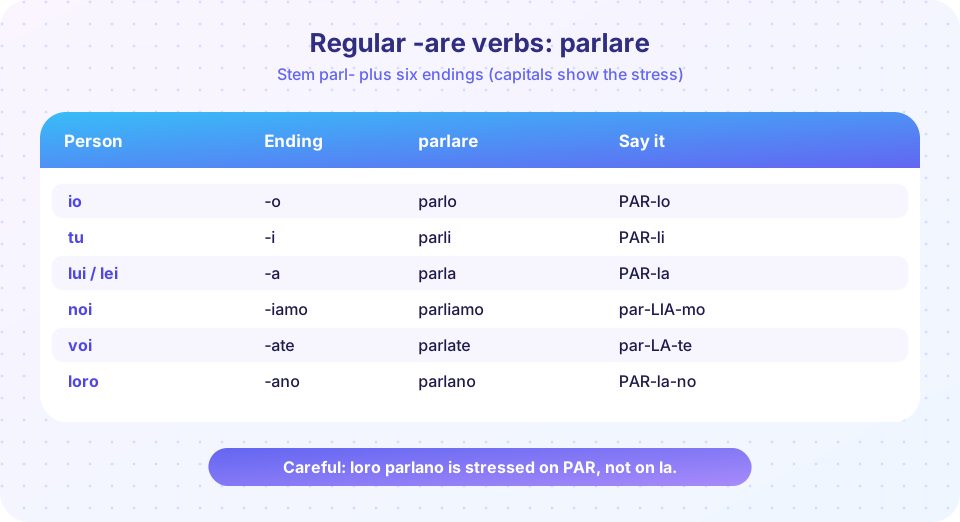
In the present tense, the stress falls on the stem (the same syllable as in the infinitive) in io, tu, lui/lei and loro, but on the ending in noi and voi. So: PAR-lo, PAR-li, PAR-la, par-LIA-mo, par-LA-te, PAR-la-no.
Watch the loro form: the stress is on the stem, even though the word is longer (PAR-la-no, three syllables with stress on the first). English speakers often put the stress on the wrong syllable and say par-LA-no. Learn it as a third to last syllable stress, like TE-le-fo-no.
The Lei form
Lei (formal "you") uses the same form as lui and lei: Lei parla bene l'italiano. (You speak Italian well.) Signora, Lei lavora qui? (Madam, do you work here?)
Spelling changes: keep the sound
Some -are verbs have a small spelling adjustment before the endings -i and -iamo, because those endings begin with the vowel i. The goal is to keep the sound of the stem the same, following the c/g rules you learned in Chapter 2.
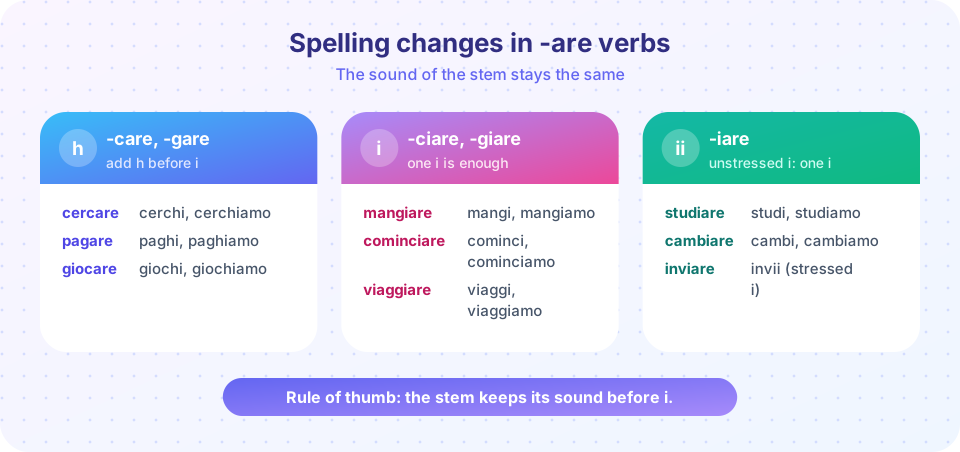
- -care and -gare add an h before -i and -iamo, to keep the hard sound: cercare (to look for): cerco, cerchi, cerca, cerchiamo, cercate, cercano. Pagare (to pay): pago, paghi, paga, paghiamo, pagate, pagano. Giocare (to play): gioco, giochi, gioca, giochiamo, giocate, giocano.
- -ciare and -giare keep one i. The stem already has an i that makes the sound soft, so it is not doubled: mangiare: mangio, mangi, mangia, mangiamo, mangiate, mangiano. Cominciare (to begin): comincio, cominci, comincia, cominciamo. Viaggiare (to travel): viaggio, viaggi, viaggia, viaggiamo.
- -iare with an unstressed i also keeps a single i: studiare: studio, studi, studia, studiamo, studiate, studiano. Cambiare (to change): cambio, cambi, cambia, cambiamo.
- -iare with a stressed i (a small group) keeps both i's in the tu form: inviare (to send): io invio, tu invii. Sciare (to ski): tu scii.
Useful -are verbs
| Verb | Meaning | Verb | Meaning |
|---|---|---|---|
| parlare | to speak, talk | ascoltare | to listen to |
| mangiare | to eat | guardare | to watch, look at |
| lavorare | to work | comprare | to buy |
| abitare | to live (reside) | cercare | to look for |
| studiare | to study | trovare | to find |
| cantare | to sing | aspettare | to wait for |
| ballare | to dance | cucinare | to cook |
| giocare | to play (a game) | pagare | to pay |
| arrivare | to arrive | amare | to love |
| camminare | to walk | usare | to use |
A trick for English speakers: no preposition follows ascoltare, guardare, cercare and aspettare. English says "listen to", "look for", "wait for", but Italian uses a direct object: Ascolto la musica. (I listen to music.) Cerco le chiavi. (I am looking for the keys.) Aspetto l'autobus. (I am waiting for the bus.) Guardo la TV. (I watch TV.)
Sentences, negatives and questions
A simple statement. Marco lavora a Milano. (Marco works in Milan.) Noi mangiamo la pizza. (We eat pizza.)
Negatives. Put non before the verb: Non parlo francese. (I do not speak French.) Non lavorano oggi. (They are not working today.)
Questions. Raise your voice or use a question word:
- Parli italiano? Do you speak Italian?
- Dove abiti? Where do you live?
- Che cosa mangi? What are you eating?
- Quando arrivate? When are you arriving?
- Chi canta? Who is singing?
Adverbs of frequency go after the verb or at the start: Studio sempre la sera. (I always study in the evening.) Mangiamo spesso la pasta. (We often eat pasta.) A volte ballano. (Sometimes they dance.) With mai (never), use non before the verb: Non mangio mai la carne. (I never eat meat.)
The present tense for what is going on now and what is coming. Parlo means "I speak" and "I am speaking". It is also used for planned future actions: Domani arrivo alle otto. (Tomorrow I arrive at eight.)
A short dialogue
- Giulia: Dove abiti, Marco?
- Marco: Abito a Bologna. E tu?
- Giulia: Io abito a Firenze, ma lavoro a Milano.
- Marco: Che cosa studi?
- Giulia: Studio medicina. Parlo anche inglese e un po' di francese.
- Marco: Complimenti! Noi studiamo storia e giochiamo a calcio la domenica.
Translation: Giulia: Where do you live, Marco? Marco: I live in Bologna. And you? Giulia: I live in Florence, but I work in Milan. Marco: What do you study? Giulia: I study medicine. I also speak English and a little French. Marco: Congratulations! We study history and play football on Sundays.
Common misconceptions
"The loro form is stressed like the noi form." Loro is stressed on the stem: PAR-la-no, not par-LA-no.
"Cercare keeps the same spelling: cerci and cercamo." The sound must stay hard, so tu cerchi and noi cerchiamo.
"Mangiare doubles the i: mangii." No: tu mangi, noi mangiamo.
"Ascoltare needs 'a' like English 'listen to'." It does not: Ascolto la radio.
"Giocare is used for instruments." For a game you use giocare a (giocare a calcio); for an instrument, suonare (suono la chitarra).
"I need the pronoun every time." Mangio una mela is complete. Use io only for emphasis.
Try it
First, run the conjugator. It applies the endings and the spelling rules to any -are verb in the list, and prints the whole table. Try adding your own verbs, for example viaggiare or dimenticare. Compare the results with the spelling rules.
Press Run (or Ctrl + Enter) to see the result here.
Program input · what you'd type while the program runs
Type the answers before you press Run, one per line. Each time the program reads a line (with input()), it gets the next line from this box.
Second, say the forms. Flip each card and say the verb in all six persons.
Third, conjugate. Each prompt gives the English and the verb in brackets. Type the Italian verb form only.
Check your understanding
Quick check · 6 questions
of 6 answered You scored / 6 · perfect!
-
1. What is the 'noi' form of 'mangiare'?
The stem mangi- loses its i before -iamo: mangiamo. -
2. How do you say 'you (tu) pay'?
Verbs in -gare add h before i to keep the g hard: paghi. -
3. Where is the stress in 'parlano'?
The loro form is stressed on the stem: PAR-la-no. -
4. Which is correct for 'I am looking for the keys'?
Cercare takes a direct object with no preposition. -
5. Which sentence means 'I never eat meat'?
With mai (never), the verb takes non before it: Non mangio mai la carne. -
6. Which verb do you use for 'to play a game'?
Giocare is for games and sports; suonare is for instruments.
Summary
- Regular -are verbs: stem + -o, -i, -a, -iamo, -ate, -ano.
- Stress is on the stem except in noi and voi (PAR-lo, par-LIA-mo, par-LA-te, PAR-la-no).
- Spelling: -care/-gare add h before i (cerchi, paghiamo); -ciare/-giare/-iare keep one i (mangi, studiamo).
- No preposition after ascoltare, guardare, cercare, aspettare.
- Negative: non + verb; with mai, use non ... mai. Questions: raise the voice or add a question word.
Track your progress
Create a free account to tick off lessons and pick up where you left off on any device.
of Italian for Beginners lessons completed