


















Lesson 31 of 50 · Past Tenses
The Imperfetto: Habits and Descriptions in the Past
Learn the Italian imperfetto: regular endings for -are, -ere and -ire, irregular verbs like essere and fare, and when to use it for habits and scenes.
The passato prossimo reports events. The imperfetto paints the world around them: how things used to be, what was going on, how people looked and felt. It is called "imperfect" because it describes the past without saying when the action began or ended. English has no single equivalent: "I was walking", "I used to walk" and "I walked (every day)" are all camminavo.
This tense is wonderfully regular. There are only a few irregular verbs, and the endings are almost the same for all three conjugations. If you know the present tense, you can build the imperfetto in minutes.
What you will learn
- How to form the imperfetto of regular -are, -ere and -ire verbs.
- The irregular imperfetto of essere and verbs like fare, dire and bere.
- The three jobs of the imperfetto: habits, descriptions and ongoing actions.
- The signal words that point to the imperfetto.
Key terms
Imperfetto: the past tense for background, habits and unfinished actions.
Azione abituale: a repeated action: Ogni estate andavamo al mare.
Descrizione: a state, a feeling, weather or age in the past: Era stanco. Pioveva.
Azione in corso: an action in progress when something else happened: Mentre studiavo...
Forming the imperfetto
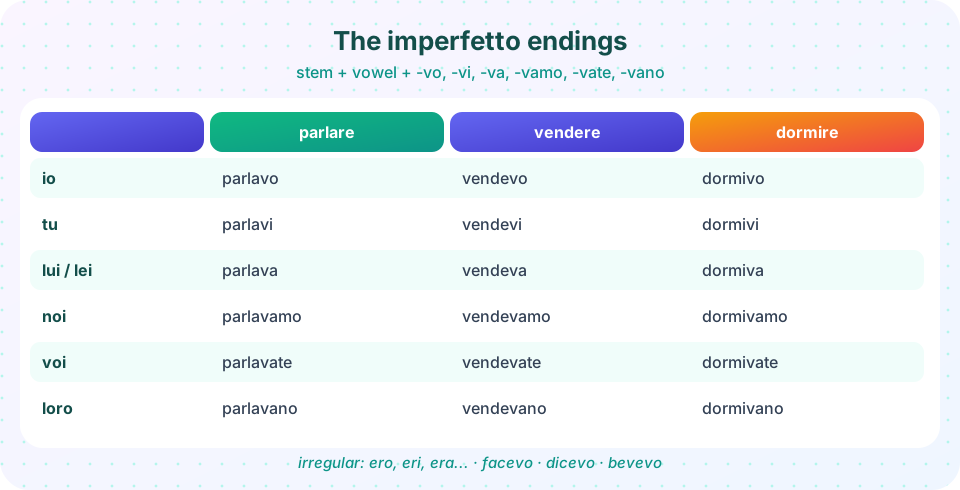
Take the infinitive, drop -re, and add the endings below. The vowel before -vo is the vowel of the infinitive (a, e or i).
| Person | parlare | vendere | dormire |
|---|---|---|---|
| io | parlavo | vendevo | dormivo |
| tu | parlavi | vendevi | dormivi |
| lui / lei / Lei | parlava | vendeva | dormiva |
| noi | parlavamo | vendevamo | dormivamo |
| voi | parlavate | vendevate | dormivate |
| loro | parlavano | vendevano | dormivano |
The endings are the same for every verb: -vo, -vi, -va, -vamo, -vate, -vano. In the noi form the stress falls on the a of -va-: parlaVAmo, pronounced pahr-lah-VAH-mo. In the third person plural the stress moves back to the stem: PAR-la-va-no.
Avere is regular (avevo, avevi, aveva...), and so are andare (andavo), mangiare (mangiavo), finire (finivo) and abitare (abitavo). For -ire verbs that add -isc- in the present (capire, finire, preferire) the imperfetto is simply regular: capivo, finivo, preferivo.
Irregular imperfetto
Only a few verbs are irregular. The most important one is essere:
| io | tu | lui/lei | noi | voi | loro |
|---|---|---|---|---|---|
| ero | eri | era | eravamo | eravate | erano |
A second group uses an old, longer stem. They are regular after that stem:
| Verb | Stem | io form | Example |
|---|---|---|---|
| fare | face- | facevo | Facevo la spesa il sabato. |
| dire | dice- | dicevo | Dicevo sempre la verità. |
| bere | beve- | bevevo | Bevevo molto caffè. |
| tradurre | traduce- | traducevo | Traducevo testi tecnici. |
| porre | pone- | ponevo | Ponevo molte domande. |
Other common verbs (andare, venire, vivere, avere) are fully regular. Verbs ending in -urre and -orre behave like tradurre and porre.
The three jobs of the imperfetto
1. Habits and repeated actions. What used to happen regularly:
- Da bambino giocavo a calcio ogni pomeriggio. As a child I played (used to play) football every afternoon.
- Mia nonna cucinava sempre la domenica. My grandmother always cooked on Sundays.
- Quando abitavamo a Torino, prendevamo il tram. When we lived in Turin, we took the tram.
2. Descriptions: weather, age, feelings, appearance, time. The setting of a memory:
- Era una bella giornata e il cielo era blu. It was a beautiful day and the sky was blue.
- Avevo dieci anni. I was ten years old. (Age is expressed with avere in Italian.)
- Aveva i capelli lunghi e gli occhi verdi. She had long hair and green eyes.
- Erano le otto di sera. It was eight in the evening.
- Ero molto stanco e avevo fame. I was very tired and I was hungry.
3. Actions in progress. Something that was going on, often interrupted:
- Mentre cucinavo, ascoltavo la radio. While I was cooking, I was listening to the radio.
- Che cosa facevi alle dieci? What were you doing at ten?
- Stavo leggendo quando sei entrato. I was reading when you came in. (stavo + gerund is the progressive form.)
Signal words
Certain words usually go with the imperfetto, because they express repetition or duration: sempre (always), spesso (often), di solito (usually), ogni giorno / ogni estate, tutti i giorni, una volta (once upon a time, in the past), da bambino/a, da piccolo/a, mentre (while) and allora (back then).
Nonno: Una volta non c'erano i telefonini. Quando ero giovane, scrivevamo lettere e aspettavamo una settimana la risposta. Abitavo in un piccolo paese, e ogni sera tutta la famiglia mangiava insieme.
"Once there were no mobile phones. When I was young, we wrote letters and waited a week for the answer. I lived in a small village, and every evening the whole family ate together." The whole paragraph is background and habit, so every verb is in the imperfetto (c'erano is the imperfetto of c'è, "there was/were").
The imperfetto for politeness and soft requests
The imperfetto has a surprising extra use in speech: it makes requests and opinions softer. Instead of saying Voglio un caffè (I want a coffee), a customer may say Volevo un caffè, literally "I wanted a coffee", with the meaning "I would like a coffee". Likewise Volevo chiederti una cosa means "I wanted to ask you something", a gentle way of beginning a question. You do not have to use it, but you will hear it often in shops, offices and phone calls. It works because the past tense creates distance and so reduces pressure.
Telling a childhood memory
The imperfetto is the tense of memory. Read this paragraph and notice how every verb describes a repeated habit or a background detail:
Quando ero bambina, passavo l'estate dai nonni in campagna. Ci svegliavamo presto, mangiavamo pane e marmellata e giocavamo fuori tutto il giorno. La nonna cucinava sempre qualcosa di buono, e la sera tutti ascoltavano le storie del nonno.
"When I was a child, I spent the summer at my grandparents' in the country. We woke up early, ate bread and jam and played outside all day. Grandma always cooked something good, and in the evening everyone listened to Grandpa's stories." Try writing your own paragraph with Quando ero piccolo/a... and five or six imperfetto verbs. Describe where you lived, what you did every day and what people were like.
Common misconceptions
"The imperfetto is a worse past tense." The name is misleading. It is not 'imperfect' in the sense of 'wrong'; it simply describes an action without marking its end.
"Use it for anything that took a long time." Duration alone is not the test. Ho vissuto a Roma per dieci anni (a finished period) uses the passato prossimo. Use the imperfetto when the focus is on habit, setting or something in progress.
"Dormivamo and dormiamo are the same." The vowel and the -v- matter: dormiamo is present (we sleep), dormivamo is imperfetto (we used to sleep).
Try it
This conjugator forms the imperfetto, including the irregular verbs. It is a small rule-based model built from this lesson and covers regular verbs plus the irregulars listed.
Press Run (or Ctrl + Enter) to see the result here.
Program input · what you'd type while the program runs
Type the answers before you press Run, one per line. Each time the program reads a line (with input()), it gets the next line from this box.
Fill in the imperfetto. Spelling matters: -vamo, -vate and the irregular stems.
Match the signal word to its meaning.
Check your understanding
Quick check · 5 questions
of 5 answered You scored / 5 · perfect!
-
1. What is the imperfetto of 'io' for the verb 'vendere'?
-ere verbs take -evo: vendevo. -
2. Which sentence describes a habit in the past?
Da piccolo and sempre point to a repeated action, so the imperfetto is used. -
3. How do you say 'We were' in the imperfetto?
Essere is irregular: ero, eri, era, eravamo, eravate, erano. -
4. What is the imperfetto of 'fare' for 'tu'?
Fare uses the stem face-: facevo, facevi, faceva... -
5. 'Avevo dieci anni' means...
Italian uses avere for age; the imperfetto sets the scene: 'I was ten years old'.
Summary
- The imperfetto endings are -vo, -vi, -va, -vamo, -vate, -vano, added to the stem plus the vowel a/e/i.
- Essere is irregular (ero, eri, era...); fare, dire, bere, tradurre, porre use longer stems (face-, dice-, beve-).
- Use it for habits (sempre, ogni giorno, da bambino), descriptions (weather, age, feelings, time) and actions in progress (mentre).
- It translates English "used to", "was ...-ing" and the habitual "-ed".
Track your progress
Create a free account to tick off lessons and pick up where you left off on any device.
of Italian for Beginners lessons completed