Learn where Italian words are stressed, when accent marks are written (città, caffè, perché), and which tiny words change meaning with an accent.
Every Italian word of more than one syllable has one syllable that is said louder, longer and with a slightly higher pitch than the rest. This is the stress. If you put it in the wrong place, the word sounds foreign and may even become a different word.
Italian writing has an interesting habit: it usually does not show the stress. Only when the stress falls on the last syllable (and in a few other cases) is a written accent mark added. So you have to learn two things: the patterns of stress, and the accent marks you do see.
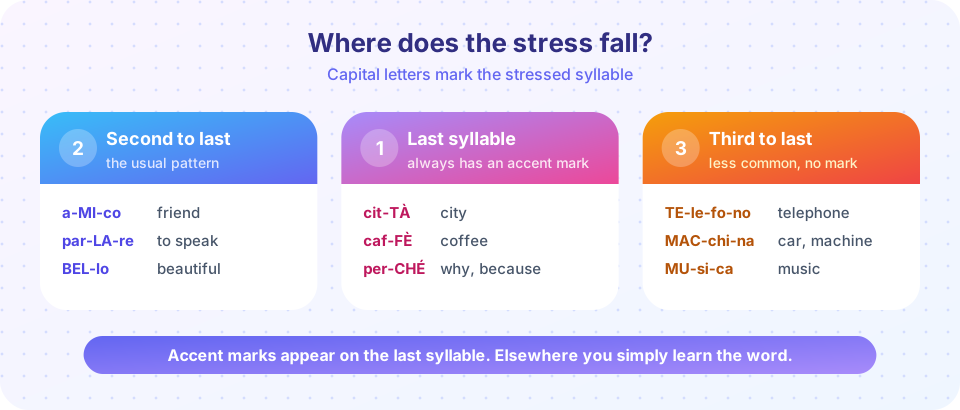
Most words are stressed on the second to last syllable. A written accent marks stress on the last syllable.
Count syllables from the end. In the large majority of Italian words, the stress falls on the second to last syllable. These words are called parole piane ("flat" words), and they never get a written accent:
co-SÌ (like this, so), più (more), già (already), gio-ven-TÙ (youth)
Words ending in -tà and -tù (from Latin) are never confusing: libertà (freedom), felicità (happiness), virtù (virtue). You will meet the -tà ending in hundreds of English cognates: -ty becomes -tà.
A few words of one syllable with two vowels also carry an accent, to remind you that the stress falls on the second vowel: più (more), può (he/she can), già (already), giù (down), ciò (that thing).
Foreign words and some very short words (qui, qua, tre, me, no, tu) do not carry accents.
Verb forms for "they" can be stressed even further back: loro TE-le-fo-na-no (they phone), loro A-bi-ta-no (they live). You will meet these in Chapter 4.
Standard Italian uses two accent marks, and the difference matters mainly for e and o.
The grave accent ( ` ) is used on à, è, ì, ò, ù. On e and o it also shows an open vowel: caffè /kafˈfɛ/, può /pwɔ/.
The acute accent ( ´ ) is used on é (and rarely ó), for closed vowels: perché, poiché, né, sé, trentatré (thirty-three).
On a keyboard, many Italians simply type è for both è and é or use an apostrophe (perche') in casual messages. In careful writing, use the correct marks. On Italian phones and keyboards, the accented letters are on their own keys; on others, hold the vowel key to open the accent menu.
An apostrophe is not an accent. Write perché, not perche', è and not e'. In formal text, always use the accent.
In a few pairs, the same written word has two meanings, depending on the stress. These are not marked in writing, so context decides:
àncora (anchor) and ancóra (still, again).
càpitano (they happen) and capitàno (captain).
prìncipi (princes) and princìpi (principles).
pèsca (peach) and pésca (fishing).
Native speakers hardly ever confuse them because the context is clear. Learn them as curiosities: they show that stress is part of the word, not a decoration.
An apostrophe in Italian shows that a letter has been left out.
Elision happens before a vowel to avoid two vowel sounds in a row: lo amico becomes l'amico (the friend), una amica becomes un'amica (a friend, feminine), dove è becomes dov'è (where is), ci è becomes c'è (there is). Note: un amico (masculine) has no apostrophe at all.
Truncation drops a final vowel or syllable: un po' (a little, from poco), bel for bello before certain words (un bel libro), fa' and va' (imperatives).
You will see how elision works with articles in Chapter 3. For now, treat l'amico, dov'è, c'è and un po' as ready-made words.
"Italian stress is always on the first syllable." It is mostly on the second to last. A stress on the first syllable happens, but only in words with three or more syllables such as TE-le-fo-no.
"An accent mark means the vowel is long." Italian accents mark stress (and open or closed quality), not length.
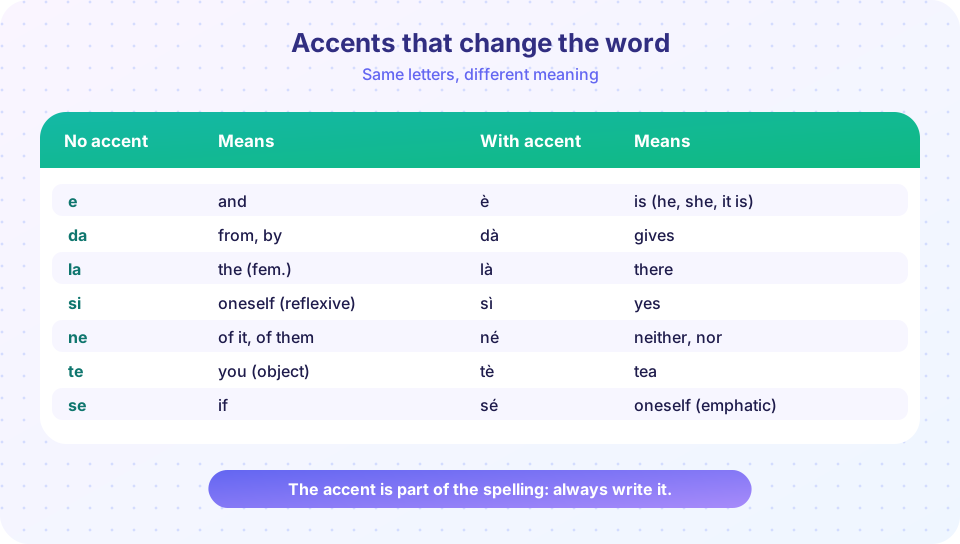
"È and e are the same word."È means "is"; e means "and". They are two of the most frequent words in Italian. Mixing them up changes the sentence: Marco e a casa is wrong.
"I can skip the accents when I type." It is a spelling mistake, but more importantly, the pairs above can turn into the wrong word.
First, mark the stress. Read each question, say the word aloud, and choose the correct pronunciation.
Which syllable is stressed?
<style>*{box-sizing:border-box}body{margin:0;padding:14px;font-family:system-ui,'Segoe UI',Arial,sans-serif;background:linear-gradient(135deg,#faf5ff,#eff6ff);color:#1e1b4b}.wrap{max-width:640px;margin:0 auto}.card{background:#fff;border-radius:20px;box-shadow:0 10px 24px rgba(67,56,202,.15);padding:18px}.big{font-size:30px;font-weight:700;color:#312e81;text-align:center;min-height:44px;margin:14px 0 4px}.sub{font-size:16px;color:#64748b;text-align:center;min-height:22px}.row{display:flex;gap:8px;flex-wrap:wrap;justify-content:center;margin-top:14px}button{font:inherit;font-weight:600;border:0;border-radius:999px;padding:9px 16px;cursor:pointer;color:#fff;background:linear-gradient(135deg,#6366f1,#a78bfa)}button.alt{background:#eef2ff;color:#3730a3}button.ok{background:linear-gradient(135deg,#10b981,#14b8a6)}button:disabled{opacity:.5;cursor:default}.meta{font-size:14px;color:#6366f1;text-align:center;margin-bottom:4px}.opt{display:block;width:100%;text-align:left;margin:8px 0;background:#eef2ff;color:#1e1b4b;border-radius:14px;padding:11px 14px}.opt.good{background:#d1fae5;color:#064e3b}.opt.bad{background:#fee2e2;color:#7f1d1d}.fb{min-height:24px;margin-top:10px;font-weight:600;text-align:center}input[type=text]{font:inherit;width:100%;padding:11px 14px;border:2px solid #c7d2fe;border-radius:14px;margin-top:10px;background:#fff;color:#1e1b4b}table{border-collapse:collapse;width:100%;margin-top:10px}td,th{padding:8px 10px;text-align:left;border-bottom:1px solid #e0e7ff;font-size:16px}th{color:#4f46e5;font-size:14px;text-transform:uppercase;letter-spacing:.04em}.mt{margin-top:10px}</style><divclass="wrap"><divclass="card"><divclass="meta"id="meta"></div><divid="q"style="font-size:19px;font-weight:700;margin:8px 0"></div><divid="opts"></div><divclass="fb"id="fb"></div><divclass="row"><buttonid="next"disabled>Next question</button></div></div></div><script>constITEMS=[{"q":"'amico' (friend) is stressed on...","options":["A-mi-co","a-MI-co","a-mi-CO"],"a":1,"why":"The default pattern: second to last syllable, a-MI-co."},{"q":"'città' (city) is stressed on...","options":["CIT-tà","cit-TÀ","both equally"],"a":1,"why":"The accent mark shows that the last syllable is stressed: cit-TÀ."},{"q":"'telefono' is stressed on...","options":["te-LE-fo-no","TE-le-fo-no","te-le-FO-no"],"a":1,"why":"This is a parola sdrucciola, stressed on the third to last syllable: TE-le-fo-no."},{"q":"'caffè' is stressed on...","options":["CAF-fe","caf-FÈ","neither"],"a":1,"why":"The grave accent shows stress on the last syllable: caf-FÈ."},{"q":"'parlare' is stressed on...","options":["PAR-la-re","par-LA-re","par-la-RE"],"a":1,"why":"Second to last again: par-LA-re."}];let i=0,score=0,done=false;const$=id=>document.getElementById(id);functionshow(){const it=ITEMS[i];done=false;$('meta').textContent='Question '+(i+1)+' of '+ITEMS.length+' | score: '+score;$('q').textContent=it.q;$('opts').innerHTML='';$('fb').textContent='';$('next').disabled=true;
it.options.forEach((o,k)=>{const b=document.createElement('button');b.className='opt';b.textContent=o;b.onclick=()=>pick(k,b);$('opts').appendChild(b);});}functionpick(k,b){if(done)return;done=true;const it=ITEMS[i];const bs=$('opts').children;if(k===it.a){score++;b.classList.add('good');$('fb').textContent='Correct! '+it.why;}else{b.classList.add('bad');bs[it.a].classList.add('good');$('fb').textContent='Not quite. '+it.why;}$('meta').textContent='Question '+(i+1)+' of '+ITEMS.length+' | score: '+score;$('next').disabled=false;$('next').textContent=i===ITEMS.length-1?'See result':'Next question';}$('next').onclick=()=>{if(i===ITEMS.length-1){$('q').textContent='Finished: '+score+' out of '+ITEMS.length;$('opts').innerHTML='';$('fb').textContent=score===ITEMS.length?'Perfetto!':'Try again to improve your score.';$('next').textContent='Start again';i=-1;score=0;$('next').onclick=()=>{$('next').onclick=null;location.reload();};return;}i++;show();};show();</script>
Second, type the accents. Each prompt gives an English word; type the Italian word with its accent. If you get the letters right but forget the accent, the exercise tells you. (On most keyboards you can copy letters from the examples above.)
Type the accent
<style>*{box-sizing:border-box}body{margin:0;padding:14px;font-family:system-ui,'Segoe UI',Arial,sans-serif;background:linear-gradient(135deg,#faf5ff,#eff6ff);color:#1e1b4b}.wrap{max-width:640px;margin:0 auto}.card{background:#fff;border-radius:20px;box-shadow:0 10px 24px rgba(67,56,202,.15);padding:18px}.big{font-size:30px;font-weight:700;color:#312e81;text-align:center;min-height:44px;margin:14px 0 4px}.sub{font-size:16px;color:#64748b;text-align:center;min-height:22px}.row{display:flex;gap:8px;flex-wrap:wrap;justify-content:center;margin-top:14px}button{font:inherit;font-weight:600;border:0;border-radius:999px;padding:9px 16px;cursor:pointer;color:#fff;background:linear-gradient(135deg,#6366f1,#a78bfa)}button.alt{background:#eef2ff;color:#3730a3}button.ok{background:linear-gradient(135deg,#10b981,#14b8a6)}button:disabled{opacity:.5;cursor:default}.meta{font-size:14px;color:#6366f1;text-align:center;margin-bottom:4px}.opt{display:block;width:100%;text-align:left;margin:8px 0;background:#eef2ff;color:#1e1b4b;border-radius:14px;padding:11px 14px}.opt.good{background:#d1fae5;color:#064e3b}.opt.bad{background:#fee2e2;color:#7f1d1d}.fb{min-height:24px;margin-top:10px;font-weight:600;text-align:center}input[type=text]{font:inherit;width:100%;padding:11px 14px;border:2px solid #c7d2fe;border-radius:14px;margin-top:10px;background:#fff;color:#1e1b4b}table{border-collapse:collapse;width:100%;margin-top:10px}td,th{padding:8px 10px;text-align:left;border-bottom:1px solid #e0e7ff;font-size:16px}th{color:#4f46e5;font-size:14px;text-transform:uppercase;letter-spacing:.04em}.mt{margin-top:10px}</style><divclass="wrap"><divclass="card"><divclass="meta"id="meta"></div><divclass="big"style="font-size:24px"id="p"></div><divclass="sub"id="h"></div><inputtype="text"id="in"autocomplete="off"autocapitalize="off"spellcheck="false"placeholder="Type your answer in Italian"><divclass="row"><buttonid="chk">Check</button><buttonclass="alt"id="nx">Next</button></div><divclass="fb"id="fb"></div></div></div><script>constITEMS=[["city","città","stress on the last syllable"],["coffee","caffè","stress on the last syllable"],["why / because","perché","closed e, acute accent"],["university","università","-ty becomes -tà"],["yes","sì","an accent keeps it apart from 'si'"],["tea","tè","an accent keeps it apart from 'te'"],["more","più",""],["he / she is","è","an accent keeps it apart from 'e' (and)"]];let i=0,score=0,tried=false;const$=id=>document.getElementById(id);conststrip=s=>s.normalize('NFD').replace(/[\u0300-\u036f]/g,'');constnorm=s=>s.trim().toLowerCase().replace(/\s+/g,' ');functionshow(){const it=ITEMS[i];$('meta').textContent='Item '+(i+1)+' of '+ITEMS.length+' | score: '+score;$('p').textContent=it[0];$('h').textContent=it[2]||'';$('in').value='';$('fb').textContent='';tried=false;$('in').focus();}functioncheck(){const it=ITEMS[i];const a=norm($('in').value);if(!a)return;const ok=norm(it[1]).split('|');if(ok.includes(a)){if(!tried)score++;$('fb').style.color='#047857';$('fb').textContent='Correct: '+it[1].split('|')[0];tried=true;}elseif(ok.map(strip).includes(strip(a))){$('fb').style.color='#b45309';$('fb').textContent='Right letters, but check the accent: '+it[1].split('|')[0];tried=true;}else{$('fb').style.color='#b91c1c';$('fb').textContent='Not yet. Try again, or press Next to see the answer.';tried=true;}$('meta').textContent='Item '+(i+1)+' of '+ITEMS.length+' | score: '+score;}$('chk').onclick=check;$('in').onkeydown=e=>{if(e.key==='Enter')check();};$('nx').onclick=()=>{if(!$('fb').textContent.startsWith('Correct')){$('fb').style.color='#475569';$('fb').textContent='Answer: '+ITEMS[i][1].split('|')[0]+' (press Next again to continue)';if(!$('nx').dataset.s){$('nx').dataset.s='1';return;}}$('nx').dataset.s='';i=(i+1)%ITEMS.length;show();};show();</script>
Third, match small words that differ only by an accent.
Accent pairs
<style>*{box-sizing:border-box}body{margin:0;padding:14px;font-family:system-ui,'Segoe UI',Arial,sans-serif;background:linear-gradient(135deg,#faf5ff,#eff6ff);color:#1e1b4b}.wrap{max-width:640px;margin:0 auto}.card{background:#fff;border-radius:20px;box-shadow:0 10px 24px rgba(67,56,202,.15);padding:18px}.big{font-size:30px;font-weight:700;color:#312e81;text-align:center;min-height:44px;margin:14px 0 4px}.sub{font-size:16px;color:#64748b;text-align:center;min-height:22px}.row{display:flex;gap:8px;flex-wrap:wrap;justify-content:center;margin-top:14px}button{font:inherit;font-weight:600;border:0;border-radius:999px;padding:9px 16px;cursor:pointer;color:#fff;background:linear-gradient(135deg,#6366f1,#a78bfa)}button.alt{background:#eef2ff;color:#3730a3}button.ok{background:linear-gradient(135deg,#10b981,#14b8a6)}button:disabled{opacity:.5;cursor:default}.meta{font-size:14px;color:#6366f1;text-align:center;margin-bottom:4px}.opt{display:block;width:100%;text-align:left;margin:8px 0;background:#eef2ff;color:#1e1b4b;border-radius:14px;padding:11px 14px}.opt.good{background:#d1fae5;color:#064e3b}.opt.bad{background:#fee2e2;color:#7f1d1d}.fb{min-height:24px;margin-top:10px;font-weight:600;text-align:center}input[type=text]{font:inherit;width:100%;padding:11px 14px;border:2px solid #c7d2fe;border-radius:14px;margin-top:10px;background:#fff;color:#1e1b4b}table{border-collapse:collapse;width:100%;margin-top:10px}td,th{padding:8px 10px;text-align:left;border-bottom:1px solid #e0e7ff;font-size:16px}th{color:#4f46e5;font-size:14px;text-transform:uppercase;letter-spacing:.04em}.mt{margin-top:10px}</style><divclass="wrap"><divclass="card"><divclass="meta"id="meta">Click an Italian word, then its English meaning.</div><divstyle="display:flex;gap:14px"><divid="L"style="flex:1"></div><divid="R"style="flex:1"></div></div><divclass="fb"id="fb"></div><divclass="row"><buttonclass="alt"id="re">Shuffle again</button></div></div></div><script>constP=[["è","is"],["e","and"],["sì","yes"],["si","oneself"],["dà","gives"],["da","from"]];const$=id=>document.getElementById(id);let selL=null,matched=0;functionsh(a){a=a.slice();for(let i=a.length-1;i>0;i--){const k=Math.floor(Math.random()*(i+1));[a[i],a[k]]=[a[k],a[i]];}return a;}functionbuild(){$('L').innerHTML='';$('R').innerHTML='';selL=null;matched=0;$('fb').textContent='';sh(P.map((_,i)=>i)).forEach(i=>{const b=document.createElement('button');b.className='opt';b.textContent=P[i][0];b.dataset.i=i;b.onclick=()=>{if(b.disabled)return;[...$('L').children].forEach(x=>x.style.outline='');b.style.outline='3px solid #6366f1';selL=b;};$('L').appendChild(b);});sh(P.map((_,i)=>i)).forEach(i=>{const b=document.createElement('button');b.className='opt';b.textContent=P[i][1];b.dataset.i=i;b.onclick=()=>{if(b.disabled||!selL)return;if(selL.dataset.i===b.dataset.i){selL.classList.add('good');b.classList.add('good');selL.disabled=true;b.disabled=true;selL.style.outline='';selL=null;matched++;$('fb').style.color='#047857';$('fb').textContent=matched===P.length?'All matched. Bravo!':'Match!';}else{b.classList.add('bad');setTimeout(()=>b.classList.remove('bad'),500);$('fb').style.color='#b91c1c';$('fb').textContent='No, try another one.';}};$('R').appendChild(b);});}$('re').onclick=build;build();</script>