Learn the Italian numbers from zero to one hundred with pronunciation, the patterns in the tens, and how to say age, prices, phone numbers and simple sums.
Numbers are among the most useful words in any language. You need them for prices, ages, phone numbers, addresses, times and dates. The good news is that Italian numbers are very regular: once you know the numbers from 0 to 20 and the ten words for the tens, you can build every number up to 100.
This lesson shows the patterns, the few spelling quirks (such as ventuno and ventitré), and how to use numbers in real situations: saying how old you are, asking prices and giving a phone number. You also get a small program that writes any number from 0 to 100 in Italian, which is a good way to see the rules in action.
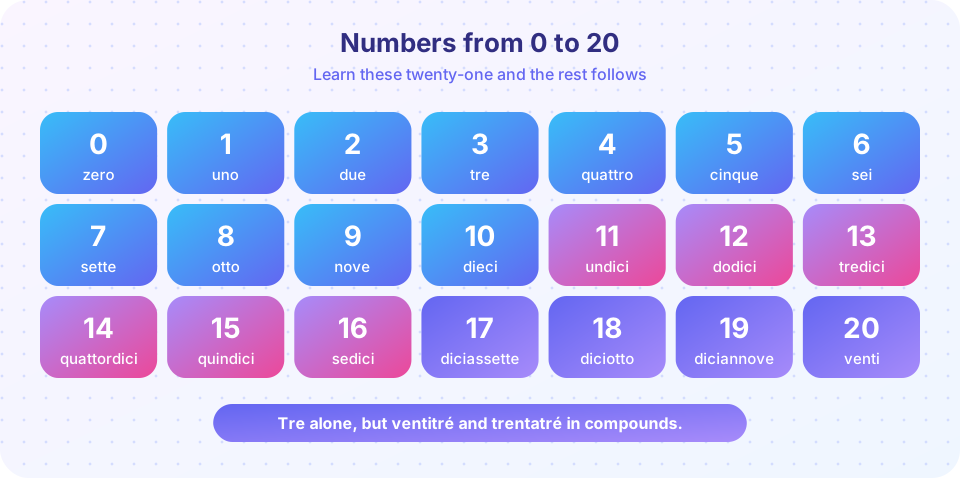
Zero to twenty: learn these twenty-one words and you can build every number up to one hundred.
Say these aloud. Italian numbers are used with the same stress rules as other words: the second to last syllable is stressed unless there is an accent mark.
#
Italian
Respelling
#
Italian
Respelling
0
zero
DZEH-ro
11
undici
OON-dee-chee
1
uno
OO-no
12
dodici
DOH-dee-chee
2
due
DOO-eh
13
tredici
TREH-dee-chee
3
tre
TREH
14
quattordici
kwat-TOR-dee-chee
4
quattro
KWAT-tro
15
quindici
KWEEN-dee-chee
5
cinque
CHEEN-kweh
16
sedici
SEH-dee-chee
6
sei
SEH-ee
17
diciassette
dee-chahs-SET-teh
7
sette
SET-teh
18
diciotto
dee-CHOT-to
8
otto
OT-to
19
diciannove
dee-chahn-NOH-veh
9
nove
NOH-veh
20
venti
VEN-tee
10
dieci
DYEH-chee
Notice some patterns: the numbers 11 to 16 end in -dici (from dieci), and 17 to 19 start with dici- and add the unit: dici-assette, dici-otto, dici-annove. In diciassette and diciannove the consonants double (dici + s-sette, dici + n-nove).
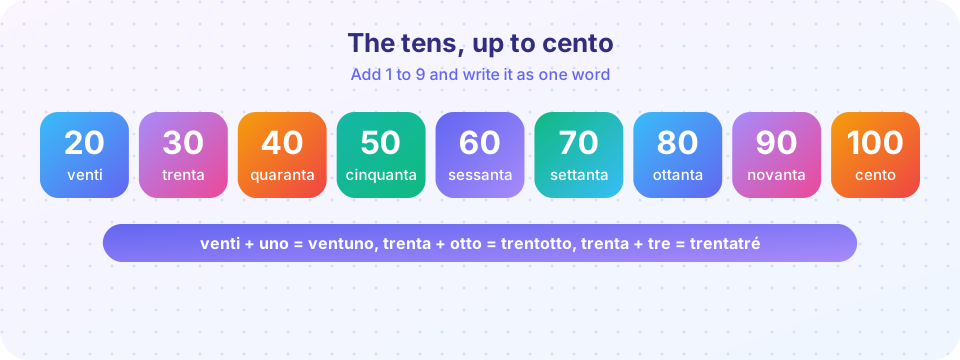
To make 21 to 99, join the ten and the unit in one word: trenta + cinque = trentacinque (35), quaranta + sei = quarantasei (46).
Two spelling rules apply:
Before uno (1) and otto (8), the ten drops its last vowel: ventuno (21), ventotto (28), trentuno (31), trentotto (38), ottantuno (81), novantotto (98). Think of it as keeping the sound smooth.
For 3, a written accent is added in compounds: ventitré (23), trentatré (33), novantatré (93), because the stress falls on the last syllable. The word tre alone has no accent.
Only uno changes with the noun, like the article un/una: un libro, una casa, and inside 21, 31 and so on: ventun libri (21 books), ventuna case (21 houses). All other numbers stay the same. You will see why in Chapter 3.
Italian mobile numbers usually begin with 3 and have ten digits (some have nine). People read phone numbers digit by digit or in small groups: tre-tre-nove, due-uno-quattro, sei-sette-otto-zero. To ask: Qual è il tuo numero di telefono? (informal) or Qual è il suo numero di telefono? (formal). To answer: Il mio numero è... followed by the digits. Note that Italian zero uses the "dz" sound.
You can also play with arithmetic: più (plus), meno (minus), per (times), diviso (divided by), fa (makes). Due più due fa quattro.Dieci meno tre fa sette.Tre per cinque fa quindici.Venti diviso quattro fa cinque.
The first five ordinals are primo (1st), secondo (2nd), terzo (3rd), quarto (4th), quinto (5th). They act like adjectives: la prima lezione (the first lesson).
First, run a converter that writes any number from 0 to 100 in Italian. It applies the two spelling rules from this lesson. Change the list of numbers and run it again. Then look at the little sums at the end.
Python
A number-to-Italian converter
UNITS =["zero","uno","due","tre","quattro","cinque","sei","sette","otto","nove","dieci","undici","dodici","tredici","quattordici","quindici","sedici","diciassette","diciotto","diciannove"]
TENS ={2:"venti",3:"trenta",4:"quaranta",5:"cinquanta",6:"sessanta",7:"settanta",8:"ottanta",9:"novanta"}defitaliano(n):if n <20:return UNITS[n]if n ==100:return"cento"
tens, unit =divmod(n,10)
word = TENS[tens]if unit ==0:return word
if unit in(1,8):# drop the final vowel before uno and otto
word = word[:-1]if unit ==3:# compounds with 3 take an accentreturn word +"tré"return word + UNITS[unit]for n in[0,7,13,16,21,28,33,47,59,70,81,99,100]:print(n,"=", italiano(n))print()for a, b in[(2,2),(7,5),(30,12),(45,55)]:print(italiano(a),"più", italiano(b),"fa", italiano(a + b))
Press Run (or Ctrl + Enter) to see the result here.
Program input · what you'd type while the program runs
Type the answers before you press Run, one per line. Each time the program reads a line (with input()), it gets the next line from this box.
Second, flip through the numbers. Cover the Italian side and say the number aloud first.
Numbers to say aloud
<style>*{box-sizing:border-box}body{margin:0;padding:14px;font-family:system-ui,'Segoe UI',Arial,sans-serif;background:linear-gradient(135deg,#faf5ff,#eff6ff);color:#1e1b4b}.wrap{max-width:640px;margin:0 auto}.card{background:#fff;border-radius:20px;box-shadow:0 10px 24px rgba(67,56,202,.15);padding:18px}.big{font-size:30px;font-weight:700;color:#312e81;text-align:center;min-height:44px;margin:14px 0 4px}.sub{font-size:16px;color:#64748b;text-align:center;min-height:22px}.row{display:flex;gap:8px;flex-wrap:wrap;justify-content:center;margin-top:14px}button{font:inherit;font-weight:600;border:0;border-radius:999px;padding:9px 16px;cursor:pointer;color:#fff;background:linear-gradient(135deg,#6366f1,#a78bfa)}button.alt{background:#eef2ff;color:#3730a3}button.ok{background:linear-gradient(135deg,#10b981,#14b8a6)}button:disabled{opacity:.5;cursor:default}.meta{font-size:14px;color:#6366f1;text-align:center;margin-bottom:4px}.opt{display:block;width:100%;text-align:left;margin:8px 0;background:#eef2ff;color:#1e1b4b;border-radius:14px;padding:11px 14px}.opt.good{background:#d1fae5;color:#064e3b}.opt.bad{background:#fee2e2;color:#7f1d1d}.fb{min-height:24px;margin-top:10px;font-weight:600;text-align:center}input[type=text]{font:inherit;width:100%;padding:11px 14px;border:2px solid #c7d2fe;border-radius:14px;margin-top:10px;background:#fff;color:#1e1b4b}table{border-collapse:collapse;width:100%;margin-top:10px}td,th{padding:8px 10px;text-align:left;border-bottom:1px solid #e0e7ff;font-size:16px}th{color:#4f46e5;font-size:14px;text-transform:uppercase;letter-spacing:.04em}.mt{margin-top:10px}</style><divclass="wrap"><divclass="card"><divclass="meta"id="meta"></div><divclass="big"id="front"></div><divclass="sub"id="back"></div><divclass="row"><buttonclass="alt"id="prev">Back</button><buttonid="flip">Show English</button><buttonid="next">Next</button></div><divclass="row"><buttonclass="alt"id="shuf">Shuffle</button><buttonclass="alt"id="say">Listen (if your browser can)</button><buttonclass="ok"id="got">I knew it</button></div><divclass="fb"id="fb"></div></div></div><script>constDATA=[["0","zero","DZEH-ro"],["1","uno","OO-no"],["2","due","DOO-eh"],["3","tre","TREH"],["4","quattro","KWAT-tro"],["5","cinque","CHEEN-kweh"],["6","sei","SEH-ee"],["7","sette","SET-teh"],["8","otto","OT-to"],["9","nove","NOH-veh"],["10","dieci","DYEH-chee"],["12","dodici","DOH-dee-chee"],["17","diciassette","dee-chahs-SET-teh"],["20","venti","VEN-tee"],["21","ventuno","ven-TOO-no"],["33","trentatré","tren-tah-TREH"],["58","cinquantotto","cheen-kwan-TOT-to"],["100","cento","CHEN-to"]];let order=DATA.map((_,i)=>i),pos=0,shown=false,known=newSet();const$=id=>document.getElementById(id);functiondraw(){const c=DATA[order[pos]];$('meta').textContent='Card '+(pos+1)+' of '+DATA.length+' | known: '+known.size;$('front').textContent=c[0];$('back').textContent=shown?c[1]+(c[2]?' ('+c[2]+')':''):'';$('flip').textContent=shown?'Hide English':'Show English';}$('flip').onclick=()=>{shown=!shown;draw()};$('next').onclick=()=>{pos=(pos+1)%DATA.length;shown=false;$('fb').textContent='';draw()};$('prev').onclick=()=>{pos=(pos-1+DATA.length)%DATA.length;shown=false;$('fb').textContent='';draw()};$('shuf').onclick=()=>{for(let i=order.length-1;i>0;i--){const k=Math.floor(Math.random()*(i+1));[order[i],order[k]]=[order[k],order[i]];}pos=0;shown=false;draw()};$('got').onclick=()=>{known.add(order[pos]);$('fb').textContent=known.size===DATA.length?'You know them all. Bravo!':'Marked as known.';draw()};$('say').onclick=()=>{try{const u=newSpeechSynthesisUtterance(DATA[order[pos]][0]);u.lang='it-IT';speechSynthesis.cancel();speechSynthesis.speak(u);}catch(e){$('fb').textContent='Speech is not available in this preview.';}};draw();</script>
Third, type the Italian numbers. The checker accepts a missing accent with a warning, so you can practice the spelling of ventitré.
Type the number
<style>*{box-sizing:border-box}body{margin:0;padding:14px;font-family:system-ui,'Segoe UI',Arial,sans-serif;background:linear-gradient(135deg,#faf5ff,#eff6ff);color:#1e1b4b}.wrap{max-width:640px;margin:0 auto}.card{background:#fff;border-radius:20px;box-shadow:0 10px 24px rgba(67,56,202,.15);padding:18px}.big{font-size:30px;font-weight:700;color:#312e81;text-align:center;min-height:44px;margin:14px 0 4px}.sub{font-size:16px;color:#64748b;text-align:center;min-height:22px}.row{display:flex;gap:8px;flex-wrap:wrap;justify-content:center;margin-top:14px}button{font:inherit;font-weight:600;border:0;border-radius:999px;padding:9px 16px;cursor:pointer;color:#fff;background:linear-gradient(135deg,#6366f1,#a78bfa)}button.alt{background:#eef2ff;color:#3730a3}button.ok{background:linear-gradient(135deg,#10b981,#14b8a6)}button:disabled{opacity:.5;cursor:default}.meta{font-size:14px;color:#6366f1;text-align:center;margin-bottom:4px}.opt{display:block;width:100%;text-align:left;margin:8px 0;background:#eef2ff;color:#1e1b4b;border-radius:14px;padding:11px 14px}.opt.good{background:#d1fae5;color:#064e3b}.opt.bad{background:#fee2e2;color:#7f1d1d}.fb{min-height:24px;margin-top:10px;font-weight:600;text-align:center}input[type=text]{font:inherit;width:100%;padding:11px 14px;border:2px solid #c7d2fe;border-radius:14px;margin-top:10px;background:#fff;color:#1e1b4b}table{border-collapse:collapse;width:100%;margin-top:10px}td,th{padding:8px 10px;text-align:left;border-bottom:1px solid #e0e7ff;font-size:16px}th{color:#4f46e5;font-size:14px;text-transform:uppercase;letter-spacing:.04em}.mt{margin-top:10px}</style><divclass="wrap"><divclass="card"><divclass="meta"id="meta"></div><divclass="big"style="font-size:24px"id="p"></div><divclass="sub"id="h"></div><inputtype="text"id="in"autocomplete="off"autocapitalize="off"spellcheck="false"placeholder="Type your answer in Italian"><divclass="row"><buttonid="chk">Check</button><buttonclass="alt"id="nx">Next</button></div><divclass="fb"id="fb"></div></div></div><script>constITEMS=[["5","cinque"],["13","tredici"],["18","diciotto"],["21","ventuno"],["28","ventotto"],["33","trentatré","remember the accent"],["47","quarantasette"],["60","sessanta"],["82","ottantadue"],["100","cento"]];let i=0,score=0,tried=false;const$=id=>document.getElementById(id);conststrip=s=>s.normalize('NFD').replace(/[\u0300-\u036f]/g,'');constnorm=s=>s.trim().toLowerCase().replace(/\s+/g,' ');functionshow(){const it=ITEMS[i];$('meta').textContent='Item '+(i+1)+' of '+ITEMS.length+' | score: '+score;$('p').textContent=it[0];$('h').textContent=it[2]||'';$('in').value='';$('fb').textContent='';tried=false;$('in').focus();}functioncheck(){const it=ITEMS[i];const a=norm($('in').value);if(!a)return;const ok=norm(it[1]).split('|');if(ok.includes(a)){if(!tried)score++;$('fb').style.color='#047857';$('fb').textContent='Correct: '+it[1].split('|')[0];tried=true;}elseif(ok.map(strip).includes(strip(a))){$('fb').style.color='#b45309';$('fb').textContent='Right letters, but check the accent: '+it[1].split('|')[0];tried=true;}else{$('fb').style.color='#b91c1c';$('fb').textContent='Not yet. Try again, or press Next to see the answer.';tried=true;}$('meta').textContent='Item '+(i+1)+' of '+ITEMS.length+' | score: '+score;}$('chk').onclick=check;$('in').onkeydown=e=>{if(e.key==='Enter')check();};$('nx').onclick=()=>{if(!$('fb').textContent.startsWith('Correct')){$('fb').style.color='#475569';$('fb').textContent='Answer: '+ITEMS[i][1].split('|')[0]+' (press Next again to continue)';if(!$('nx').dataset.s){$('nx').dataset.s='1';return;}}$('nx').dataset.s='';i=(i+1)%ITEMS.length;show();};show();</script>
Learn 0 to 20 first; 11 to 16 end in -dici, 17 to 19 begin with dici-.
The tens are venti, trenta, quaranta, cinquanta, sessanta, settanta, ottanta, novanta, then cento.
Compounds are written as one word: trentacinque; the ten drops its vowel before uno and otto (ventuno, ventotto); compounds with 3 take an accent (ventitré).
Age uses avere: Ho venti anni. Prices: Quanto costa?Costa dodici euro.