


















Lesson 17 of 50 · Present Tense Verbs
Present Tense Verbs: chapter overview
A map of Chapter 4: Italian subject pronouns, the three verb families (-are, -ere, -ire), essere and avere, and the most useful irregular verbs in the present tense.
Verbs are the engines of sentences. Until now you have met nouns, articles and adjectives, and a few set phrases such as Mi chiamo Anna and Ho venti anni. In this chapter you learn how Italian verbs work, so you can say what people are, have, do and want right now.
Italian verbs change their endings to show who is acting. This sounds hard, but there are only six endings in each tense, and most verbs fall into three families. Once you learn the pattern for one verb, you know it for hundreds.
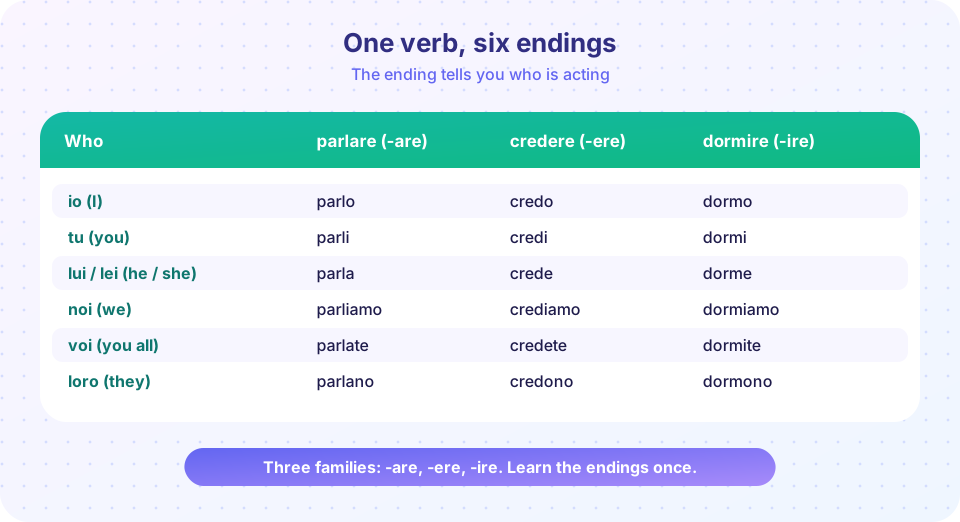
What you will learn
- How to read an Italian verb: infinitive, stem and ending.
- The six subject pronouns and why Italians often drop them.
- The three regular families (-are, -ere, -ire).
- The big picture of the chapter and what each lesson covers.
Key terms
Infinitive (infinito): the dictionary form of a verb, such as parlare (to speak). Italian infinitives end in -are, -ere or -ire.
Stem (radice): the infinitive without its ending: parl- in parlare.
Ending (desinenza): the part added to the stem to show the person: parl-o, parl-i, parl-a.
Conjugation (coniugazione): the full set of forms of a verb for each person in a tense. We also call each family a conjugation.
Subject pronoun: io, tu, lui/lei, noi, voi, loro.
Reading a verb
The infinitive tells you everything you need to build the present tense:
| Infinitive | Stem | Ending of the infinitive | Family |
|---|---|---|---|
| parlare (to speak) | parl- | -are | first conjugation |
| credere (to believe) | cred- | -ere | second conjugation |
| dormire (to sleep) | dorm- | -ire | third conjugation |
Cut off -are, -ere or -ire to find the stem, then add the endings for the person you want. The first family (-are) is the biggest, and its verbs are all regular except for four (andare, dare, fare, stare). Most new verbs that Italian creates (such as chattare, to chat, or googlare, to google) join this family.
Who is acting: subject pronouns
| Person | Pronoun | Meaning |
|---|---|---|
| 1st singular | io | I |
| 2nd singular | tu | you (informal) |
| 3rd singular | lui / lei | he / she |
| 1st plural | noi | we |
| 2nd plural | voi | you (plural) |
| 3rd plural | loro | they |
The formal "you" is Lei (capital L) and uses the same verb form as lui / lei: Lei parla italiano? (Do you speak Italian?). In the plural, the formal and informal "you" are both voi in everyday speech.
Italians usually drop the subject pronoun, because the ending already shows who is acting. Parlo italiano means "I speak Italian"; Io parlo italiano is correct, too, but adds emphasis ("I speak Italian, not him"). Use pronouns when you want to stress, contrast or avoid confusion, as in Lui parla, lei ascolta (He talks, she listens).
The big picture
Cut the ending, find the stem
Three families
Two key verbs
Irregular but essential
What each lesson covers
- Essere and avere: the two most important Italian verbs, "to be" and "to have", with all their uses (identity, state, age, hunger, and more).
- Regular -are verbs: the largest family, spelling changes for -care, -gare and -iare, negatives and questions, with the verbs you need every day.
- Regular -ere and -ire verbs: the other two families, including the -isc- verbs such as finire.
- Irregular verbs: andare, fare, stare, venire, dare, dire, uscire, potere, volere, dovere, sapere, bere, with a drill for each.
- Chapter review: a recap and a ten-question test.
Making sentences
An Italian sentence in the present tense is simple:
- Statement: subject (often omitted) + verb + the rest. Marco mangia una mela. (Marco eats an apple.)
- Negative: put non before the verb. Non mangio carne. (I do not eat meat.)
- Question: keep the same words and raise your voice at the end, or add a question word. Parli italiano? (Do you speak Italian?) Dove abiti? (Where do you live?)
There is no equivalent of the English "do" in questions and negatives: Do you speak Italian? is just Parli italiano?, and I do not know is Non lo so. And the present tense does a lot of work: Parlo means "I speak", "I am speaking" and often "I will speak" (Domani parlo con Anna, Tomorrow I will talk to Anna).
Common misconceptions
"I must always say io, tu, lui..." No. The ending carries the information. Use the pronoun only for emphasis or clarity.
"The present tense has two forms, like I speak / I am speaking." Italian has only one simple present for both: parlo.
"All verbs ending in -are are completely regular." Almost all, but andare, dare, fare and stare are irregular.
"Lei is only 'she'." lei is also "she", but with a capital L, Lei is the polite "you". The verb form is the same.
Try it
First, flip through ten very common verbs. Notice that each ends in -are, -ere or -ire.
Second, try the conjugator. Press one of the buttons, or type another verb and press Enter. It shows the present tense and tells you whether the verb is regular. Note that it can only guess for verbs it does not know.
Check your understanding
Quick check · 4 questions
of 4 answered You scored / 4 · perfect!
-
1. What is the stem of 'parlare'?
Remove the infinitive ending -are to get the stem: parl-. -
2. Which ending shows 'I' in the present tense of regular verbs?
Io parlo, io credo, io dormo: the io form ends in -o. -
3. How do you say 'Do you speak Italian?' (informal)?
Italian has no 'do' in questions: just raise your voice, Parli italiano? -
4. Which pronoun is optional in 'Parlo italiano'?
The verb ending -o already shows 'I', so io is optional and used only for emphasis.
Summary
- An Italian verb is stem + ending; the infinitive ends in -are, -ere or -ire.
- The endings tell you who acts, so subject pronouns are usually omitted.
- Lei (formal you) uses the same form as lui / lei.
- Negative: non + verb. Questions need no extra word, just a rising voice or a question word.
- This chapter covers essere, avere, regular verbs and the most useful irregular verbs.
Next: Essere and avere
Track your progress
Create a free account to tick off lessons and pick up where you left off on any device.
of Italian for Beginners lessons completed