


















Lesson 48 of 50 · Projects and Practice
Glossary: Key Words and Grammar Terms
A beginner glossary for chapters 5 to 8: grammar terms, question words, numbers, time, food, travel, family and everyday verbs with English meanings and notes.
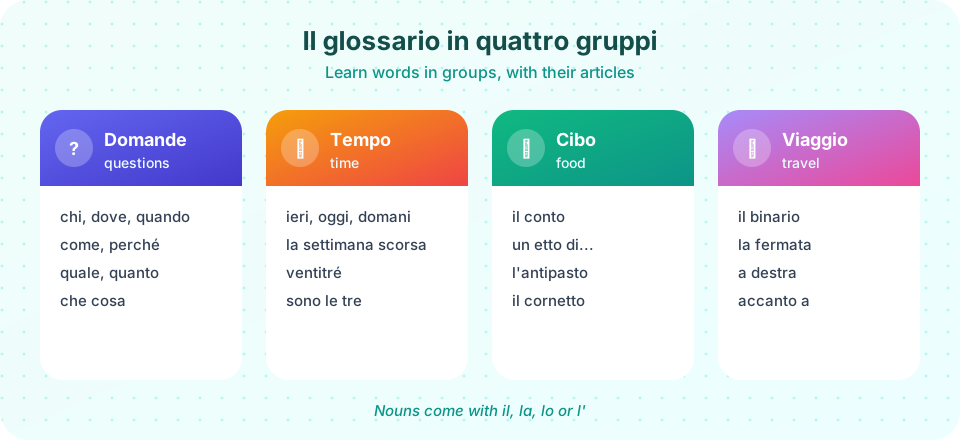
This glossary gathers the most important words and grammar terms from the second half of the course. Use it for quick lookups, as a source for your flashcard deck, and as a checklist: if you do not recognize a word, go back to the lesson where it appears. The entries are grouped by theme rather than listed in strict alphabetical order, because themes are easier to learn than isolated words.
Nouns are given with their article (il, la, l', lo) so that you learn the gender together with the word. Verbs are listed in the infinitive. Where a word has a special spelling, an accent or an irregular form, a short note is added.
What you will learn
- The essential vocabulary of chapters 5 to 8, grouped by theme.
- The Italian names of the grammar terms used in this course.
- How to use this page to build a flashcard deck.
Key terms
Glossario: a list of terms with their meanings.
Genere: gender (maschile, femminile).
Numero: number (singolare, plurale).
Articolo: article (il, lo, la, l', i, gli, le; un, uno, una, un').
Grammar terms
| Italian | English | Example |
|---|---|---|
| il verbo | verb | parlare |
| il sostantivo / il nome | noun | la casa |
| l'aggettivo | adjective | grande |
| l'avverbio | adverb | sempre |
| il pronome | pronoun | lo, la, mi |
| la preposizione | preposition | a, di, con |
| l'articolo | article | il, la |
| il presente | present tense | parlo |
| il passato prossimo | compound past | ho parlato |
| l'imperfetto | imperfect | parlavo |
| il futuro | future | parlerò |
| il condizionale | conditional | parlerei |
| il congiuntivo | subjunctive | che io parli |
| l'imperativo | imperative | parla! |
| il participio passato | past participle | parlato |
| l'ausiliare | auxiliary verb | avere, essere |
| riflessivo | reflexive | mi lavo |
| regolare / irregolare | regular / irregular | andare è irregolare |
| singolare / plurale | singular / plural | libro / libri |
| maschile / femminile | masculine / feminine | il ragazzo / la ragazza |
Question words and small words
| Italian | English | Note |
|---|---|---|
| chi | who | |
| che cosa / cosa / che | what | |
| dove | where | dov'è = where is |
| quando | when | |
| come | how | com'è = what is it like |
| perché | why / because | acute accent |
| quale / quali | which | qual è |
| quanto / quanta / quanti / quante | how much / how many | agrees with the noun |
| sì / no | yes / no | accent on sì |
| e | and | no accent |
| è | is | accent |
| già | already | between auxiliary and participle |
| ancora | yet, still | non ... ancora |
| mai | ever, never | non ... mai |
| sempre | always | |
| spesso | often | |
| di solito | usually | signals the imperfetto |
| mentre | while |
Numbers, time and dates
| Italian | English | Note |
|---|---|---|
| zero, uno, due, tre | 0, 1, 2, 3 | |
| venti, trenta, quaranta | 20, 30, 40 | |
| ventuno, ventotto | 21, 28 | vowel drop |
| ventitré | 23 | accent on the final tre |
| cento, mille, duemila | 100, 1,000, 2,000 | mille becomes mila |
| un milione | one million | un milione di + noun |
| l'ora / le ore | hour(s), time | Che ore sono? |
| mezzogiorno / mezzanotte | noon / midnight | |
| un quarto, mezza | a quarter, half | le tre e un quarto |
| meno | minus, to (the hour) | le sei meno dieci |
| lunedì, martedì, mercoledì | Monday, Tuesday, Wednesday | lowercase |
| giovedì, venerdì, sabato, domenica | Thursday ... Sunday | |
| gennaio ... dicembre | January ... December | lowercase |
| ieri / oggi / domani | yesterday / today / tomorrow | |
| ieri sera | last night | |
| stamattina | this morning | |
| la settimana scorsa | last week | scorsa agrees |
| l'anno prossimo | next year | |
| fa | ago | due giorni fa |
| tra / fra | in (a time span) | tra due giorni |
Food and drink
| Italian | English | Note |
|---|---|---|
| il caffè | espresso | |
| il cappuccino | cappuccino | morning drink |
| il cornetto | croissant | |
| l'acqua (naturale / frizzante) | water (still / sparkling) | |
| il vino (rosso / bianco) | wine (red / white) | |
| il pane | bread | |
| il formaggio | cheese | |
| il prosciutto | ham | |
| le olive | olives | |
| la pasta | pasta | |
| il riso | rice | |
| la zuppa | soup | |
| il pesce | fish | |
| la carne | meat | |
| le patate | potatoes | |
| il dolce | dessert, sweet | |
| il conto | the bill | Il conto, per favore. |
| il coperto | cover charge | |
| l'antipasto | starter | |
| il primo / il secondo | first / main course | |
| il contorno | side dish | |
| un etto | 100 grams | |
| un chilo | kilogram |
Travel and places
| Italian | English | Note |
|---|---|---|
| la stazione | station | |
| il treno | train | |
| il binario | platform | |
| il biglietto | ticket | |
| l'autobus | bus | |
| la fermata | stop | |
| l'aeroporto | airport | |
| l'albergo / l'hotel | hotel | |
| la camera | room | camera doppia |
| la strada | street | |
| la piazza | square | |
| l'incrocio | intersection | |
| il semaforo | traffic light | |
| a destra / a sinistra | right / left | |
| (sempre) dritto | straight ahead | |
| vicino a / lontano da | near / far from | |
| accanto a | next to | |
| davanti a / dietro | in front of / behind | |
| la farmacia | pharmacy | |
| l'ospedale | hospital | |
| in ritardo | late |
People and life
| Italian | English | Note |
|---|---|---|
| la famiglia | family | |
| il padre / la madre | father / mother | papà, mamma |
| il fratello / la sorella | brother / sister | |
| i nonni | grandparents | |
| lo zio / la zia | uncle / aunt | |
| il cugino / la cugina | cousin | |
| il marito / la moglie | husband / wife | |
| il figlio / la figlia | son / daughter | |
| l'amico / l'amica | friend | |
| il lavoro | job, work | |
| l'insegnante | teacher | |
| lo studente / la studentessa | student | |
| il tempo libero | free time | |
| il tempo | weather, time | Che tempo fa? |
| la giornata | day (as a span) | Buona giornata! |
Everyday verbs (infinitives)
| Italian | English | Note |
|---|---|---|
| essere / avere | to be / to have | irregular helpers |
| andare / venire | to go / to come | essere in the past |
| fare / dire | to do / to say | irregular participles: fatto, detto |
| vedere / prendere | to see / to take | visto, preso |
| volere / potere / dovere | to want / can / must | irregular |
| sapere / conoscere | to know (fact) / to know (a person) | sapere, conoscere |
| mangiare / bere | to eat / to drink | bevuto |
| parlare / studiare / lavorare | to speak / study / work | regular -are |
| capire / finire / preferire | to understand / finish / prefer | -isc- verbs |
| svegliarsi / alzarsi / lavarsi | to wake up / get up / wash | reflexive |
| piacere | to please (like) | Mi piace il caffè |
| chiamarsi | to be called | Mi chiamo Luca. |
| partire / arrivare / tornare | to leave / arrive / return | essere in the past |
Polite phrases and fixed expressions
| Italian | English |
|---|---|
| per favore / per piacere | please |
| grazie / prego | thank you / you're welcome, go ahead |
| scusi / scusa | excuse me (formal / informal) |
| mi dispiace | I'm sorry |
| permesso? | may I (pass, come in)? |
| buongiorno / buonasera | good morning / good evening |
| arrivederci / ciao | goodbye / hi, bye |
| a presto / ci vediamo | see you soon / see you |
| buon appetito! | enjoy your meal! |
| in bocca al lupo! | good luck! |
| salute! / cin cin! | cheers! |
| non capisco | I don't understand |
| può ripetere? | can you repeat? |
Try it
Review the glossary words with flashcards. Say each Italian word aloud before flipping.
Match the grammar terms with their English names.
Finally, a Python tool that turns the glossary tables into a deck. This sketch has a few entries; paste in more rows and export them as comma-separated text for any flashcard app.
Press Run (or Ctrl + Enter) to see the result here.
Program input · what you'd type while the program runs
Type the answers before you press Run, one per line. Each time the program reads a line (with input()), it gets the next line from this box.
Check your understanding
Quick check · 5 questions
of 5 answered You scored / 5 · perfect!
-
1. What does 'il binario' mean?
Il binario is the platform at a train station. -
2. Which word means 'usually'?
Di solito = usually; mentre = while; ancora = yet or still. -
3. What is 'l'ausiliare'?
The auxiliary is the helper verb of compound tenses. -
4. Which is the correct spelling for 23?
Compound numbers ending in tre take an acute accent: ventitré. -
5. Which expression means 'last week'?
Scorsa means last; prossima means next; tra means in.
Summary
- The glossary groups words by theme: grammar, question words, numbers and time, food, travel, people, verbs and polite phrases.
- Learn nouns with their articles and verbs in the infinitive; note the accents (perché, è, sì, ventitré, lunedì).
- Turn the tables into flashcards and review them with spaced repetition.
- Return to the lessons whenever a word is unfamiliar.
Next: Cheat sheet
Track your progress
Create a free account to tick off lessons and pick up where you left off on any device.
of Italian for Beginners lessons completed