


















Lesson 41 of 50 · Conversation and Culture
Travel and Directions in Italian
Learn Italian for travel: ask for directions, understand a reply, buy train tickets, book a hotel room and handle problems, with dialogues, drills and a route builder.
Travel is the moment most learners use Italian for real, and it demands a specific kit of phrases: asking for the station, buying a ticket, understanding "turn left at the second street", checking in at a hotel, and saying "I am lost" when things go wrong. The phrases are short and repeatable, and you already know many of the grammar pieces: question words, numbers, the polite vorrei, and a few verbs.
This lesson also introduces one new grammar point that is essential on the road: the formal imperative, the form used to give instructions to someone you address as Lei. When a stranger tells you Vada dritto e giri a destra, they are using it. Fortunately, it is built from forms you have already met in the subjunctive lesson.
What you will learn
- How to ask where something is and understand the answer.
- Words for direction and position: a destra, a sinistra, dritto, vicino, davanti a.
- The formal imperative: Vada, giri, prenda, attraversi.
- Phrases for trains, tickets, hotels and emergencies.
Key terms
Imperativo di cortesia: the polite imperative used with Lei; its forms match the present subjunctive (vada, giri, prenda).
Preposizione di luogo: a word that tells you where something is: davanti a (in front of), dietro (behind), accanto a (next to).
Il binario: the platform at a train station.
Convalidare: to validate a paper ticket in a machine before boarding a regional train.
Asking the way
Start with Scusi (Excuse me) and then ask:
- Scusi, dov'è la stazione? Excuse me, where is the station?
- Dov'è il bagno / la farmacia / la banca? Where is the bathroom / the pharmacy / the bank?
- Come arrivo in Piazza Duomo? How do I get to Piazza Duomo?
- È lontano da qui? Is it far from here? È vicino? Is it near?
- Posso andare a piedi? Can I go on foot?
Words of place and direction
| Italian | English |
|---|---|
| a destra / a sinistra | to the right / to the left |
| (sempre) dritto | straight ahead |
| all'angolo | at the corner |
| al semaforo | at the traffic light |
| all'incrocio | at the intersection |
| in fondo alla strada | at the end of the street |
| la prima / la seconda (strada) | the first / the second (street) |
| vicino a / lontano da | near / far from |
| davanti a / dietro | in front of / behind |
| accanto a / di fronte a | next to / opposite |
| tra / fra | between |
Many prepositions combine with the article: accanto al bar, davanti alla stazione, vicino all'ospedale, in fondo alla strada.
Understanding the answer: the formal imperative
A passer-by speaking to you formally uses the Lei imperative:
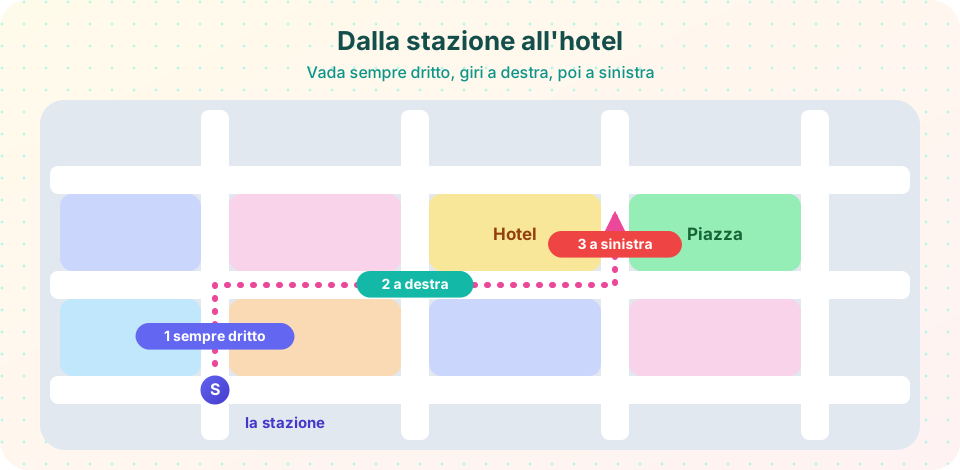
- Vada sempre dritto. Go straight ahead. (andare, irregular: vada)
- Giri a destra al semaforo. Turn right at the traffic light. (girare → giri)
- Prenda la seconda a sinistra. Take the second on the left. (prendere → prenda)
- Attraversi la piazza. Cross the square. (attraversare → attraversi)
- Continui fino alla chiesa. Continue to the church. (continuare → continui)
The rule: for -are verbs use -i; for -ere and -ire verbs use -a. Verbs like andare and venire borrow the subjunctive form (vada, venga). With a friend you would use the informal imperative: Vai dritto. Gira a destra. Prendi la seconda. (-are verbs end in -a, -ere/-ire verbs in -i.)
A typical exchange:
Turista: Scusi, dov'è la stazione? Passante: Vada sempre dritto per due strade, poi giri a sinistra. La stazione è di fronte alla farmacia. Turista: È lontano? Passante: No, circa cinque minuti a piedi. Turista: Grazie mille! Passante: Prego!
"Where is the station?" "Go straight ahead for two streets, then turn left. The station is opposite the pharmacy." "Is it far?" "No, about five minutes on foot." "Thank you very much!" "You are welcome!"
Trains and public transport
| Italian | English |
|---|---|
| Un biglietto per Firenze, per favore. | A ticket to Florence, please. |
| Solo andata / andata e ritorno | one way / round trip |
| A che ora parte il treno per Roma? | When does the train to Rome leave? |
| Da quale binario? | From which platform? |
| Il treno è in ritardo. | The train is late. |
| Devo cambiare? | Do I have to change? |
| Dov'è la fermata dell'autobus? | Where is the bus stop? |
Italy has fast trains (Frecciarossa, Italo), regional trains (regionali), buses and metros in the big cities. For some regional trains you must validate a paper ticket in a machine on the platform before boarding (convalidare il biglietto); if you buy an electronic ticket you usually do not. Check the rules for your ticket type when you travel.
Timetables use the 24-hour clock: Il treno parte alle 17:42 (alle diciassette e quarantadue).
A hotel room
- Ho prenotato una camera a nome di Rossi. I booked a room under the name Rossi.
- Vorrei una camera singola / doppia / matrimoniale. I would like a single / twin / double room.
- La colazione è inclusa? Is breakfast included?
- A che ora è il check-out? What time is check-out?
- C'è il Wi-Fi? Is there Wi-Fi?
- Può chiamarmi un taxi? Can you call me a taxi?
Receptionist: Buonasera, in che cosa posso aiutarla? Ospite: Buonasera. Ho prenotato una camera doppia per due notti. Receptionist: Come si chiama, per favore? Ospite: Giulia Bianchi. Receptionist: Ecco la chiave. La camera è al secondo piano. La colazione è dalle sette alle dieci.
"Good evening, how can I help you?" "Good evening. I booked a double room for two nights." "What is your name, please?" "Giulia Bianchi." "Here is the key. The room is on the second floor. Breakfast is from seven to ten."
When something goes wrong
- Mi sono perso (man) / Mi sono persa (woman). I am lost.
- Non capisco. Può parlare più lentamente? I do not understand. Can you speak more slowly?
- Ho bisogno di un medico. I need a doctor.
- Dov'è la farmacia / l'ospedale più vicino? Where is the nearest pharmacy / hospital?
- Ho perso il passaporto. I lost my passport.
- Aiuto! Help!
In Italy and across the European Union, 112 is the general emergency number. In an emergency, say your location and the problem slowly and clearly: Sono in via Roma. Ho bisogno di un'ambulanza.
Common misconceptions
"Dritto means 'right'." It means "straight". Destra is right and sinistra is left. Mixing dritto and destra is a classic error.
"Prego just means 'you are welcome'." It also means "please go ahead", "after you" and "can I help you?". Its meaning depends on the situation.
"The imperative is the same for tu and Lei." It is not: Prendi (tu) versus Prenda (Lei).
Try it
This route builder turns a list of steps into polite directions with the formal imperative. It is a simple template model, not a navigation tool.
Press Run (or Ctrl + Enter) to see the result here.
Program input · what you'd type while the program runs
Type the answers before you press Run, one per line. Each time the program reads a line (with input()), it gets the next line from this box.
Fill in the missing words of this lesson.
And a flashcard deck for travel words.
Check your understanding
Quick check · 5 questions
of 5 answered You scored / 5 · perfect!
-
1. What does 'Giri a sinistra' mean?
Giri is the formal imperative of girare and sinistra is left. -
2. Which word means 'platform' at a train station?
Il binario is the platform; la fermata is a bus stop; il biglietto is the ticket. -
3. What is the formal imperative of 'prendere' (to take)?
-ere verbs take -a in the Lei imperative: Prenda la seconda a sinistra. -
4. How do you say 'next to the bar'?
Accanto a + il = accanto al: accanto al bar. -
5. Which is the general emergency number in Italy?
112 is the general emergency number across the European Union, including Italy.
Summary
- Ask with Scusi, dov'è...?; understand a destra, a sinistra, sempre dritto, all'angolo, al semaforo.
- The formal imperative: -are → -i (giri), -ere/-ire → -a (prenda), vada from andare.
- Use Un biglietto per..., per favore, A che ora parte...?, Da quale binario? at the station.
- At a hotel: Ho prenotato una camera a nome di..., La colazione è inclusa?
- In trouble: Mi sono perso/a, Ho bisogno di...; call 112 in an emergency.
Track your progress
Create a free account to tick off lessons and pick up where you left off on any device.
of Italian for Beginners lessons completed