


















Lesson 24 of 50 · Daily Life and Questions
Question Words and Asking Questions
Learn Italian question words (chi, che cosa, dove, quando, come, perché, quale, quanto), yes/no questions, intonation and polite forms with examples.
Asking questions is the fastest way to get things done in a new language. A traveler who can say "Dove?" gets directions, one who can say "Quanto costa?" gets a price, and a learner who can say "Come si dice...?" gets new vocabulary on demand. The good news is that Italian questions are simple: for yes/no questions you do not rearrange anything, and the list of question words is short.
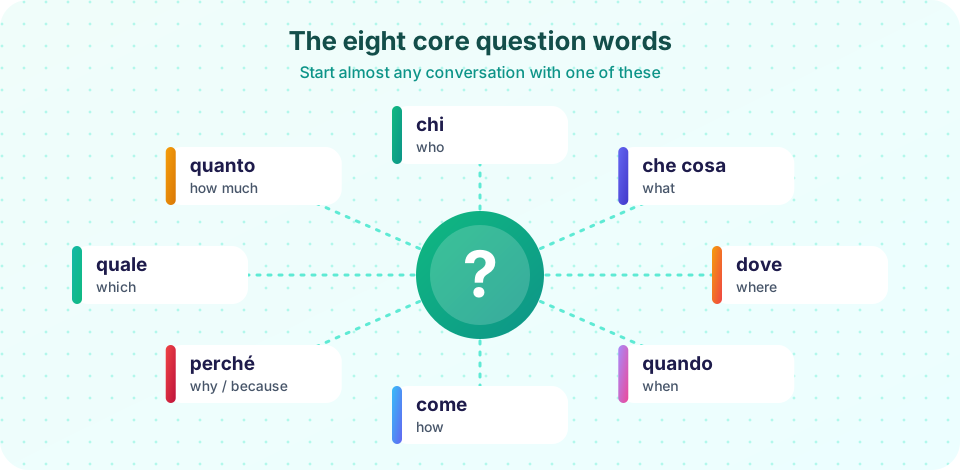
In this lesson you will learn the eight core question words, how some of them change form, how to build yes/no questions, and how to ask politely. Every pattern comes with examples and a translation.
What you will learn
- The eight core question words and how to pronounce them.
- Which words change for gender and number (quanto, quale).
- How to form yes/no questions with intonation and tag words.
- How to ask politely with Lei and a few set phrases.
Key terms
Parola interrogativa: a question word that opens a question, such as dove (where).
Domanda sì/no: a yes/no question, formed with rising intonation.
Elisione: dropping a final vowel before another vowel and replacing it with an apostrophe: dove è becomes dov'è.
Lei: the formal "you" used with strangers, older people and in business.
The eight core question words
| Italian | Pronunciation (IPA) | English | Example |
|---|---|---|---|
| chi | /ki/ | who | Chi è? (Who is it?) |
| che cosa / cosa / che | /ke ˈkɔːza/ | what | Che cosa fai? (What are you doing?) |
| dove | /ˈdoːve/ | where | Dove abiti? (Where do you live?) |
| quando | /ˈkwando/ | when | Quando arriva il treno? (When does the train arrive?) |
| come | /ˈkoːme/ | how | Come stai? (How are you?) |
| perché | /perˈke/ | why / because | Perché studi italiano? (Why are you studying Italian?) |
| quale | /ˈkwaːle/ | which | Quale preferisci? (Which do you prefer?) |
| quanto | /ˈkwanto/ | how much / how many | Quanto costa? (How much is it?) |
A few notes. Che cosa, cosa and che all mean "what" and are interchangeable in everyday speech: Che cosa vuoi? Cosa vuoi? Che vuoi? The short forms are more casual. In the written word che has no accent when it means "what" or "that", but perché always has an acute accent on the final é, and you pronounce it with a closed e, as in "PAIR-keh".
Notice also that perché means both why and because. The question and the answer use the same word:
- Perché studi italiano? "Why are you studying Italian?"
- Perché voglio viaggiare in Italia. "Because I want to travel in Italy."
Words that change form
Most question words never change, but two of them agree with a noun:
- Quanto has four forms when it describes a noun: quanto (masculine singular), quanta (feminine singular), quanti (masculine plural), quante (feminine plural). Examples: Quanto tempo hai? (How much time do you have?), Quanta acqua vuoi? (How much water do you want?), Quanti anni hai? (How old are you?, literally "How many years do you have?"), Quante persone siete? (How many people are you?). When quanto stands alone as an adverb, as in Quanto costa?, it stays quanto.
- Quale has a plural, quali: Quale libro? (Which book?), Quali libri? (Which books?). Before the verb è it shortens to qual, with no apostrophe: Qual è il tuo nome? (What is your name?). Writing qual'è is one of the most common spelling mistakes, even among native speakers.
Combining with prepositions
Italian puts the preposition before the question word, never at the end of the sentence:
- Con chi parli? With whom are you talking? (not "Who are you talking with?")
- Di dove sei? Where are you from?
- Da dove vieni? Where do you come from?
- Per chi è il regalo? Who is the present for?
- A che ora parte il treno? At what time does the train leave?
Yes/no questions
In Italian you do not need a helper verb like "do" and you do not need to swap the subject and verb. A statement becomes a question only through your voice, which rises on the last stressed syllable, and through the question mark in writing.
- Parli italiano. You speak Italian.
- Parli italiano? Do you speak Italian?
- Marco è a casa? Is Marco at home?
If you do want a subject pronoun for emphasis, you can put it at the end: Parli italiano, tu? or Hai fame, Marco? This is natural and common.
To invite a "yes", add a tag at the end: vero? (right?), no? (no?) or non è vero? (isn't it?).
- Sei stanco, vero? You are tired, right?
- Domani andiamo al mare, no? We are going to the sea tomorrow, aren't we?
To answer, say sì (yes, with an accent to separate it from the word si), no, or repeat the verb: Sì, parlo un po'. "Yes, I speak a little."
Asking politely and asking for help
Use Lei with strangers: Scusi, parla inglese? (Excuse me, do you speak English?), Mi scusi, dov'è la stazione? (Excuse me, where is the station?). Scusi is the formal command of scusare; to a friend you say scusa.
Here are the most useful survival questions for a learner:
| Italian | English |
|---|---|
| Come si dice "thank you" in italiano? | How do you say "thank you" in Italian? |
| Che cosa significa "subito"? | What does "subito" mean? |
| Può ripetere, per favore? | Can you repeat, please? (formal) |
| Può parlare più lentamente? | Can you speak more slowly? |
| Non capisco. Che cosa ha detto? | I do not understand. What did you say? |
| Dov'è il bagno? | Where is the bathroom? |
Notice dov'è and com'è: dove è and come è contract because è starts with a vowel. You will also hear Com'è il tempo? (What is the weather like?).
A short dialogue
Anna: Scusi, dov'è la fermata dell'autobus? Passante: È là, vicino al bar. Anna: Grazie. Quando passa il prossimo autobus? Passante: Tra dieci minuti.
In English: "Excuse me, where is the bus stop?" "It is over there, near the bar." "Thank you. When does the next bus come?" "In ten minutes."
How to practice questions
Questions are best learned by asking real ones. Pick five question words each day and invent one question for each person in your life: Come stai? Dove lavori? Quando torni? Perché sei stanco? Quanti anni ha tua sorella? Then answer your own questions in a full sentence. You can also practice in the shop or on the street by silently forming the question you would ask: Dov'è il bagno? Quanto costa questo? Remember to say the rising tone at the end of yes/no questions, and listen for it when Italians speak: the melody of a question is as important as the words.
Common misconceptions
"Italian needs a word like 'do' to make a question." It does not. Parli italiano? is complete. Do not try to translate "Do you" word for word.
"Perché has two different words, one for why and one for because." It is one word. Context tells you which meaning is intended.
"Qual è is written qual'è." It is not: qual is a shortened form, not an elision, so it takes no apostrophe.
Try it
Practice the vocabulary with a gap-fill drill. Answers are checked for accents too: perché and dov'è must be spelled exactly.
Next, check which answer type each question word expects. This tiny Python helper is a simulation of a rule of thumb, not a language model, but it shows the system clearly.
Press Run (or Ctrl + Enter) to see the result here.
Program input · what you'd type while the program runs
Type the answers before you press Run, one per line. Each time the program reads a line (with input()), it gets the next line from this box.
Check your understanding
Quick check · 5 questions
of 5 answered You scored / 5 · perfect!
-
1. How do you turn 'Hai fame.' (You are hungry.) into a question?
Italian uses the same words and a rising intonation, plus a question mark in writing. -
2. Which sentence is correct for 'How many people are you?'
Persone is feminine plural, so quanto must become quante. -
3. What does 'Con chi parli?' mean?
The preposition con comes before chi, giving 'With whom do you speak?' -
4. Which spelling is correct?
Qual is a shortened form of quale and takes no apostrophe. -
5. What does 'perché' mean in 'Perché ho fame.'?
As an answer, perché means 'because'. As a question opener it means 'why'.
Summary
- The eight core question words: chi, che cosa, dove, quando, come, perché, quale, quanto.
- Quanto and quale change for number (and quanto for gender): quanta acqua, quanti anni, quali libri.
- Prepositions come before the question word: Con chi? Di dove? A che ora?
- Yes/no questions keep the statement word order and use rising intonation; tags such as vero? ask for agreement.
- Perché means both "why" and "because"; write dov'è, com'è and qual è correctly.
Next: Numbers, time and dates
Track your progress
Create a free account to tick off lessons and pick up where you left off on any device.
of Italian for Beginners lessons completed