


















Lesson 30 of 50 · Past Tenses
Passato Prossimo with Essere
Learn which Italian verbs take essere in the passato prossimo (movement, change, reflexives) and how the participle agrees in gender and number, with drills.
Most verbs form the passato prossimo with avere, but a smaller and very important group uses essere instead. These are mainly verbs of movement and change of state (andare, venire, arrivare, partire, nascere) and all reflexive verbs. They come with an extra rule that surprises English speakers: the past participle behaves like an adjective and agrees with the subject in gender and number.
You will need this tense every time you say where you went, when you arrived or how you felt. Fortunately, there is a pattern behind the list, and a handful of questions lets you decide which helper to choose.
What you will learn
- Which verbs take essere in the passato prossimo.
- How to make the participle agree with the subject.
- How to choose between avere and essere with a short decision test.
- How to say where you went, when you arrived and what happened.
Key terms
Verbo di movimento: a verb of movement such as andare, venire, partire, arrivare, entrare, uscire.
Accordo (agreement): the participle ending changes to match the subject: -o, -a, -i, -e.
Verbo riflessivo: a verb with a reflexive pronoun (mi lavo, si sveglia). They all take essere.
Verbo di cambiamento: a verb of change of state, such as diventare, nascere, morire.
The present of essere as helper
| Person | Italian | Person | Italian | |
|---|---|---|---|---|
| io | sono | noi | siamo | |
| tu | sei | voi | siete | |
| lui / lei / Lei | è | loro | sono |
Combine each form with the participle: sono andato (I went, masculine speaker), sei arrivata (you arrived, feminine), è partito (he left), siamo usciti (we went out).
Which verbs take essere
Learn the groups, not a random list:
- Movement from place to place: andare (andato), venire (venuto), partire (partito), arrivare (arrivato), entrare (entrato), uscire (uscito), tornare (tornato), salire (salito), scendere (sceso), cadere (caduto).
- Staying and being: essere (stato), stare (stato), restare (restato) and rimanere (rimasto).
- Change of state: nascere (nato), morire (morto), diventare (diventato), crescere (cresciuto), invecchiare (invecchiato).
- Things that happen or please: succedere (successo), piacere (piaciuto), costare (costato), bastare (bastato).
- All reflexive verbs: mi sono alzato, ti sei svegliata, si è vestito.
Some verbs with a surface similarity to movement still take avere, for example camminare, viaggiare, nuotare, passeggiare, correre: Ho camminato per due ore. Ho viaggiato in treno. A useful test is this: verbs that express a change of place or state take essere, while verbs that describe an activity or have a direct object take avere.
Agreement: the participle changes
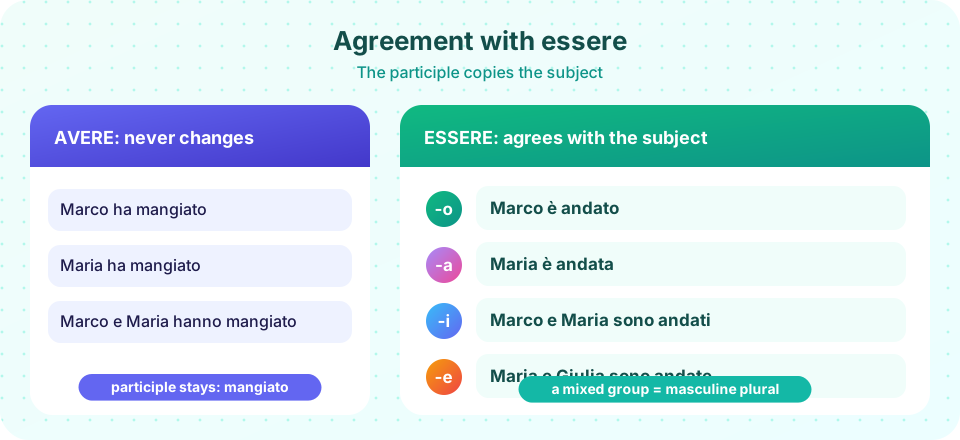
When the helper is essere, the participle agrees with the subject:
| Subject | Participle | Example |
|---|---|---|
| masculine singular | -o | Marco è andato a Roma. |
| feminine singular | -a | Maria è andata a Roma. |
| masculine plural (or mixed group) | -i | Marco e Maria sono andati a Roma. |
| feminine plural | -e | Maria e Giulia sono andate a Roma. |
So for andare, a woman says sono andata, a man says sono andato; for noi you hear siamo andati (mixed or all male) or siamo andate (all female). A group with even one man is masculine: Luca, Anna e Sara sono arrivati.
Compare with avere, where the participle never changes with the subject: Maria ha mangiato, Marco e Maria hanno mangiato.
The same sentence, four ways
| Italian | Who | English |
|---|---|---|
| Sono arrivato alle otto. | a man | I arrived at eight. |
| Sono arrivata alle otto. | a woman | I arrived at eight. |
| Siamo arrivati alle otto. | mixed group | We arrived at eight. |
| Siamo arrivate alle otto. | women only | We arrived at eight. |
Using the tense
Here are typical sentences for talking about a trip or a day:
- Sono stato a Napoli due volte. I have been to Naples twice. (stato is the participle of both essere and stare.)
- Ieri siamo andati al cinema. Yesterday we went to the cinema.
- Il treno è partito in ritardo. The train left late. (A thing as subject: the participle agrees with il treno.)
- Le mie amiche sono venute alla festa. My (female) friends came to the party.
- Quando sei tornata? When did you come back?
- Non sono uscito perché pioveva. I did not go out because it was raining.
Adverbs such as già, ancora, mai and appena again go between the helper and the participle: Sono già arrivati. (They have already arrived.) Non è ancora partito. (He has not left yet.)
A dialogue about a weekend
Chiara: Dove sei andata sabato? Sofia: Sono andata in montagna con Luca e Teresa. Siamo partiti presto e siamo arrivati a mezzogiorno. Chiara: E vi siete divertiti? Sofia: Moltissimo! Siamo rimasti lì fino a domenica sera.
"Where did you go on Saturday?" "I went to the mountains with Luca and Teresa. We left early and arrived at noon." "And did you have fun?" "A lot! We stayed there until Sunday evening." Notice Sofia says sono andata (a woman), and the group (with Luca) is partiti, arrivati, rimasti in the masculine plural.
A four-question test for the helper verb
When you are not sure which helper to use, ask yourself:
- Is the verb reflexive? (mi lavo, si alza) Then use essere.
- Does it describe moving from one place to another, or a change of state? (arrivare, partire, nascere, diventare) Then use essere.
- Does it have a direct object? (ho letto un libro, ho visto un film) Then use avere.
- Is it an activity without a change of place? (camminare, nuotare, lavorare, dormire) Then use avere.
A few verbs can take either helper depending on how they are used. The clearest pattern is with or without a direct object: Ho finito il lavoro (I finished the work, direct object, avere) but Il film è finito (the film ended, no object, essere). The same happens with cominciare: Ho cominciato la lezione versus La lezione è cominciata. You will not need to produce these perfectly yet, but you will see them often.
Time words that go with the tense
The same time words that accompany the passato prossimo with avere work here: ieri, ieri sera, stamattina, la settimana scorsa, l'anno scorso, due giorni fa, una volta. For example: La settimana scorsa siamo andati a Venezia. Due anni fa mia sorella è tornata dall'estero. Some verbs call for a date or a time: Sono nata nel 1998 ("I was born in 1998"), and a question like Quando sei arrivato? is answered with a time: Sono arrivato alle otto.
Common misconceptions
"Sono andato" is for men only. It is the masculine form. A woman says sono andata; the helper sono is the same for both.
"Every verb of motion takes essere." Activity verbs like camminare and viaggiare take avere. The test is change of place versus ongoing activity.
"With avere the participle also agrees with the subject." It does not. (It can agree with a direct-object pronoun placed before the verb, which you will meet in the pronouns chapter.)
Try it
This simulation chooses the helper and the agreement for the verbs in its list. It is a teaching model built on the rules of this lesson, not a complete Italian grammar.
Press Run (or Ctrl + Enter) to see the result here.
Program input · what you'd type while the program runs
Type the answers before you press Run, one per line. Each time the program reads a line (with input()), it gets the next line from this box.
Fill in the helper verb and the participle ending.
Check your understanding
Quick check · 5 questions
of 5 answered You scored / 5 · perfect!
-
1. A woman says: 'Ieri ___ al mare.'
Andare takes essere, and the participle agrees with the female subject: andata. -
2. Which verb takes avere in the passato prossimo?
Camminare describes an activity and takes avere: ho camminato. -
3. What is the form for 'Luca and Sara arrived'?
A mixed group uses the masculine plural: arrivati. -
4. All reflexive verbs form the passato prossimo with...
Reflexive verbs always take essere: mi sono alzata. -
5. 'Il treno è partito' - why is it partito and not partita?
The participle agrees with the subject il treno, which is masculine singular.
Summary
- Verbs of movement, change of state, being and all reflexive verbs take essere in the passato prossimo.
- With essere the participle agrees: -o, -a, -i, -e (andato, andata, andati, andate).
- A mixed group is masculine plural.
- Activity verbs (camminare, viaggiare, nuotare) take avere, and then the participle does not change.
- Già, ancora, mai and appena sit between essere and the participle.
Next: The imperfetto
Track your progress
Create a free account to tick off lessons and pick up where you left off on any device.
of Italian for Beginners lessons completed