Cheat Sheet: Italian Grammar and Phrases on One Page
A one-page Italian cheat sheet for beginners: tense endings, helper verbs, pronouns, question words, time expressions, subjunctive triggers and key phrases.
This page is a compact reference for chapters 5 to 8: everything you need to check quickly, in tables you can screenshot or print. Keep it beside you while you write, and use it to test yourself: cover the right column and recall the forms. It is not a replacement for the lessons, which explain the why behind each rule, but it is a fast way to find the how.
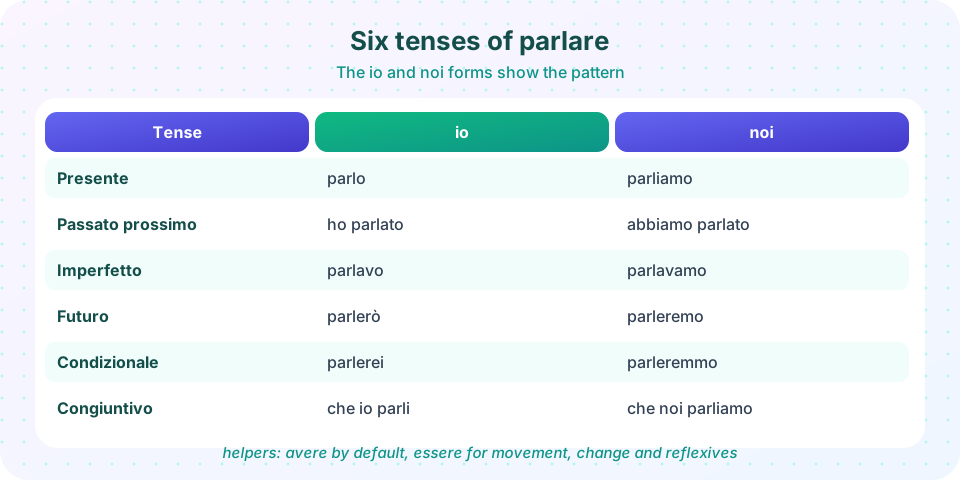
The big picture at the top shows the tenses side by side for the verb parlare. The sections below list the rules, the exceptions that matter most and the phrases that you will use every day.
Six tenses of parlare at a glance: io and noi forms show the pattern.
Position: before the conjugated verb (Lo vedo), attached to the infinitive (vederlo); in the passato prossimo with lo, la, li, le the participle agrees (l'ho vista).
Use the cheat sheet for self-testing: this card deck reveals one form at a time.
Cheat-sheet flashcards
<metacharset="utf-8"><style>*{box-sizing:border-box}body{margin:0;padding:14px;font:16px system-ui,-apple-system,'Segoe UI',sans-serif;color:#1e1b4b;background:linear-gradient(135deg,#f0fdfa,#ecfeff)}.card{background:#fff;border-radius:18px;padding:18px;box-shadow:0 10px 26px rgba(13,148,136,.18)}.n{color:#0d9488;font-size:14px;font-weight:600}.q{font-size:20px;margin:10px 0;min-height:30px}.h{color:#64748b;font-size:14px;min-height:20px}input{font:inherit;padding:8px 12px;border:2px solid #99f6e4;border-radius:12px;width:min(100%,22em)}button{font:inherit;font-weight:600;border:0;border-radius:12px;padding:9px 15px;color:#fff;background:linear-gradient(135deg,#14b8a6,#6366f1);cursor:pointer;margin:4px 4px 0 0}button.alt{background:linear-gradient(135deg,#f59e0b,#ef4444)}button.ghost{background:#e0f2fe;color:#075985}.ok{color:#047857;font-weight:600}.bad{color:#b91c1c;font-weight:600}.face{min-height:120px;display:flex;align-items:center;justify-content:center;text-align:center;font-size:30px;font-weight:700;border-radius:16px;background:linear-gradient(135deg,#ccfbf1,#e0e7ff);padding:14px;cursor:pointer;margin:10px 0}.note{color:#475569;font-size:15px;min-height:22px}.cols{display:grid;grid-template-columns:1fr 1fr;gap:10px}.cols button{display:block;width:100%;margin:0 0 8px;background:#f1f5f9;color:#1e1b4b;border:2px solid #cbd5e1;text-align:left}.cols button.sel{border-color:#6366f1;background:#e0e7ff}.cols button.done{border-color:#10b981;background:#d1fae5;color:#065f46}.cols button.wrong{border-color:#ef4444;background:#fee2e2}</style><divclass="card"><divclass="n"id="n"></div><divclass="face"id="f"tabindex="0"role="button"aria-label="Flip card"></div><divclass="note"id="note"></div><buttonid="flip">Flip</button><buttonid="know"class="alt">I knew it</button><buttonid="again"class="ghost">Again later</button><buttonid="say"class="ghost">Listen</button><pclass="note"id="m"></p></div><script>const items=[["participle of fare","fatto","ho fatto"],["future of essere (io)","sarò",""],["conditional of volere (io)","vorrei",""],["subjunctive of essere (che lui)","sia","penso che sia"],["imperfetto of essere (noi)","eravamo",""],["direct pronoun for 'them' (f.)","le","le ho comprate"],["combined: to me + it","me lo","me lo dai?"],["how to say 'I am hungry'","ho fame","avere"]];let deck=items.map((_,k)=>k),flipped=false,known=0;const$=id=>document.getElementById(id);functionrender(){$("n").textContent="Known "+known+" of "+items.length+" - "+deck.length+" left";if(!deck.length){$("f").textContent="Tutto fatto! All cards known.";$("note").textContent="Press Again later to restart.";deck=items.map((_,k)=>k);known=0;flipped=false;return}const it=items[deck[0]];$("f").textContent=flipped?it[1]:it[0];$("note").textContent=flipped?(it[2]||""):"Tap the card to see the English.";}functionflip(){flipped=!flipped;render()}$("f").onclick=flip;$("flip").onclick=flip;$("know").onclick=()=>{deck.shift();known++;flipped=false;render()};$("again").onclick=()=>{deck.push(deck.shift());flipped=false;render()};$("say").onclick=()=>{try{if(!deck.length||!("speechSynthesis"in window)){$("m").textContent="Speech is not available in this preview.";return}const u=newSpeechSynthesisUtterance(items[deck[0]][0]);u.lang="it-IT";window.speechSynthesis.speak(u);$("m").textContent="";}catch(e){$("m").textContent="Speech is not available in this preview."}};render();</script>
Now a drill that mixes forms from all sections.
Cheat-sheet drill
<metacharset="utf-8"><style>*{box-sizing:border-box}body{margin:0;padding:14px;font:16px system-ui,-apple-system,'Segoe UI',sans-serif;color:#1e1b4b;background:linear-gradient(135deg,#f0fdfa,#ecfeff)}.card{background:#fff;border-radius:18px;padding:18px;box-shadow:0 10px 26px rgba(13,148,136,.18)}.n{color:#0d9488;font-size:14px;font-weight:600}.q{font-size:20px;margin:10px 0;min-height:30px}.h{color:#64748b;font-size:14px;min-height:20px}input{font:inherit;padding:8px 12px;border:2px solid #99f6e4;border-radius:12px;width:min(100%,22em)}button{font:inherit;font-weight:600;border:0;border-radius:12px;padding:9px 15px;color:#fff;background:linear-gradient(135deg,#14b8a6,#6366f1);cursor:pointer;margin:4px 4px 0 0}button.alt{background:linear-gradient(135deg,#f59e0b,#ef4444)}button.ghost{background:#e0f2fe;color:#075985}.ok{color:#047857;font-weight:600}.bad{color:#b91c1c;font-weight:600}.face{min-height:120px;display:flex;align-items:center;justify-content:center;text-align:center;font-size:30px;font-weight:700;border-radius:16px;background:linear-gradient(135deg,#ccfbf1,#e0e7ff);padding:14px;cursor:pointer;margin:10px 0}.note{color:#475569;font-size:15px;min-height:22px}.cols{display:grid;grid-template-columns:1fr 1fr;gap:10px}.cols button{display:block;width:100%;margin:0 0 8px;background:#f1f5f9;color:#1e1b4b;border:2px solid #cbd5e1;text-align:left}.cols button.sel{border-color:#6366f1;background:#e0e7ff}.cols button.done{border-color:#10b981;background:#d1fae5;color:#065f46}.cols button.wrong{border-color:#ef4444;background:#fee2e2}</style><divclass="card"><divclass="n"id="n"></div><divclass="q"id="q"></div><divclass="h"id="h"></div><inputid="a"autocomplete="off"autocapitalize="off"spellcheck="false"aria-label="Your answer"><buttonid="b">Check</button><pid="m"class="note"></p></div><script>const items=[["Futuro di andare (io): ___","andrò",""],["Imperfetto di fare (io): ___","facevo",""],["Participio di prendere: ___","preso",""],["Congiuntivo di avere (che lui): che ___","abbia",""],["Il ___ giugno: festa della Repubblica (2)","due",""],["Sono le sei ___ un quarto (5:45)","meno",""],["Mi ___ alzata alle sette. (essere, io)","sono","reflexive in the past"],["Penso ___ sia vero.","che",""]];let i=0,score=0,checked=false;const$=id=>document.getElementById(id);constnorm=s=>s.toLowerCase().replace(/[.,;!?]/g,"").replace(/[\u2018\u2019]/g,"'").replace(/\s+/g," ").trim();conststrip=s=>norm(s).normalize("NFD").replace(/[\u0300-\u036f]/g,"");functionrender(){const it=items[i];$("n").textContent="Question "+(i+1)+" of "+items.length+" - score "+score;$("q").textContent=it[0];$("h").textContent=it[2]?"Hint: "+it[2]:"";$("a").style.display="";$("a").value="";$("m").textContent="";$("m").className="note";$("b").textContent="Check";checked=false;$("a").focus();}functionact(){if(i>=items.length){i=0;score=0;render();return}if(checked){
i++;if(i>=items.length){$("n").textContent="";$("h").textContent="";$("q").textContent="Finished! Score: "+score+" / "+items.length;$("a").style.display="none";$("m").textContent="";$("b").textContent="Try again";return}render();return;}const opts=items[i][1].split("|"),g=norm($("a").value);if(!g){return}if(opts.some(o=>norm(o)===g)){score++;$("m").className="ok";$("m").textContent="Corretto! "+opts[0]}elseif(opts.some(o=>strip(o)===strip(g))){$("m").className="bad";$("m").textContent="Almost - watch the accent: "+opts[0]}else{$("m").className="bad";$("m").textContent="Not quite. Answer: "+opts.join(" / ")}$("n").textContent="Question "+(i+1)+" of "+items.length+" - score "+score;
checked=true;$("b").textContent="Next";}$("b").onclick=act;$("a").addEventListener("keydown",e=>{if(e.key==="Enter")act()});render();</script>
A Python lookup tool for irregular verbs. Type a verb in the verb variable and run it. The table has the ten verbs of section 4.
Python
Irregular verb lookup
table ={"essere":("sono","ero","sarò","sia"),"avere":("ho","avevo","avrò","abbia"),"andare":("vado","andavo","andrò","vada"),"fare":("faccio","facevo","farò","faccia"),"venire":("vengo","venivo","verrò","venga"),"potere":("posso","potevo","potrò","possa"),"volere":("voglio","volevo","vorrò","voglia"),"dovere":("devo","dovevo","dovrò","debba"),"sapere":("so","sapevo","saprò","sappia"),"dire":("dico","dicevo","dirò","dica"),}
labels =["presente (io)","imperfetto (io)","futuro (io)","congiuntivo (che lui)"]for verb in["andare","volere","dovere"]:print(verb.upper())for label, form inzip(labels, table[verb]):print(f" {label:<22}{form}")
Press Run (or Ctrl + Enter) to see the result here.
Program input · what you'd type while the program runs
Type the answers before you press Run, one per line. Each time the program reads a line (with input()), it gets the next line from this box.