


















Lesson 50 of 50 · Projects and Practice
Further Study: What to Learn After This Course
Plan your next steps in Italian: grammar topics to learn next, listening and reading habits, language exams, speaking practice, and related language tracks on this site.
You have reached the end of the second half of this course. You can greet people, ask questions, count, tell the time, order food, travel, talk about the past and the future, and recognize the subjunctive. That is a genuine foundation: with it you can handle many everyday situations in Italy, as long as people speak slowly and you are patient with yourself.
Language learning does not stop at a course. The next level comes from volume (lots of listening and reading), output (speaking and writing with feedback), and targeted grammar. This lesson maps the road ahead, suggests habits that work, and points to other tracks on this site that connect to what you have learned.
What you will learn
- Where you are on the CEFR scale and what the next stages involve.
- Which grammar topics to study next.
- Daily and weekly habits that build listening, reading, speaking and writing.
- How Italian relates to other languages on this site.
Key terms
CEFR (Common European Framework of Reference): a six-level scale from A1 (beginner) to C2 (near-native), used by most language exams.
Input: language you hear or read (listening and reading).
Output: language you produce (speaking and writing).
Immersione: immersion, surrounding yourself with the language.
Where you are
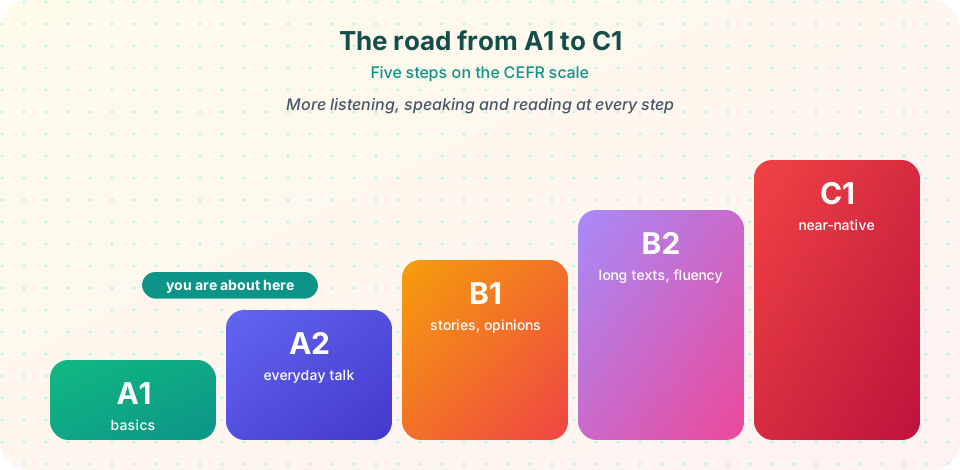
The CEFR scale has six levels: A1 and A2 (basic user), B1 and B2 (independent user), C1 and C2 (proficient user). Roughly speaking, a learner who has worked carefully through a beginner course like this one is somewhere around A1 to early A2: able to use familiar everyday expressions and simple phrases, introduce yourself, ask and answer simple questions, and describe the immediate environment. Your exact level depends on how much you practiced speaking and listening, so treat this as an estimate, not a diagnosis.
The next stages bring more independence. At B1 you can deal with most situations when traveling, describe experiences and plans, and give reasons and opinions. At B2 you can follow complex texts, interact with native speakers with fluency, and write clearly on many topics. How long each stage takes varies enormously with how much time you study and how much you use the language; there is no single honest number of hours for everyone.
What to study next
Here are the grammar topics that most learners meet after the basics. Study them roughly in this order.
| Topic | Why it matters | Example |
|---|---|---|
| The imperative (tu, noi, voi) | commands, instructions, recipes | Mangia! Andiamo! Venite! |
| Stare + gerund | actions in progress | Sto leggendo. |
| Ci and ne in depth | very frequent small words | Ce l'ho. Ne voglio due. |
| Comparatives and superlatives | comparing things | più grande di, il più bello |
| The passato remoto | reading novels and history | andò, disse, fu |
| The imperfect subjunctive and hypotheticals | "if" sentences | Se avessi tempo, verrei. |
| Relative pronouns (che, cui) | joining sentences | Il libro che ho letto... |
| Passive voice | news and formal writing | La casa è stata venduta. |
| Indirect speech | reporting what was said | Ha detto che sarebbe venuto. |
| Prepositions with articles | precision | nel, sul, dalla, delle |
Learn each topic the same way: read the explanation, study ten to twenty real examples, write ten sentences of your own, and then look for the structure in listening and reading.
Build habits that work
Listen every day. Aim for ten to thirty minutes of Italian audio: radio from public broadcasters, podcasts for learners, songs, or films with Italian subtitles. At first you will understand little; keep going. Listening to the same short clip several times, once without text and once with a transcript, is a very effective technique.
Read a little each day. Short news articles, simplified readers designed for learners, children's stories, recipes and social media posts are all good. Do not look up every word: guess from context, and look up only the words that appear again and again.
Speak early and often. Talk to a language partner, join a conversation group, or book lessons with a tutor. If you cannot find a partner, speak to yourself: describe your day, narrate what you are cooking, repeat dialogues from this course aloud. A course cannot replace speaking with real people, and the progress you make in conversation is faster than any app can provide.
Write and get corrections. Keep a short diary in Italian (three to five sentences a day) and ask a tutor or native speaker to correct it. Notice your repeated mistakes and write them in a list.
Review vocabulary with spaced repetition. Use the trainer from the first project or any flashcard application. Keep your deck small and relevant to your life.
A sample weekly plan
| Day | Activity | Time |
|---|---|---|
| Monday | Grammar topic + 10 example sentences | 30 min |
| Tuesday | Listening to a podcast or radio | 20 min |
| Wednesday | Conversation practice with a partner or tutor | 30 min |
| Thursday | Reading an article or story | 20 min |
| Friday | Flashcard review + diary entry | 20 min |
| Weekend | A film or a video with Italian subtitles | 60 min |
Exams and certificates
Several organizations issue certificates of Italian as a foreign language that map to the CEFR levels. Well-known examples include CILS (from the University for Foreigners of Siena), CELI (from the University for Foreigners of Perugia) and PLIDA (from the Società Dante Alighieri). Certificates can be useful for study, work or immigration purposes, but formats and requirements change, so check each organization's official website before you decide.
Related languages on this site
Italian is a Romance language, a descendant of Latin, and shares much of its vocabulary and grammar with Spanish and French. If you want to extend your skills, these tracks are natural companions:
- Spanish for Beginners: very close to Italian in vocabulary and verb patterns.
- French for Beginners: shares many words and structures with Italian, with a very different pronunciation.
- German for Beginners: not a Romance language, but a good contrast to train your ear and your grammar.
- Linguistics: to understand how languages are built and why they are related.
Learning a related language is easier when you know the cognates: words that share a common ancestor. The next TryIt compares some everyday words in Italian, Spanish and French with a simple similarity score.
Press Run (or Ctrl + Enter) to see the result here.
Program input · what you'd type while the program runs
Type the answers before you press Run, one per line. Each time the program reads a line (with input()), it gets the next line from this box.
The scores are a rough spelling similarity, not a linguistic measure, but they show that Italian often looks closer to Spanish than to French in writing.
Finally, here is a quick weekly-plan builder in JavaScript. Change the minutes to match your life and run it.
Press Run (or Ctrl + Enter) to see the console output here.
No output.
Common misconceptions
"I need to finish all the grammar before I speak." Speak from the start. Grammar and conversation reinforce each other.
"Understanding a podcast means I am fluent." Listening is easier than speaking. Balance input with output.
"An exam certificate is the goal." Certificates can be useful, but being able to communicate is the real goal.
Check your understanding
Quick check · 4 questions
of 4 answered You scored / 4 · perfect!
-
1. What does CEFR stand for?
CEFR is the Common European Framework of Reference for Languages, with levels A1 to C2. -
2. Which activity is output?
Output means producing language: speaking and writing. -
3. Which grammar topic is a natural next step after this course?
The imperative and the progressive (sto leggendo) are common next topics after the basics. -
4. Why is learning Spanish or French easier after Italian?
Romance languages share many cognates and grammar patterns, though pronunciation differs.
Summary
- A beginner course takes you to roughly A1 to early A2; B1 and B2 need much more input and output.
- Next topics: imperative, stare + gerund, ci and ne, comparatives, passato remoto, hypotheticals, relatives, passive.
- Build daily habits: listen, read, speak, write and review vocabulary.
- Certificates such as CILS, CELI and PLIDA map to CEFR levels; check their official sites.
- Spanish, French and German tracks on this site are natural companions to Italian.
You have finished the course. Review any lesson whenever you need, and keep speaking. In bocca al lupo!
Track your progress
Create a free account to tick off lessons and pick up where you left off on any device.
of Italian for Beginners lessons completed