


















Lesson 32 of 50 · Past Tenses
Choosing Between Passato Prossimo and Imperfetto
Learn how to choose between the Italian passato prossimo and imperfetto, with a decision test, signal words, verbs that change meaning, and a short story.
Learning the forms of the passato prossimo and the imperfetto is half the job. The other half is choosing between them while you speak. Italian speakers do this almost without thinking, because the two tenses answer two different questions. This lesson gives you a short test you can run in your head, a list of signal words, a few verbs whose meaning changes with the tense, and a complete story to read.
By the end you will be able to take a simple English narrative ("It was raining when I left the house, so I took an umbrella") and tell it correctly in Italian. You will also meet a third compound tense, the trapassato prossimo (the "had done" tense), which lets you talk about something that happened before another past event.
What you will learn
- A simple test to choose between the passato prossimo and the imperfetto.
- How the two tenses combine in one sentence (mentre, quando).
- How the meaning of conoscere, sapere and volere shifts with the tense.
- How to form and use the trapassato prossimo.
Key terms
Evento: a completed action that moves the story on (passato prossimo).
Sfondo (background): the setting, state or habit around the events (imperfetto).
Trapassato prossimo: the past perfect, made with the imperfetto of avere/essere + participle: avevo mangiato, ero partito.
Azione interrotta: an ongoing action interrupted by an event.
The decision test
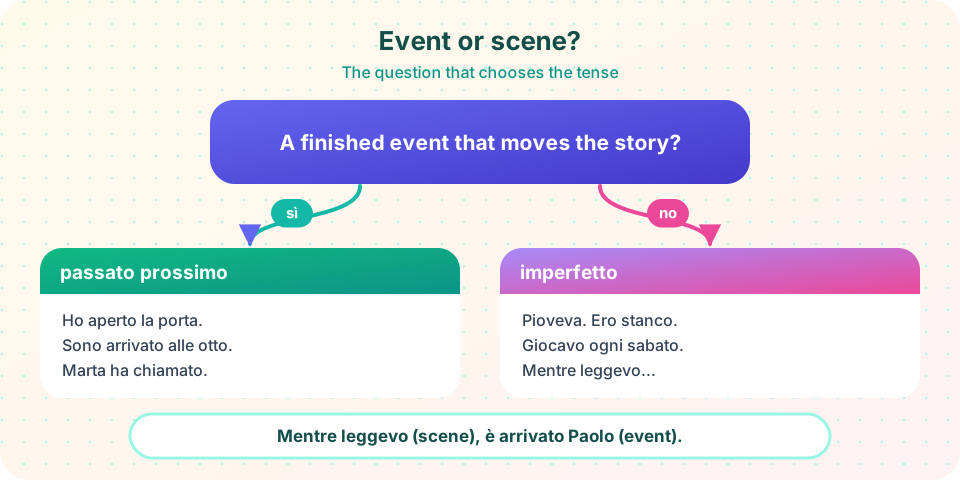
Ask three quick questions about the verb you want to put into the past:
- Did it happen once, and is it finished? Ho comprato un libro. → passato prossimo.
- Does it describe how things were (weather, age, mood, appearance, time of day)? Era sera. Faceva freddo. → imperfetto.
- Was it a repeated habit or in progress when something else happened? Ogni sabato andavo al mercato. / Leggevo quando è arrivato Paolo. → imperfetto.
Some quick pairs show the contrast:
| Passato prossimo (event) | Imperfetto (scene or habit) |
|---|---|
| Ieri ho mangiato una pizza. | Da bambino mangiavo sempre la pizza. |
| Sono uscito alle otto. | Erano le otto quando sono uscito. |
| Ho visto un film. | Vedevo un film quando hai chiamato. |
| Ieri ho lavorato tutto il giorno. | Lavoravo in un ufficio in centro. |
Combining the tenses
Many sentences have one of each, joined by quando or mentre:
- Mentre camminavo, ho visto un vecchio amico. While I was walking, I saw an old friend.
- Dormivo quando il telefono ha squillato. I was sleeping when the phone rang.
- Pioveva, quindi ho preso l'ombrello. It was raining, so I took an umbrella.
- Quando ero giovane, ho vissuto due anni a Parigi. When I was young, I lived two years in Paris. (State = ero; finished period = ho vissuto.)
Two events in a row that follow each other both use the passato prossimo: Sono entrato, ho salutato tutti e mi sono seduto. The second verb does not become an imperfetto just because it follows another verb; each action advances the story.
Verbs whose meaning changes
With a few verbs of knowledge and will, the tense shifts the meaning, because a state of mind is different from a moment of change:
| Verb | Imperfetto (state) | Passato prossimo (moment) |
|---|---|---|
| conoscere | Conoscevo Marco. I knew Marco. | Ho conosciuto Marco. I met Marco (for the first time). |
| sapere | Sapevo la verità. I knew the truth. | Ho saputo la verità. I found out the truth. |
| volere | Volevo uscire. I wanted to go out. | Ho voluto uscire. I insisted on going out / I made up my mind. |
| avere | Avevo fame. I was hungry. | Ho avuto fame. I felt hungry (suddenly). |
You will hear the imperfetto much more often with these verbs, because mental states are usually background.
The trapassato prossimo: before the past
Sometimes you need to refer to something that happened before another past event. Italian uses the trapassato prossimo: the imperfetto of the helper verb plus the participle.
| Helper | Example | English |
|---|---|---|
| avevo, avevi, aveva, avevamo, avevate, avevano + participle | Avevo già mangiato quando sei arrivato. | I had already eaten when you arrived. |
| ero, eri, era, eravamo, eravate, erano + participle | Eravamo già partiti quando ha chiamato. | We had already left when he called. |
The choice of avere or essere follows the same rules as the passato prossimo, and the agreement with essere works the same way: Maria era già uscita (Maria had already gone out). Typical companions are già (already), ancora (yet) and prima (before).
A complete story
Read this short narrative. Look for the scene (imperfetto) and the events (passato prossimo).
Sabato scorso ero a casa e pioveva. Non avevo voglia di uscire, ma verso le sei ha chiamato Marta. Mi ha invitato a cena e io ho accettato. Sono uscito, ho preso l'autobus e sono arrivato al ristorante alle sette. Marta mi aspettava già. Aveva un vestito rosso e sembrava molto felice. Abbiamo mangiato, abbiamo parlato per ore e siamo tornati a casa tardi.
"Last Saturday I was at home and it was raining. I did not feel like going out, but around six Marta called. She invited me to dinner and I accepted. I went out, took the bus and arrived at the restaurant at seven. Marta was already waiting for me. She was wearing a red dress and seemed very happy. We ate, we talked for hours and we went home late."
Sort the verbs: ero, pioveva, avevo, aspettava, aveva, sembrava are the scene. Ha chiamato, ha invitato, ho accettato, sono uscito, ho preso, sono arrivato, abbiamo mangiato, abbiamo parlato, siamo tornati are events.
A routine for practicing the choice
The best exercise is retelling. Take any short story (a film plot, a news item, your last holiday) and tell it twice: first in two lines of pure events (passato prossimo only), then again, adding the scene (imperfetto): weather, feelings, time, people. For example: Sono arrivato in stazione. Ho comprato il biglietto. Ho preso il treno. Then: Erano le sette di mattina e faceva freddo. Ero stanco, ma contento. Sono arrivato in stazione... The first version is a skeleton; the second has flesh. Doing this for five minutes a day trains your intuition for both tenses much faster than isolated drills.
You can also check yourself by drawing the timeline from the chapter overview: the imperfetto verbs sit on the long band, the passato prossimo verbs are dots. If you cannot tell whether a verb belongs on the band or is a dot, ask the question Did it begin and end, and does it move the story forward?
Common misconceptions
"Use the imperfetto for long actions and the passato prossimo for short ones." The real test is the role in the story, not the length. Ho dormito dieci ore is a finished block; Dormivo sets a scene.
"Mentre always needs the imperfetto in both halves." Two simultaneous background actions both take the imperfetto (Mentre io cucinavo, lui leggeva), but a single interrupting event takes the passato prossimo.
"Trapassato is optional." It is often needed for clarity: Ho mangiato prima di uscire is fine, but Quando sei arrivato, avevo già mangiato is the natural way to say "I had already eaten".
Try it
Here is a small helper that scans a sentence for signal words and suggests a tense. It is a simulation of the rule of thumb in this lesson, not a real Italian parser, so treat its output as a hint and compare it with your own judgment.
Press Run (or Ctrl + Enter) to see the console output here.
No output.
Choose the right tense in context. Type just the verb form, using the passato prossimo or the imperfetto.
Check your understanding
Quick check · 5 questions
of 5 answered You scored / 5 · perfect!
-
1. Which sentence uses the correct tense? 'It was raining when I left.'
Background (pioveva) plus a completed event (sono uscito). -
2. What does 'Ho conosciuto Marco' mean?
Conoscere in the passato prossimo means to meet someone for the first time. -
3. How do you say 'I had already eaten'?
The trapassato prossimo: imperfetto of avere + participle. -
4. Which verb sets the scene?
Faceva freddo describes the weather: background, imperfetto. -
5. 'Mentre cucinavo, ha chiamato Anna.' Why is 'ha chiamato' in the passato prossimo?
The call is a completed event inside an ongoing action.
Summary
- Passato prossimo = events that happen and finish; imperfetto = scene, habit, description, ongoing action.
- Signal words help: ieri, due giorni fa, poi (event) versus sempre, di solito, mentre, da bambino (scene).
- Combine them: Mentre camminavo, ho visto... (scene + event).
- Conoscere, sapere and volere change meaning with the tense.
- The trapassato prossimo (avevo mangiato, ero partito) places an action before another past action.
Next: Chapter 6 review
Track your progress
Create a free account to tick off lessons and pick up where you left off on any device.
of Italian for Beginners lessons completed