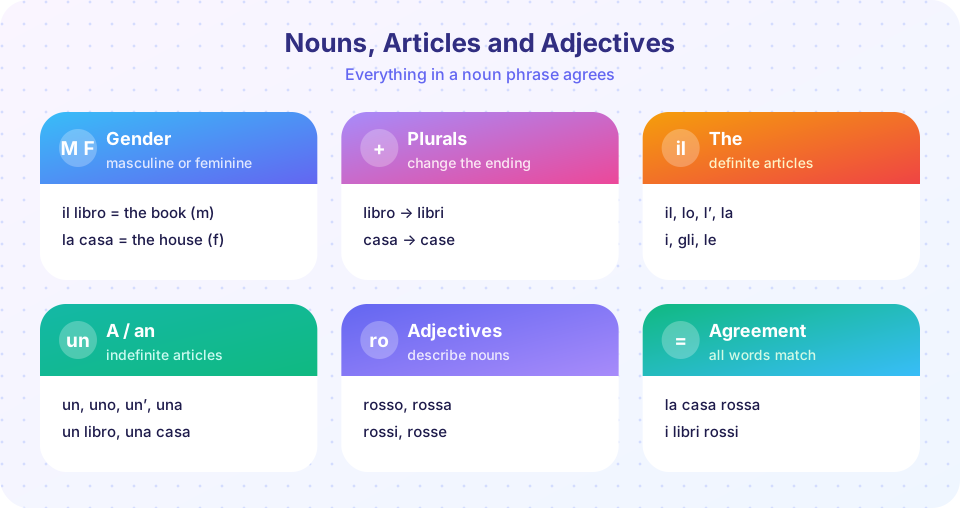
A map of Chapter 3: Italian noun gender, plurals, definite and indefinite articles, and adjectives that agree, with the key idea that every word in a noun phrase matches.
Nouns name things: a book, a house, a friend, an idea. In English a noun is simple: it has a singular and a plural, and the little word the never changes. Italian nouns work differently, and this chapter shows you how.
In Italian every noun has a gender (masculine or feminine), a number (singular or plural), and a small family of words around it, the articles and adjectives, that change their endings to match. This matching is called agreement. It is the single most important idea of the chapter, and once it clicks, a huge part of Italian grammar clicks with it.
Six ideas to master: gender, plurals, two kinds of article, adjectives and agreement.
Gender (genere): the grammatical class of a noun, masculine (maschile) or feminine (femminile). It is a grammar label, not always a matter of biology: a table is not "male".
Number (numero): singular (one) or plural (more than one).
Article (articolo): the small word before a noun: the (definite) or a/an (indefinite).
Agreement (concordanza): the matching of gender and number among a noun, its article and its adjectives.
Noun gender and plurals: how to tell masculine from feminine by the ending (-o and -a, -e, and the exceptions), how to make plurals (-i, -e), and the nouns that do not change or that are irregular.
Articles: the definite articles (il, lo, l', la, i, gli, le), the indefinite articles (un, uno, una, un'), how the first sound of the next word decides, and when Italian uses an article where English does not.
Adjectives and agreement: the two patterns (-o/-a and -e), where adjectives go in the sentence, colors, and the special adjectives bello and buono.
In English only the noun changes (book / books), and the red stays the same. In Italian every word changes: il / i, libro / libri, rosso / rossi. Agreement can feel like extra work at first, but it has a benefit: it makes sentences clear. When you hear le case rosse, three words tell you "plural feminine", so even if you miss one, the others tell you.
"Gender is about being male or female." For people it often is (il ragazzo, la ragazza), but for objects it is only a grammar category. A table is il tavolo (m.) and a chair is la sedia (f.), with no meaning behind it.
"I can learn the gender later." Learn it with every new noun, by always learning the article: la casa, not just casa. Fixing wrong gender habits later is harder.
"Agreement is too hard for beginners." It is a pattern with only a few endings (-o, -a, -i, -e). After a couple of lessons it becomes automatic.
Start with vocabulary: twelve common nouns, each with its article. Say the article and noun together.
Twelve nouns with articles
<style>*{box-sizing:border-box}body{margin:0;padding:14px;font-family:system-ui,'Segoe UI',Arial,sans-serif;background:linear-gradient(135deg,#faf5ff,#eff6ff);color:#1e1b4b}.wrap{max-width:640px;margin:0 auto}.card{background:#fff;border-radius:20px;box-shadow:0 10px 24px rgba(67,56,202,.15);padding:18px}.big{font-size:30px;font-weight:700;color:#312e81;text-align:center;min-height:44px;margin:14px 0 4px}.sub{font-size:16px;color:#64748b;text-align:center;min-height:22px}.row{display:flex;gap:8px;flex-wrap:wrap;justify-content:center;margin-top:14px}button{font:inherit;font-weight:600;border:0;border-radius:999px;padding:9px 16px;cursor:pointer;color:#fff;background:linear-gradient(135deg,#6366f1,#a78bfa)}button.alt{background:#eef2ff;color:#3730a3}button.ok{background:linear-gradient(135deg,#10b981,#14b8a6)}button:disabled{opacity:.5;cursor:default}.meta{font-size:14px;color:#6366f1;text-align:center;margin-bottom:4px}.opt{display:block;width:100%;text-align:left;margin:8px 0;background:#eef2ff;color:#1e1b4b;border-radius:14px;padding:11px 14px}.opt.good{background:#d1fae5;color:#064e3b}.opt.bad{background:#fee2e2;color:#7f1d1d}.fb{min-height:24px;margin-top:10px;font-weight:600;text-align:center}input[type=text]{font:inherit;width:100%;padding:11px 14px;border:2px solid #c7d2fe;border-radius:14px;margin-top:10px;background:#fff;color:#1e1b4b}table{border-collapse:collapse;width:100%;margin-top:10px}td,th{padding:8px 10px;text-align:left;border-bottom:1px solid #e0e7ff;font-size:16px}th{color:#4f46e5;font-size:14px;text-transform:uppercase;letter-spacing:.04em}.mt{margin-top:10px}</style><divclass="wrap"><divclass="card"><divclass="meta"id="meta"></div><divclass="big"id="front"></div><divclass="sub"id="back"></div><divclass="row"><buttonclass="alt"id="prev">Back</button><buttonid="flip">Show English</button><buttonid="next">Next</button></div><divclass="row"><buttonclass="alt"id="shuf">Shuffle</button><buttonclass="alt"id="say">Listen (if your browser can)</button><buttonclass="ok"id="got">I knew it</button></div><divclass="fb"id="fb"></div></div></div><script>constDATA=[["il libro","the book","eel LEE-bro"],["la casa","the house","lah KAH-zah"],["il ragazzo","the boy","eel rah-GAHT-tso"],["la ragazza","the girl","lah rah-GAHT-tsah"],["il tavolo","the table","eel TAH-vo-lo"],["la finestra","the window","lah fee-NEH-strah"],["l'amico","the friend (m.)","lah-MEE-ko"],["l'amica","the friend (f.)","lah-MEE-kah"],["il caffè","the coffee","eel kaf-FEH"],["la città","the city","lah cheet-TAH"],["il nome","the name","eel NOH-meh"],["la lezione","the lesson","lah leh-TSYOH-neh"]];let order=DATA.map((_,i)=>i),pos=0,shown=false,known=newSet();const$=id=>document.getElementById(id);functiondraw(){const c=DATA[order[pos]];$('meta').textContent='Card '+(pos+1)+' of '+DATA.length+' | known: '+known.size;$('front').textContent=c[0];$('back').textContent=shown?c[1]+(c[2]?' ('+c[2]+')':''):'';$('flip').textContent=shown?'Hide English':'Show English';}$('flip').onclick=()=>{shown=!shown;draw()};$('next').onclick=()=>{pos=(pos+1)%DATA.length;shown=false;$('fb').textContent='';draw()};$('prev').onclick=()=>{pos=(pos-1+DATA.length)%DATA.length;shown=false;$('fb').textContent='';draw()};$('shuf').onclick=()=>{for(let i=order.length-1;i>0;i--){const k=Math.floor(Math.random()*(i+1));[order[i],order[k]]=[order[k],order[i]];}pos=0;shown=false;draw()};$('got').onclick=()=>{known.add(order[pos]);$('fb').textContent=known.size===DATA.length?'You know them all. Bravo!':'Marked as known.';draw()};$('say').onclick=()=>{try{const u=newSpeechSynthesisUtterance(DATA[order[pos]][0]);u.lang='it-IT';speechSynthesis.cancel();speechSynthesis.speak(u);}catch(e){$('fb').textContent='Speech is not available in this preview.';}};draw();</script>
Now try the rule of thumb. Decide whether each noun is masculine or feminine from its ending, and see which ones are surprises.
Masculine or feminine?
<style>*{box-sizing:border-box}body{margin:0;padding:14px;font-family:system-ui,'Segoe UI',Arial,sans-serif;background:linear-gradient(135deg,#faf5ff,#eff6ff);color:#1e1b4b}.wrap{max-width:640px;margin:0 auto}.card{background:#fff;border-radius:20px;box-shadow:0 10px 24px rgba(67,56,202,.15);padding:18px}.big{font-size:30px;font-weight:700;color:#312e81;text-align:center;min-height:44px;margin:14px 0 4px}.sub{font-size:16px;color:#64748b;text-align:center;min-height:22px}.row{display:flex;gap:8px;flex-wrap:wrap;justify-content:center;margin-top:14px}button{font:inherit;font-weight:600;border:0;border-radius:999px;padding:9px 16px;cursor:pointer;color:#fff;background:linear-gradient(135deg,#6366f1,#a78bfa)}button.alt{background:#eef2ff;color:#3730a3}button.ok{background:linear-gradient(135deg,#10b981,#14b8a6)}button:disabled{opacity:.5;cursor:default}.meta{font-size:14px;color:#6366f1;text-align:center;margin-bottom:4px}.opt{display:block;width:100%;text-align:left;margin:8px 0;background:#eef2ff;color:#1e1b4b;border-radius:14px;padding:11px 14px}.opt.good{background:#d1fae5;color:#064e3b}.opt.bad{background:#fee2e2;color:#7f1d1d}.fb{min-height:24px;margin-top:10px;font-weight:600;text-align:center}input[type=text]{font:inherit;width:100%;padding:11px 14px;border:2px solid #c7d2fe;border-radius:14px;margin-top:10px;background:#fff;color:#1e1b4b}table{border-collapse:collapse;width:100%;margin-top:10px}td,th{padding:8px 10px;text-align:left;border-bottom:1px solid #e0e7ff;font-size:16px}th{color:#4f46e5;font-size:14px;text-transform:uppercase;letter-spacing:.04em}.mt{margin-top:10px}</style><divclass="wrap"><divclass="card"><divclass="meta"id="meta"></div><divid="q"style="font-size:19px;font-weight:700;margin:8px 0"></div><divid="opts"></div><divclass="fb"id="fb"></div><divclass="row"><buttonid="next"disabled>Next question</button></div></div></div><script>constITEMS=[{"q":"il ragazzo (boy): gender?","options":["masculine","feminine"],"a":0,"why":"Ends in -o, so masculine."},{"q":"la finestra (window): gender?","options":["masculine","feminine"],"a":1,"why":"Ends in -a, so feminine."},{"q":"il nome (name): gender?","options":["masculine","feminine"],"a":0,"why":"Nouns in -e can be either. Nome is masculine: il nome."},{"q":"la lezione (lesson): gender?","options":["masculine","feminine"],"a":1,"why":"Nouns in -zione are feminine: la lezione."},{"q":"il problema (problem): gender?","options":["masculine","feminine"],"a":0,"why":"A surprise: problema ends in -a but is masculine, as are many Greek-origin words ending in -ma."}];let i=0,score=0,done=false;const$=id=>document.getElementById(id);functionshow(){const it=ITEMS[i];done=false;$('meta').textContent='Question '+(i+1)+' of '+ITEMS.length+' | score: '+score;$('q').textContent=it.q;$('opts').innerHTML='';$('fb').textContent='';$('next').disabled=true;
it.options.forEach((o,k)=>{const b=document.createElement('button');b.className='opt';b.textContent=o;b.onclick=()=>pick(k,b);$('opts').appendChild(b);});}functionpick(k,b){if(done)return;done=true;const it=ITEMS[i];const bs=$('opts').children;if(k===it.a){score++;b.classList.add('good');$('fb').textContent='Correct! '+it.why;}else{b.classList.add('bad');bs[it.a].classList.add('good');$('fb').textContent='Not quite. '+it.why;}$('meta').textContent='Question '+(i+1)+' of '+ITEMS.length+' | score: '+score;$('next').disabled=false;$('next').textContent=i===ITEMS.length-1?'See result':'Next question';}$('next').onclick=()=>{if(i===ITEMS.length-1){$('q').textContent='Finished: '+score+' out of '+ITEMS.length;$('opts').innerHTML='';$('fb').textContent=score===ITEMS.length?'Perfetto!':'Try again to improve your score.';$('next').textContent='Start again';i=-1;score=0;$('next').onclick=()=>{$('next').onclick=null;location.reload();};return;}i++;show();};show();</script>