


















Lesson 37 of 50 · Future, Pronouns and Subjunctive Basics
Reflexive Verbs and the Daily Routine
Learn Italian reflexive verbs (mi lavo, ti alzi, si veste): present tense, passato prossimo with essere, reciprocal verbs, word order and a daily routine, with drills.
Reflexive verbs describe actions that you do to yourself: wash, get up, get dressed, sit down. In English we often leave the "myself" out (I wake up), but Italian says it with a small pronoun in front of the verb: Mi sveglio alle sette (literally "I wake myself at seven"). These verbs are everywhere in daily conversation, because so much of our day is made of them.
You recognise them in the dictionary by the ending -si: lavarsi, alzarsi, vestirsi, divertirsi. The ending -si is a reflexive pronoun attached to the infinitive. When you conjugate the verb, the pronoun moves in front and changes with the person. This lesson teaches the pattern and the vocabulary of a typical day.
What you will learn
- The reflexive pronouns mi, ti, si, ci, vi, si and how they change with the person.
- The vocabulary of a daily routine.
- How reflexive verbs form the passato prossimo (always with essere).
- How reciprocal verbs work (ci vediamo, si abbracciano) and where the pronoun goes with infinitives.
Key terms
Verbo riflessivo: a verb whose action returns to the subject: lavarsi (to wash oneself).
Pronome riflessivo: mi, ti, si, ci, vi, si, placed before the conjugated verb.
Verbo reciproco: a verb of mutual action: si salutano (they greet each other).
Routine quotidiana: daily routine.
The present tense
Conjugate the verb as usual, then add the reflexive pronoun before it.
| Person | Pronoun | lavarsi (to wash oneself) | alzarsi (to get up) |
|---|---|---|---|
| io | mi | mi lavo | mi alzo |
| tu | ti | ti lavi | ti alzi |
| lui / lei / Lei | si | si lava | si alza |
| noi | ci | ci laviamo | ci alziamo |
| voi | vi | vi lavate | vi alzate |
| loro | si | si lavano | si alzano |
Negation puts non before the pronoun: Non mi alzo presto la domenica. (I do not get up early on Sundays.) Questions use rising intonation: Ti alzi alle sette?
The vocabulary of a day
| Verb | Meaning | Example |
|---|---|---|
| svegliarsi | to wake up | Mi sveglio alle sei e mezza. |
| alzarsi | to get up | Mi alzo subito. |
| lavarsi | to wash | Mi lavo la faccia. |
| farsi la doccia | to take a shower | Mi faccio la doccia la mattina. |
| vestirsi | to get dressed | Mi vesto in fretta. |
| pettinarsi | to comb one's hair | Si pettina allo specchio. |
| sedersi | to sit down | Ci sediamo a tavola. |
| rilassarsi | to relax | Mi rilasso con un libro. |
| addormentarsi | to fall asleep | Mi addormento tardi. |
| divertirsi | to have fun | Ci divertiamo molto. |
Sedersi is irregular: mi siedo, ti siedi, si siede, ci sediamo, vi sedete, si siedono.
A body part takes the definite article, not a possessive, because the reflexive pronoun already shows whose it is: Mi lavo le mani. (I wash my hands.) Si lava i denti. (He brushes his teeth; literally, he washes his teeth.)
A day in Italian
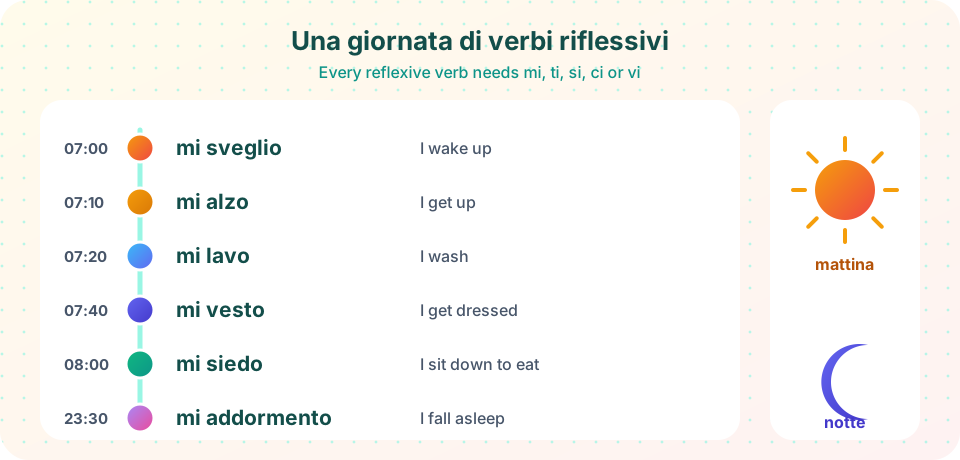
Mi sveglio alle sette e mi alzo subito. Mi lavo, mi vesto e faccio colazione con un caffè e un cornetto. Il pomeriggio mi rilasso un po'. La sera mi diverto con gli amici, e verso mezzanotte mi addormento.
"I wake up at seven and get up immediately. I wash, get dressed and have breakfast with a coffee and a croissant. In the afternoon I relax a little. In the evening I have fun with friends, and around midnight I fall asleep."
Passato prossimo: always essere
All reflexive verbs form the passato prossimo with essere. The participle agrees with the subject, just as in the previous chapter.
| Person | Masculine | Feminine |
|---|---|---|
| io | mi sono svegliato | mi sono svegliata |
| tu | ti sei svegliato | ti sei svegliata |
| lui / lei | si è svegliato | si è svegliata |
| noi | ci siamo svegliati | ci siamo svegliate |
| voi | vi siete svegliati | vi siete svegliate |
| loro | si sono svegliati | si sono svegliate |
Examples: Stamattina mi sono alzata alle sei. (A woman speaking.) Ieri ci siamo divertiti molto. Non si è lavato. The imperfetto is regular: Da bambino mi svegliavo alle sette.
Reciprocal verbs
Plural reflexive pronouns can also mean "each other". These are reciprocal verbs: Ci vediamo domani. (We will see each other tomorrow.) Si salutano ogni mattina. (They greet each other every morning.) Ci siamo incontrati al bar. (We met each other at the bar.) Vi telefonate spesso? (Do you call each other often?)
The phrase Ci vediamo! ("See you!") is one of the most common ways to say goodbye among friends. Another is Ci sentiamo ("We will talk", by phone).
Reflexive pronouns with infinitives and modals
When a reflexive verb is in the infinitive after volere, potere, dovere or after a preposition, the pronoun attaches to the infinitive (its -re ending remains, losing the final -e: alzar-mi). The pronoun changes to match the subject.
- Voglio alzarmi presto. (or Mi voglio alzare presto.) I want to get up early.
- Devi riposarti. (or Ti devi riposare.) You need to rest.
- Prima di uscire, mi lavo. Before going out, I wash.
- Vado a letto senza lavarmi i denti. I go to bed without brushing my teeth.
Many verbs change meaning when they are reflexive:
| Non-reflexive | Reflexive |
|---|---|
| chiamare (to call) | chiamarsi (to be called): Mi chiamo Luca. |
| sentire (to hear) | sentirsi (to feel): Mi sento bene. |
| fermare (to stop something) | fermarsi (to stop oneself): Mi fermo qui. |
| trovare (to find) | trovarsi (to be located / to feel): Ci troviamo bene qui. |
Reflexive and non-reflexive pairs
Many verbs exist in both a plain and a reflexive version, and the difference is who receives the action. Compare Lavo la macchina (I wash the car) with Mi lavo (I wash myself), or Sveglio il bambino (I wake the child up) with Mi sveglio (I wake up). When the action is done to someone else or to a thing, the verb is not reflexive. When you do it to yourself, you add the pronoun. This is also why Mi vesto means "I get dressed" but Vesto il bambino means "I dress the child".
A preview of the reflexive imperative
When you tell someone to do a reflexive action, the pronoun attaches to the end of the informal command: Alzati! (Get up!), Siediti! (Sit down!), Svegliatevi! (Wake up, all of you!). With the formal Lei the pronoun stays in front: Si accomodi! (Make yourself comfortable! / Please come in). These forms are very common in everyday life, and you will learn the imperative properly in later study.
Common misconceptions
"Reflexive verbs take avere in the passato prossimo." They always take essere: mi sono lavato, never ho lavato me.
"The pronoun follows the verb like in English." It comes before: si lava, not lava si. The only exception is the infinitive, where it attaches at the end.
"Mi chiamo means 'I call'." Chiamarsi means "to be called": Mi chiamo Sara = "My name is Sara".
Try it
This conjugator forms the present and the passato prossimo of reflexive verbs. It is a rule-based model that handles regular verbs; sedersi is added as an irregular example.
Press Run (or Ctrl + Enter) to see the result here.
Program input · what you'd type while the program runs
Type the answers before you press Run, one per line. Each time the program reads a line (with input()), it gets the next line from this box.
Fill in the reflexive pronoun or form. Note the apostrophes and accents.
A matching game: reflexive verb and its meaning.
Check your understanding
Quick check · 5 questions
of 5 answered You scored / 5 · perfect!
-
1. What does 'Mi chiamo Luca' mean?
Chiamarsi means to be called: Mi chiamo Luca = My name is Luca. -
2. Which auxiliary do reflexive verbs take in the passato prossimo?
All reflexive verbs use essere: mi sono lavato. -
3. A woman says 'Stamattina ___ alzata alle sei.'
Mi sono alzata: reflexive pronoun + sono + agreeing participle. -
4. How do you say 'I want to get up early'?
The pronoun attaches to the infinitive: alzarmi. (Mi voglio alzare presto is also correct.) -
5. What does 'Ci vediamo domani' express?
The plural reflexive pronoun ci can mean each other (reciprocal).
Summary
- Reflexive verbs end in -si in the infinitive; conjugate the verb and put mi, ti, si, ci, vi, si before it.
- A daily routine uses svegliarsi, alzarsi, lavarsi, vestirsi, addormentarsi; sedersi is irregular (mi siedo).
- The passato prossimo always uses essere, with the participle agreeing: mi sono alzata.
- Plural forms can be reciprocal: ci vediamo, si salutano.
- With infinitives the pronoun attaches: voglio alzarmi (or mi voglio alzare).
Track your progress
Create a free account to tick off lessons and pick up where you left off on any device.
of Italian for Beginners lessons completed