


















Lesson 35 of 50 · Future, Pronouns and Subjunctive Basics
The Future and the Conditional
Learn the Italian futuro semplice and condizionale: regular endings, irregular stems like sarò and vorrei, spelling changes, plans, probability and polite requests.
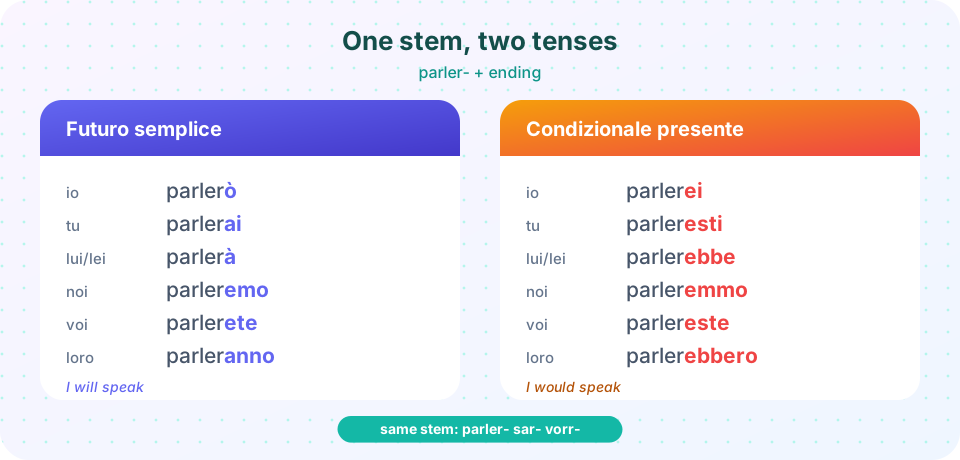
Plans, predictions and polite requests all rely on two related tenses: the futuro semplice (the simple future) and the condizionale presente (the present conditional). They share the same stem, built from the infinitive, and differ only in their endings. If you know how to make one, you are most of the way to the other.
Italians also use the present tense for the near future (Domani vado a Roma), so the future is not always necessary in conversation. But you will hear and read it constantly, and it has a special extra job: expressing probability (Sarà in ritardo, "He is probably late"). The conditional is essential for being polite: Vorrei, Potrei, Mi piacerebbe.
What you will learn
- How to form the futuro semplice of regular verbs and the spelling changes.
- The most common irregular future stems.
- How to use the future for plans, predictions and probability.
- How to form and use the conditional for polite requests and wishes.
Key terms
Futuro semplice: the simple future (parlerò).
Radice del futuro (future stem): the infinitive minus the final -e, with -are changing to -er-.
Condizionale presente: the "would" tense (parlerei).
Futuro di probabilità: the future used to guess about the present (Saranno le tre).
Forming the future
Take the infinitive, drop the final -e, and for -are verbs change the a to e. Then add the endings: -ò, -ai, -à, -emo, -ete, -anno.
| Person | parlare | vendere | dormire |
|---|---|---|---|
| io | parlerò | venderò | dormirò |
| tu | parlerai | venderai | dormirai |
| lui / lei | parlerà | venderà | dormirà |
| noi | parleremo | venderemo | dormiremo |
| voi | parlerete | venderete | dormirete |
| loro | parleranno | venderanno | dormiranno |
Notice the accents: -ò and -à are written, and the stress falls on that final syllable (parlerò = par-le-RÒ). The written accent is a clear signal of the future: parlerà (he will speak) versus parla (he speaks).
Spelling changes
To keep the hard or soft sound of the stem, some verbs change their spelling:
- Verbs in -care and -gare add an h: cercare → cercherò, pagare → pagherò, dimenticare → dimenticherò.
- Verbs in -ciare and -giare drop the i: cominciare → comincerò, mangiare → mangerò, viaggiare → viaggerò.
Irregular stems
Many common verbs lose a vowel in the stem. The endings stay the same. Memorize these:
| Verb | Future stem | io form | Meaning |
|---|---|---|---|
| essere | sar- | sarò | I will be |
| avere | avr- | avrò | I will have |
| andare | andr- | andrò | I will go |
| fare | far- | farò | I will do |
| dare / stare | dar- / star- | darò / starò | I will give / stay |
| venire | verr- | verrò | I will come |
| potere | potr- | potrò | I will be able |
| dovere | dovr- | dovrò | I will have to |
| volere | vorr- | vorrò | I will want |
| sapere | sapr- | saprò | I will know |
| vedere | vedr- | vedrò | I will see |
| bere | berr- | berrò | I will drink |
| vivere | vivr- | vivrò | I will live |
Using the future
Plans and predictions:
- Domani andrò al mare con gli amici. Tomorrow I will go to the beach with my friends.
- L'anno prossimo studierò a Bologna. Next year I will study in Bologna.
- Tra due giorni sarò a Roma. In two days I will be in Rome.
- Pioverà tutto il fine settimana. It will rain all weekend.
Common time words: domani, dopodomani, stasera, la settimana prossima, l'anno prossimo, tra/fra una settimana (in a week).
After quando, appena and se: Italian uses the future after quando and appena when the main verb is future: Quando arriverò, ti chiamerò (When I arrive, I will call you). English uses the present here, so this is a trap for learners. After se (if), Italian usually uses the present: Se piove, resto a casa.
Probability about the present: the future can mean "probably":
- Che ore sono? Saranno le tre. What time is it? It must be about three.
- Dov'è Marco? Sarà a casa. Where is Marco? He is probably at home.
- Avrà trent'anni. He is probably thirty.
The near future with the present tense: Domani vado a Roma is perfectly normal. Use stare per + infinitive for "about to": Sto per uscire (I am about to go out).
The conditional
The conditional uses the same stem as the future with these endings: -ei, -esti, -ebbe, -emmo, -este, -ebbero.
| Person | parlare | essere | volere |
|---|---|---|---|
| io | parlerei | sarei | vorrei |
| tu | parleresti | saresti | vorresti |
| lui / lei | parlerebbe | sarebbe | vorrebbe |
| noi | parleremmo | saremmo | vorremmo |
| voi | parlereste | sareste | vorreste |
| loro | parlerebbero | sarebbero | vorrebbero |
Use it for:
- Polite requests: Vorrei un caffè. (I would like a coffee.) Potrei avere il conto? (Could I have the bill?) Mi daresti una mano? (Would you give me a hand?)
- Wishes: Mi piacerebbe visitare la Sicilia. (I would like to visit Sicily.) Vivrei volentieri in Italia. (I would gladly live in Italy.)
- Advice and obligation: Dovresti dormire di più. (You should sleep more.) Dovremmo partire presto. (We should leave early.)
- Reported or uncertain information: Secondo il giornale, il presidente arriverebbe domani. (According to the paper, the president would arrive tomorrow.)
Cliente: Buongiorno, vorrei prenotare una camera per due notti. Receptionist: Certo. Quando arriverete? Cliente: Arriveremo venerdì sera. Potreste darci una camera tranquilla? Receptionist: Sì, vedrò che cosa posso fare.
"Good morning, I would like to book a room for two nights." "Of course. When will you arrive?" "We will arrive on Friday evening. Could you give us a quiet room?" "Yes, I will see what I can do."
Tips for remembering the irregular stems
The irregular future stems look like a long list, but most follow a few patterns. Verbs that lose the vowel before the ending (andare → andr-, avere → avr-, potere → potr-, dovere → dovr-, sapere → sapr-, vedere → vedr-, vivere → vivr-) simply compress the infinitive. Verbs that double the r (venire → verr-, volere → vorr-, bere → berr-, rimanere → rimarr-) are the second family. A third group is essere → sar-, fare → far-, dare → dar- and stare → star-, where the a of the infinitive does not change to e.
Practice by writing a plan for next week: Lunedì andrò in palestra. Martedì avrò una riunione. Mercoledì verrò da te. Giovedì farò la spesa. Four sentences use four irregular stems, and the repetition helps them stick. For if sentences, remember that Italian prefers the present after se in everyday speech: Se piove, resto a casa ("If it rains, I stay home").
Common misconceptions
"The future is required for every future event." Italians often say Domani parto with the present. The future is used for more distant, planned or uncertain events, and for probability.
"After 'when', Italian uses the present like English." It does not: Quando arriverò (future). Use the future after quando if both actions lie ahead.
"Vorrei and voglio are the same." Voglio is a direct "I want"; vorrei is the polite "I would like". Use vorrei in shops and restaurants.
Try it
This conjugator builds the future and conditional from the infinitive, including spelling changes and irregular stems. It is a rule-based model covering the verbs of this lesson.
Press Run (or Ctrl + Enter) to see the result here.
Program input · what you'd type while the program runs
Type the answers before you press Run, one per line. Each time the program reads a line (with input()), it gets the next line from this box.
Fill in the correct form. Check the accent on the future: parlerò, andrà.
Match the verb to its irregular future stem.
Check your understanding
Quick check · 5 questions
of 5 answered You scored / 5 · perfect!
-
1. What is the future of 'io' + 'parlare'?
-are verbs change a to e in the future stem and need the accent on the final -ò. -
2. How do you write 'I will search' (cercare)?
Verbs in -care add h to keep the hard c sound: cercherò. -
3. What does 'Saranno le tre' mean?
The future can express probability: 'It must be about three'. -
4. Which is the most polite way to ask for a table?
The conditional vorrei is the polite 'I would like'. -
5. What is the conditional of 'tu' + 'dovere'?
Dovere has the stem dovr- and the conditional ending -esti: dovresti.
Summary
- Future endings -ò, -ai, -à, -emo, -ete, -anno go on the infinitive stem; -are verbs change a to e (parlerò).
- Spelling changes: cercare → cercherò, mangiare → mangerò.
- Irregular stems: sarò, avrò, andrò, farò, verrò, potrò, dovrò, vorrò, saprò, vedrò, berrò.
- The future covers plans, predictions and probability; after quando and appena Italian uses the future.
- The conditional (-ei, -esti, -ebbe, -emmo, -este, -ebbero) is for polite requests, wishes and advice.
Next: Object pronouns
Track your progress
Create a free account to tick off lessons and pick up where you left off on any device.
of Italian for Beginners lessons completed