


















Lesson 36 of 50 · Future, Pronouns and Subjunctive Basics
Object Pronouns: Lo, La, Mi, Gli and More
Learn Italian direct and indirect object pronouns (lo, la, li, le, mi, ti, gli), where they go, how they agree in the passato prossimo, and combined pronouns.
Imagine telling a story without ever saying "it", "him" or "them": "I bought the book. I read the book. I gave the book to Marco. Marco liked the book." It sounds robotic. Pronouns let you replace a noun that you have already mentioned. Italian has two main families of object pronouns: direct (answering "whom or what?") and indirect (answering "to whom?").
Italian pronouns are small words, and they sit in surprising places: before the verb, not after it. This is probably the most characteristic feature of Italian sentence structure, and it takes practice. The good news is that the rules are regular, and you will meet the same few words again and again.
What you will learn
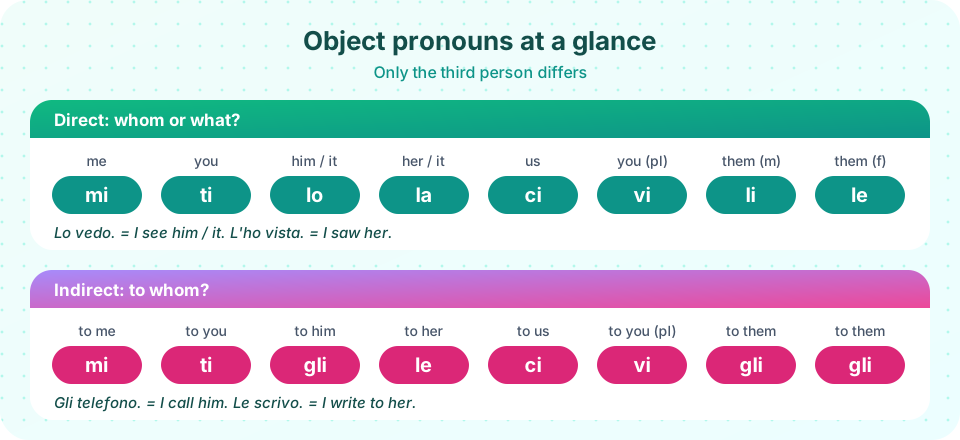
- The direct pronouns mi, ti, lo, la, ci, vi, li, le and the indirect pronouns mi, ti, gli, le, ci, vi, gli.
- Where the pronoun goes: before the verb, or attached to an infinitive.
- How lo, la, li, le make the participle agree in the passato prossimo.
- How to combine two pronouns (me lo, glielo) and use stressed pronouns after prepositions.
Key terms
Complemento oggetto: the direct object, what receives the action (Vedo Marco).
Complemento di termine: the indirect object, the person "to" or "for" whom (Telefono a Marco).
Pronome tonico (stressed pronoun): me, te, lui, lei, noi, voi, loro, used after prepositions.
Pronome combinato: two pronouns joined: me lo, te la, glielo.
Direct object pronouns
| English | Italian | Example |
|---|---|---|
| me | mi | Marco mi vede. Marco sees me. |
| you (singular) | ti | Ti vedo. I see you. |
| him, it (m.) | lo | Lo vedo. I see him / it. |
| her, it (f.) | la | La vedo. I see her / it. |
| us | ci | Ci chiamano. They call us. |
| you (plural) | vi | Vi aspetto. I am waiting for you. |
| them (m.) | li | Li compro. I buy them. |
| them (f.) | le | Le compro. I buy them. |
The formal "you" (Lei) uses La: La ringrazio. (I thank you.)
Where the pronoun goes. In a simple tense the pronoun comes right before the verb:
- Leggo il libro. → Lo leggo. I read the book. → I read it.
- Non lo leggo. I do not read it. (non comes first.)
- Chi ti chiama? Who is calling you?
With an infinitive, the pronoun attaches to the end of the infinitive, which drops its final -e:
- Voglio vedere il film → Voglio vederlo. I want to see it.
- Devo chiamare Anna → Devo chiamarla. I have to call her.
With modal verbs (volere, potere, dovere) you may also put the pronoun before the whole verb: Lo voglio vedere. La devo chiamare. Both orders are correct.
Elision. Lo and la become l' before a vowel or h: L'ho visto. (I saw him/it.) L'ho chiamata. (I called her.) Li and le never elide.
Pronouns in the passato prossimo
With lo, la, li, le placed before the verb, the past participle agrees with the pronoun in gender and number:
| Sentence with noun | With pronoun |
|---|---|
| Ho visto Marco. | **L'**ho visto. |
| Ho visto Maria. | L'ho vista. |
| Ho comprato i libri. | Li ho comprati. |
| Ho mangiato le mele. | Le ho mangiate. |
With mi, ti, ci, vi the agreement is optional in everyday speech: Maria mi ha chiamato / chiamata are both heard.
Indirect object pronouns
| English | Italian | Example |
|---|---|---|
| to me | mi | Mi telefona. He calls me. |
| to you | ti | Ti scrivo. I write to you. |
| to him | gli | Gli parlo. I speak to him. |
| to her | le | Le dico la verità. I tell her the truth. |
| to us | ci | Ci dà un consiglio. He gives us advice. |
| to you (pl.) | vi | Vi rispondo domani. I will answer you tomorrow. |
| to them | gli | Gli scrivo una email. I write them an email. |
The formal singular is Le: Le telefono domani, signora. (I will call you tomorrow, madam.)
The indirect pronoun answers "to whom?" with verbs that take a: telefonare a, scrivere a, parlare a, dire a, dare a, rispondere a, chiedere a, regalare a, piacere a. Note that telefonare and rispondere take an indirect pronoun in Italian even where English uses a direct object (I call him = Gli telefono).
The most important example is piacere (to please): Mi piace il caffè means "I like coffee", literally "coffee is pleasing to me". Ti piacciono i gatti? means "Do you like cats?". The thing liked is the subject, and the person who likes is the indirect object: mi, ti, gli, le, ci, vi, gli.
In the passato prossimo, indirect pronouns do not change the participle: Gli ho scritto. Le ho telefonato.
Combined pronouns
When an indirect and a direct pronoun meet, the indirect comes first and changes: mi → me, ti → te, ci → ce, vi → ve, and gli/le → glie-, written together with the direct pronoun.
| Combination | Example | English |
|---|---|---|
| me lo / me la | Me lo dai? | Will you give it to me? |
| te lo / te la | Te la spiego. | I will explain it to you. |
| glielo / gliela | Glielo dico domani. | I will tell it to him/her tomorrow. |
| ce lo / ve lo | Ve lo mando stasera. | I will send it to you (pl.) tonight. |
Stressed pronouns after prepositions
After a preposition use the stressed forms: me, te, lui, lei, Lei, noi, voi, loro.
- Vieni con me? Are you coming with me?
- Questo regalo è per te. This gift is for you.
- Parlo di lui. I am talking about him.
- Esco con loro. I am going out with them.
Two useful extras: ci and ne
Ci replaces a place: Vai a Roma? Sì, ci vado domani. (Are you going to Rome? Yes, I am going there tomorrow.) Ne replaces "of it/of them", especially with quantities: Hai fratelli? Sì, ne ho due. (Do you have siblings? Yes, I have two.) Quanti caffè bevi? Ne bevo tre. (How many coffees do you drink? I drink three.)
A short dialogue
Paolo: Hai comprato il pane? Lucia: Sì, l'ho comprato. E ho preso anche le olive. Le vuoi? Paolo: Sì, le mangio volentieri. Hai chiamato Anna? Lucia: Le ho telefonato stamattina. Viene con noi stasera.
"Did you buy the bread?" "Yes, I bought it. And I also got the olives. Do you want them?" "Yes, I will gladly eat them. Did you call Anna?" "I phoned her this morning. She is coming with us tonight."
Common misconceptions
"Pronouns follow the verb like in English." In Italian they come before a conjugated verb: Lo vedo, not Vedo lo.
"Gli means only 'to him'." It also means "to them" in everyday Italian, although loro (after the verb) exists in formal writing.
"La is only for 'her'." La also means "it" (a feminine thing) and, with a capital, the formal "you".
Try it
This tool replaces a noun phrase with the right direct pronoun and agrees the participle. It is a rule-based demonstration of the pattern in the table above, for verbs with regular -o participles.
Press Run (or Ctrl + Enter) to see the result here.
Program input · what you'd type while the program runs
Type the answers before you press Run, one per line. Each time the program reads a line (with input()), it gets the next line from this box.
Choose the right pronoun. Remember elision: l'ho and the participle agreement.
Match the pronoun to its meaning.
Check your understanding
Quick check · 5 questions
of 5 answered You scored / 5 · perfect!
-
1. Which sentence is correct for 'I see it' (il libro)?
A direct object pronoun comes before the conjugated verb: Lo vedo. -
2. Replace the noun: 'Ho mangiato le mele.'
Le agrees with the feminine plural noun, and the participle becomes mangiate. -
3. What does 'Le telefono domani' mean (to a woman you know)?
Le is the indirect pronoun 'to her': I will phone her. -
4. How do you attach a pronoun to 'chiamare' in 'I have to call her'?
The pronoun attaches to the infinitive and the final -e drops: chiamarla. -
5. What is 'me lo' made of?
Mi changes to me before lo: me lo dai? (will you give it to me?).
Summary
- Direct pronouns: mi, ti, lo, la, ci, vi, li, le; indirect: mi, ti, gli, le, ci, vi, gli.
- Pronouns go before the conjugated verb or attach to an infinitive (Voglio vederlo).
- Lo/la elide to l'; in the passato prossimo the participle agrees with lo, la, li, le.
- Combined pronouns: me lo, te la, glielo, ce lo, ve lo.
- After prepositions use me, te, lui, lei, noi, voi, loro; ci means "there" and ne means "of it/them".
Next: Reflexive verbs
Track your progress
Create a free account to tick off lessons and pick up where you left off on any device.
of Italian for Beginners lessons completed