Count in Italian from 0 to a million, tell the time with che ore sono, and say days, months and dates correctly. Examples, a converter and drills.
Numbers are the second great key to daily Italian. You need them for prices, phone numbers, addresses, train times and dates. Italian numbers are regular once you see the pattern, and telling the time works differently from English in a few charming ways. Italians say "the hours are three" instead of "it is three o'clock", and they often switch to a 24-hour clock for timetables.
This lesson takes you from zero to a million, then through the clock, the days of the week, the months and the way dates are written and spoken.
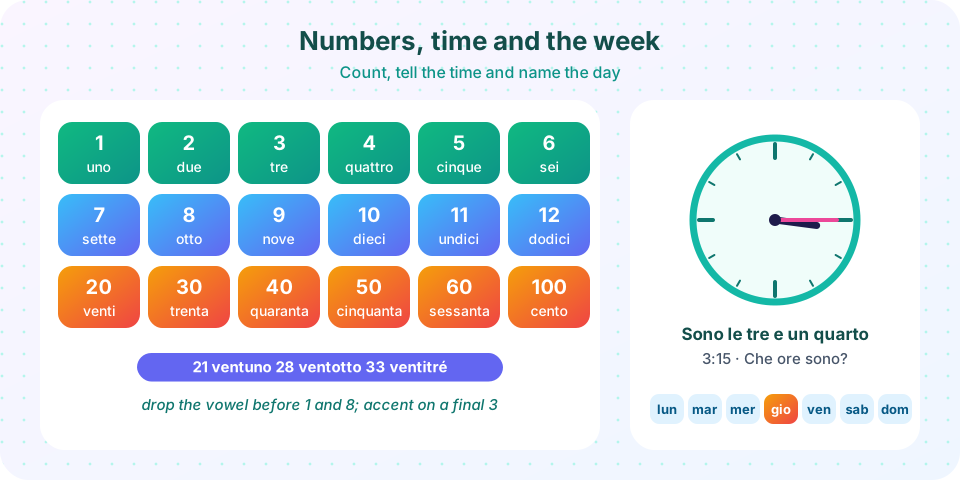
From uno to cento: the numbers 0-20 are learned by heart, the tens follow a pattern, and a clock and a week complete the picture.
These have to be memorized. Say them aloud as you read.
0 zero
1 uno
2 due
3 tre
4 quattro
5 cinque
6 sei
7 sette
8 otto
9 nove
10 dieci
11 undici
12 dodici
13 tredici
14 quattordici
15 quindici
16 sedici
17 diciassette
18 diciotto
19 diciannove
20 venti
Notice that 17, 18 and 19 start with dici- ("ten and ...") and that 11 to 16 end in -dici. The word uno behaves like the article un/una: un caffè, una pizza, uno studente.
To build 21 to 99, add the unit directly to the ten: venti + due = ventidue, trenta + cinque = trentacinque. There are two rules to remember:
Vowel drop with 1 and 8. The ten loses its last vowel before uno and otto: ventuno, ventotto, trentuno, trentotto, novantuno, novantotto.
Accent on a final 3. Compound numbers that end in 3 take an acute accent: ventitré, trentatré, centotré. The plain number is tre with no accent.
Hundreds and thousands are written as one word: centodieci (110), duecento (200), trecentocinquanta (350), novecentonovantanove (999). Thousands use mille in the singular and mila in the plural: mille (1,000), duemila (2,000), diecimila (10,000), centomila (100,000). A million is un milione (1,000,000) and two million is due milioni, always followed by di before a noun: un milione di euro.
Italian writes numbers differently from English in two ways: it uses a comma for decimals and a dot for thousands. So 1,250.50 in English is 1.250,50 in Italian, and you say milleduecentocinquanta virgola cinquanta. Prices are spoken as due euro e cinquanta for €2,50.
Here are some phrases in which you will use numbers every day:
Ho trentacinque anni. I am thirty-five years old.
Il mio numero è tre-tre-quattro, uno-due-tre, quattro-cinque-sei. My number is 334 123 456. (Mobile numbers are often read in single digits or pairs.)
To ask the time, say Che ore sono? or Che ora è? The answer uses the plural sono le with the hour, except for one o'clock, noon and midnight, which are singular:
Time
Italian
1:00
È l'una.
2:00
Sono le due.
3:15
Sono le tre e un quarto. (or e quindici)
4:30
Sono le quattro e mezza. (or e trenta)
5:45
Sono le sei meno un quarto. (a quarter to six)
6:50
Sono le sette meno dieci. (ten to seven)
12:00
È mezzogiorno.
00:00
È mezzanotte.
Minutes after the hour use e (le otto e venti = 8:20). For the second half of the hour Italians prefer meno (minus): le nove meno venticinque is 8:35. To say at a time, use a with the article: alle otto, **all'**una, a mezzogiorno. So: A che ora parte il treno? Alle otto e venti.
To say whether it is morning or evening, add di mattina, del pomeriggio, di sera or di notte: le tre del pomeriggio (3 p.m.). Timetables, cinema listings and trains use the 24-hour clock instead: alle diciotto e trenta means 18:30, i.e. 6:30 p.m., and alle venti means 8 p.m.
Days from Monday to Friday carry a grave accent on the final ì. Use the bare day name for "this coming ...": Sabato vado al mare (This Saturday I am going to the beach). Put il or la before the day for something that happens every week: Il sabato vado al mare (On Saturdays I go to the beach), La domenica mangiamo dai nonni (On Sundays we eat at the grandparents').
The months are also lowercase: gennaio, febbraio, marzo, aprile, maggio, giugno, luglio, agosto, settembre, ottobre, novembre, dicembre. The seasons are la primavera (spring), l'estate (summer, feminine), l'autunno (autumn) and l'inverno (winter).
To say a date use il + number + month: Oggi è il quattordici novembre. The only exception is the first of the month, which takes the ordinal: il primo maggio (1 May). Dates are written day first: 14/11/2026. Two public holidays make good memory hooks: il venticinque aprile (25 April, Liberation Day) and il due giugno (2 June, Republic Day).
Giulia: Che giorno è oggi?
Marco: È giovedì, il dodici giugno.
Giulia: E a che ora comincia la lezione?
Marco: Alle quattordici e trenta, cioè alle due e mezza.
"What day is it today?" "It is Thursday, 12 June." "And at what time does the lesson start?" "At 14:30, that is half past two."
Use this converter to see how the pieces fit together. The code is a simulation of the spelling rules from this lesson; it handles whole numbers up to 999,999. Try your own numbers.
Python
Number to Italian words
units =["zero","uno","due","tre","quattro","cinque","sei","sette","otto","nove","dieci","undici","dodici","tredici","quattordici","quindici","sedici","diciassette","diciotto","diciannove"]
tens ={2:"venti",3:"trenta",4:"quaranta",5:"cinquanta",6:"sessanta",7:"settanta",8:"ottanta",9:"novanta"}defbelow100(n):if n <20:return units[n]
t, u =divmod(n,10)
word = tens[t]if u in(1,8):# vowel drop: ventuno, ventotto
word = word[:-1]if u:
word += units[u]return word
defbelow1000(n):
h, r =divmod(n,100)
out =""if h:
out ="cento"if h ==1else units[h]+"cento"if r:if h and80<= r <90:# centottanta
out = out[:-1]
out += below100(r)return out
defitalian(n):if n ==0:return"zero"if n <1000:
word = below1000(n)else:
th, r =divmod(n,1000)
head ="mille"if th ==1else below1000(th)+"mila"
word = head +(below1000(r)if r else"")if word.endswith("tre")and n >3:# accent on compound -tre
word = word[:-3]+"tré"return word
for n in[0,3,13,21,28,33,80,99,100,123,180,250,999,1000,2026,15000,100000]:print(f"{n:>7,}{italian(n)}")
Press Run (or Ctrl + Enter) to see the result here.
Program input · what you'd type while the program runs
Type the answers before you press Run, one per line. Each time the program reads a line (with input()), it gets the next line from this box.
Now drill the clock. Type the Italian for each time, using words (and watch the accents and the è l'una exception).
Time drill
<metacharset="utf-8"><style>*{box-sizing:border-box}body{margin:0;padding:14px;font:16px system-ui,-apple-system,'Segoe UI',sans-serif;color:#1e1b4b;background:linear-gradient(135deg,#f0fdfa,#ecfeff)}.card{background:#fff;border-radius:18px;padding:18px;box-shadow:0 10px 26px rgba(13,148,136,.18)}.n{color:#0d9488;font-size:14px;font-weight:600}.q{font-size:20px;margin:10px 0;min-height:30px}.h{color:#64748b;font-size:14px;min-height:20px}input{font:inherit;padding:8px 12px;border:2px solid #99f6e4;border-radius:12px;width:min(100%,22em)}button{font:inherit;font-weight:600;border:0;border-radius:12px;padding:9px 15px;color:#fff;background:linear-gradient(135deg,#14b8a6,#6366f1);cursor:pointer;margin:4px 4px 0 0}button.alt{background:linear-gradient(135deg,#f59e0b,#ef4444)}button.ghost{background:#e0f2fe;color:#075985}.ok{color:#047857;font-weight:600}.bad{color:#b91c1c;font-weight:600}.face{min-height:120px;display:flex;align-items:center;justify-content:center;text-align:center;font-size:30px;font-weight:700;border-radius:16px;background:linear-gradient(135deg,#ccfbf1,#e0e7ff);padding:14px;cursor:pointer;margin:10px 0}.note{color:#475569;font-size:15px;min-height:22px}.cols{display:grid;grid-template-columns:1fr 1fr;gap:10px}.cols button{display:block;width:100%;margin:0 0 8px;background:#f1f5f9;color:#1e1b4b;border:2px solid #cbd5e1;text-align:left}.cols button.sel{border-color:#6366f1;background:#e0e7ff}.cols button.done{border-color:#10b981;background:#d1fae5;color:#065f46}.cols button.wrong{border-color:#ef4444;background:#fee2e2}</style><divclass="card"><divclass="n"id="n"></div><divclass="q"id="q"></div><divclass="h"id="h"></div><inputid="a"autocomplete="off"autocapitalize="off"spellcheck="false"aria-label="Your answer"><buttonid="b">Check</button><pid="m"class="note"></p></div><script>const items=[["3:00 -> ___ le tre. (It is)","sono","Sono le tre."],["1:00 -> ___ l'una. (It is)","è","È l'una. (accent on the verb)"],["3:15 -> Sono le tre e un ___.","quarto","a quarter"],["4:30 -> Sono le quattro e ___.","mezza","half"],["5:45 -> Sono le sei ___ un quarto.","meno","minus"],["33 in words: trenta___","tré","accent on the final 3 in compounds"],["28 in words (one word)","ventotto","vowel drop"],["Day after martedì?","mercoledì","accent on the final i"]];let i=0,score=0,checked=false;const$=id=>document.getElementById(id);constnorm=s=>s.toLowerCase().replace(/[.,;!?]/g,"").replace(/[\u2018\u2019]/g,"'").replace(/\s+/g," ").trim();conststrip=s=>norm(s).normalize("NFD").replace(/[\u0300-\u036f]/g,"");functionrender(){const it=items[i];$("n").textContent="Question "+(i+1)+" of "+items.length+" - score "+score;$("q").textContent=it[0];$("h").textContent=it[2]?"Hint: "+it[2]:"";$("a").style.display="";$("a").value="";$("m").textContent="";$("m").className="note";$("b").textContent="Check";checked=false;$("a").focus();}functionact(){if(i>=items.length){i=0;score=0;render();return}if(checked){
i++;if(i>=items.length){$("n").textContent="";$("h").textContent="";$("q").textContent="Finished! Score: "+score+" / "+items.length;$("a").style.display="none";$("m").textContent="";$("b").textContent="Try again";return}render();return;}const opts=items[i][1].split("|"),g=norm($("a").value);if(!g){return}if(opts.some(o=>norm(o)===g)){score++;$("m").className="ok";$("m").textContent="Corretto! "+opts[0]}elseif(opts.some(o=>strip(o)===strip(g))){$("m").className="bad";$("m").textContent="Almost - watch the accent: "+opts[0]}else{$("m").className="bad";$("m").textContent="Not quite. Answer: "+opts.join(" / ")}$("n").textContent="Question "+(i+1)+" of "+items.length+" - score "+score;
checked=true;$("b").textContent="Next";}$("b").onclick=act;$("a").addEventListener("keydown",e=>{if(e.key==="Enter")act()});render();</script>
Finally, practice days and months with the matching game.
Days and months
<metacharset="utf-8"><style>*{box-sizing:border-box}body{margin:0;padding:14px;font:16px system-ui,-apple-system,'Segoe UI',sans-serif;color:#1e1b4b;background:linear-gradient(135deg,#f0fdfa,#ecfeff)}.card{background:#fff;border-radius:18px;padding:18px;box-shadow:0 10px 26px rgba(13,148,136,.18)}.n{color:#0d9488;font-size:14px;font-weight:600}.q{font-size:20px;margin:10px 0;min-height:30px}.h{color:#64748b;font-size:14px;min-height:20px}input{font:inherit;padding:8px 12px;border:2px solid #99f6e4;border-radius:12px;width:min(100%,22em)}button{font:inherit;font-weight:600;border:0;border-radius:12px;padding:9px 15px;color:#fff;background:linear-gradient(135deg,#14b8a6,#6366f1);cursor:pointer;margin:4px 4px 0 0}button.alt{background:linear-gradient(135deg,#f59e0b,#ef4444)}button.ghost{background:#e0f2fe;color:#075985}.ok{color:#047857;font-weight:600}.bad{color:#b91c1c;font-weight:600}.face{min-height:120px;display:flex;align-items:center;justify-content:center;text-align:center;font-size:30px;font-weight:700;border-radius:16px;background:linear-gradient(135deg,#ccfbf1,#e0e7ff);padding:14px;cursor:pointer;margin:10px 0}.note{color:#475569;font-size:15px;min-height:22px}.cols{display:grid;grid-template-columns:1fr 1fr;gap:10px}.cols button{display:block;width:100%;margin:0 0 8px;background:#f1f5f9;color:#1e1b4b;border:2px solid #cbd5e1;text-align:left}.cols button.sel{border-color:#6366f1;background:#e0e7ff}.cols button.done{border-color:#10b981;background:#d1fae5;color:#065f46}.cols button.wrong{border-color:#ef4444;background:#fee2e2}</style><divclass="card"><divclass="n"id="n">Pick an Italian item, then its English match.</div><divclass="cols"style="margin-top:10px"><divid="L"></div><divid="R"></div></div><pid="m"class="note"></p><buttonid="re"class="ghost">Shuffle again</button></div><script>const pairs=[["lunedì","Monday"],["giovedì","Thursday"],["domenica","Sunday"],["gennaio","January"],["agosto","August"],["settembre","September"],["l'estate","summer"],["l'inverno","winter"]];const$=id=>document.getElementById(id);let sel=null,found=0;constshuffle=a=>{a=a.slice();for(let k=a.length-1;k>0;k--){const j=Math.floor(Math.random()*(k+1));[a[k],a[j]]=[a[j],a[k]]}return a};functionbuild(){
sel=null;found=0;$("m").textContent="";$("L").innerHTML="";$("R").innerHTML="";
pairs.forEach((p,k)=>{const b=document.createElement("button");b.textContent=p[0];b.onclick=()=>pick(b,k,"L");$("L").appendChild(b)});shuffle(pairs.map((p,k)=>k)).forEach(k=>{const b=document.createElement("button");b.textContent=pairs[k][1];b.onclick=()=>pick(b,k,"R");$("R").appendChild(b)});}functionpick(b,k,side){if(b.classList.contains("done"))return;if(!sel||sel.side===side){if(sel)sel.b.classList.remove("sel");sel={b,k,side};b.classList.add("sel");return}const a=sel;sel=null;a.b.classList.remove("sel");if(a.k===k){a.b.classList.add("done");b.classList.add("done");found++;$("m").textContent=found===pairs.length?"Bravo! All pairs matched.":found+" of "+pairs.length+" matched."}else{a.b.classList.add("wrong");b.classList.add("wrong");setTimeout(()=>{a.b.classList.remove("wrong");b.classList.remove("wrong")},600);$("m").textContent="Not a pair - try again."}}$("re").onclick=build;build();</script>