


















Lesson 3 of 50 · Getting Started
How to learn Italian effectively
A practical routine for learning Italian: daily habits, spaced repetition, learning phrases, pronunciation from day one, and how to find speaking practice.
Most people who give up on a language do not fail because the language is too hard. They fail because their study plan is too big, too irregular or too boring. This lesson gives you a small, realistic routine, explains the ideas behind it, and shows you how to measure your progress. Used with the rest of the course, it will carry you through the whole beginner stage.
What you will learn
- How much study time a beginner needs and how to schedule it.
- Why short daily sessions beat one long weekly session.
- How spaced repetition works and how to use it with flashcards.
- Why you should learn phrases, say them aloud, and make mistakes early.
- Which survival phrases let you ask for help in Italian.
Key terms
Spaced repetition: reviewing material at growing intervals (1 day, 3 days, a week, and so on) just before you would forget it.
Chunk: a ready-made group of words learned as a unit, such as Come si dice...? (How do you say...?).
Input: Italian you read or hear. Output: Italian you speak or write. You need both.
Shadowing: repeating a speaker right after you hear them, copying rhythm and melody as well as words.
Think in minutes per day, not hours per month
The most reliable predictor of progress is regularity. A learner who studies twenty-five minutes every day will almost always beat one who studies for three hours on Sunday. Memory fades quickly when it is not used, and each short session pulls it back before the fade is complete.
How long will it take? That depends on your goals. The US Foreign Service Institute, which trains diplomats, estimates that English-speaking learners need something like 600 to 750 hours of class time to reach strong professional proficiency in a language like Italian (which it classes among the easier languages for English speakers). That is a long-term goal. You do not need anything like that to start enjoying the language: after the 100 hours or so of a serious beginner course you can handle everyday situations, introduce yourself, order food and have simple conversations.
Plan your own numbers in the first exercise below. Choose a time you will really keep (a commute, breakfast, a lunch break) and attach the study session to something you already do every day.
The daily loop
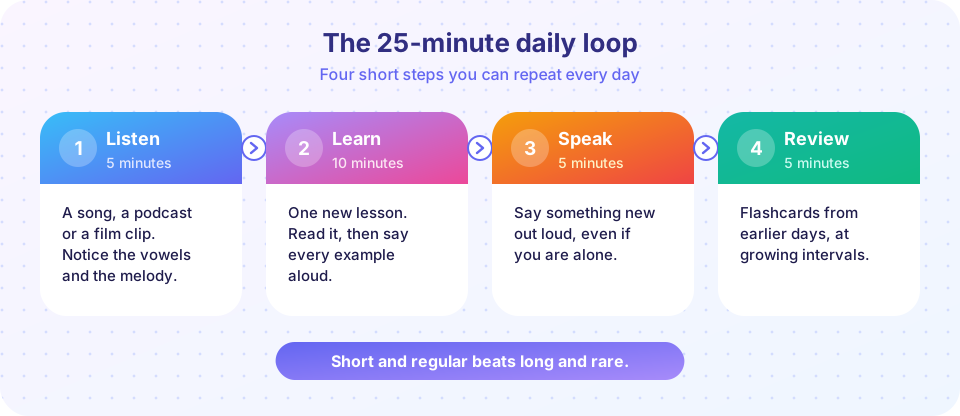
The picture above divides a twenty-five minute session into four parts. You can stretch or shorten it, but keep the order.
- Listen (5 minutes). Hear real Italian: a song, a short podcast for learners, a clip from a film with Italian subtitles. At first you will understand almost nothing, and that is fine. You are teaching your ear what Italian sounds like: the clear vowels, the double consonants and the melody.
- Learn (10 minutes). Study one new lesson, or one section of a lesson. Read the explanation, then say each example aloud.
- Speak (5 minutes). Use what you just learned to say something new, aloud, even if you are alone. Describe the room you are in. Say what you will do today. Answer the questions in a lesson as if someone were asking you.
- Review (5 minutes). Go over flashcards from earlier lessons. This is where spaced repetition comes in.
How spaced repetition works
In 1885 the German psychologist Hermann Ebbinghaus measured how fast people forget meaningless syllables, and found that forgetting is fastest right after learning and then slows down. Later researchers found the other side of the same coin, called the spacing effect: reviewing something just as you are about to forget it makes the memory last much longer than reviewing it again immediately.
You can use this idea with a simple schedule. After you first learn a word, review it after 1 day. If you remember it, wait 3 more days. Then a week, then two weeks, then a month. If you forget it, go back to the shortest interval. Flashcard programs automate this, but a paper box with a few compartments (the Leitner system) works just as well.
The second exercise below prints a review calendar for a word you learn on a given day. It is a model of the idea, not a rule: some people need shorter intervals and some longer.
Learn chunks, not isolated words
Beginners often memorize a list of single words and then discover that they cannot speak. The cure is to learn chunks: short, complete expressions that you can say without building them word by word. Mi chiamo Luca (My name is Luca), Vorrei un caffè (I would like a coffee), and Dov'è la stazione? (Where is the station?) are chunks. Once you know many chunks, grammar lessons feel like discovering the rules behind sentences you already use, which is far easier than the other way around.
When you learn a noun, always learn it with its article, because the article tells you the gender: write la casa (the house) and il libro (the book), not just casa and libro. You will see why in Chapter 3.
Pronunciation from day one
Italian spelling is regular, so correct pronunciation is within your reach very early. Do not postpone it. A wrong habit learned in the first week is hard to remove in the tenth. Chapter 2 teaches the sound system in detail. Meanwhile, follow three habits:
- Say every vowel clearly and in full: Italian does not reduce vowels the way English does.
- Pronounce every letter of a word (apart from h, which is silent).
- Listen first, then repeat. Shadowing a speaker is excellent practice.
Start speaking early and accept mistakes
Mistakes are not a sign that you are doing it wrong; they are how the brain works out the rules. Italians are generally generous with learners: most will respond kindly to any effort, and many will correct you gently. If a sentence is too hard, say a simpler one that you can manage. A short correct sentence beats a long broken one.
Look for speaking partners as soon as you can say a few sentences. Options include conversation exchanges with Italian speakers who want to practice your language, online tutors, university or community language clubs, and local Italian cultural associations. Even five minutes of real conversation a week gives you a feedback loop that no book can provide.
Survival phrases
Learn these first. They let you ask for help in Italian instead of switching to English, which means every conversation becomes a lesson. The formal forms (Lei) are used with strangers.
| Italian | English |
|---|---|
| Non capisco. | I do not understand. |
| Può ripetere, per favore? | Can you repeat, please? |
| Può parlare più lentamente? | Can you speak more slowly? |
| Come si dice "thank you" in italiano? | How do you say "thank you" in Italian? |
| Che cosa significa...? | What does... mean? |
| Parla inglese? | Do you speak English? |
| Parlo un po' di italiano. | I speak a little Italian. |
Common misconceptions
"I am too old to learn a language." Adults often learn grammar faster than children, because they can use explicit rules. Adults may find it harder to reach a native-like accent, but a clear and pleasant accent is within reach of nearly everyone.
"I should wait until I am ready to speak." Nobody feels ready. Speaking early is the training, not the test.
"Memorizing word lists is enough." Lists help with recall, but sentences, chunks and real use are what make words stick.
"If I make a mistake, people will laugh." Most people are delighted that you are trying. Perfectionism is the biggest enemy of a learner.
Try it
First, plan your study time. Change the numbers in the code to match your life and run it. It tells you how many weeks you need to collect 50, 100 and 200 hours of study.
Press Run (or Ctrl + Enter) to see the result here.
Program input · what you'd type while the program runs
Type the answers before you press Run, one per line. Each time the program reads a line (with input()), it gets the next line from this box.
Second, print a review calendar using spaced repetition. A word is learned on January 5, and each review waits longer than the one before.
Press Run (or Ctrl + Enter) to see the result here.
Program input · what you'd type while the program runs
Type the answers before you press Run, one per line. Each time the program reads a line (with input()), it gets the next line from this box.
Third, practice the survival phrases from the table. Say each one aloud before you flip the card.
Check your understanding
Quick check · 5 questions
of 5 answered You scored / 5 · perfect!
-
1. Which schedule is usually better for a beginner?
Regular short sessions refresh memory before it fades, so progress builds steadily. -
2. What is spaced repetition?
Each review is timed just before you would forget, so the intervals grow. -
3. Why should you learn a noun together with its article, such as 'la casa'?
The article tells you whether the noun is masculine or feminine, which affects many other words in the sentence. -
4. Which phrase asks 'Can you repeat, please?' politely?
Può ripetere, per favore? uses the formal form and the word 'per favore'. -
5. What is a chunk?
Chunks such as 'Vorrei un caffè' can be used immediately without building the sentence word by word.
Summary
- Short, regular sessions beat long, rare ones; a 25-minute daily loop of listen, learn, speak and review works well.
- Spaced repetition schedules reviews at growing intervals to make memories last.
- Learn chunks and nouns with their articles; say everything aloud.
- Start pronunciation, and then speaking, early; mistakes are part of learning.
- Survival phrases like Non capisco and Può ripetere, per favore? turn every conversation into a lesson.
Next: Getting Started: review
Track your progress
Create a free account to tick off lessons and pick up where you left off on any device.
of Italian for Beginners lessons completed