


















Lesson 21 of 50 · Present Tense Verbs
Irregular verbs: andare, fare, stare, potere, volere and more
Learn the twelve most useful Italian irregular verbs in the present tense (andare, fare, stare, dare, venire, dire, uscire, potere, volere, dovere, sapere, bere) with patterns and examples.
Italian has a handful of verbs that do not follow the regular patterns, and they happen to be among the most common words in the language. You cannot avoid them: you need andare (to go) to travel, fare (to do, to make) for almost everything, potere, volere and dovere to say what you can, want and must do, and stare to say how you are.
You already know two irregular verbs, essere and avere. In this lesson you add twelve more. They look like a lot, but they follow patterns that make them easier to remember, and you will use each of them in every conversation.
What you will learn
- The present tense of andare, fare, stare, dare, venire, dire, uscire, potere, volere, dovere, sapere and bere.
- Patterns that help you remember them.
- How to use potere, volere and dovere with another verb.
- The difference between sapere and conoscere, and between essere and stare.
- Everyday expressions with fare, andare and venire.
Key terms
Modal verb (verbo modale or servile): a verb that expresses ability, wish or obligation and is followed by an infinitive: potere, volere, dovere.
Irregular stem: a different stem in some forms, such as vengo / veniamo.
Idiomatic expression: a set phrase such as fare colazione (to have breakfast), where the verb does not translate word for word.
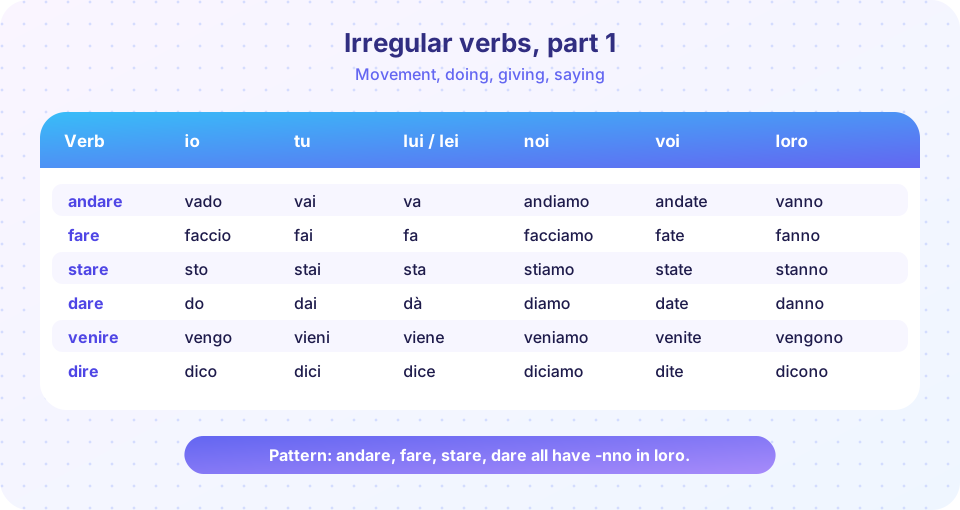
Part 1: go, do, stay, give, come, say
| Person | andare (go) | fare (do, make) | stare (stay, be) | dare (give) | venire (come) | dire (say) |
|---|---|---|---|---|---|---|
| io | vado | faccio | sto | do | vengo | dico |
| tu | vai | fai | stai | dai | vieni | dici |
| lui / lei | va | fa | sta | dà | viene | dice |
| noi | andiamo | facciamo | stiamo | diamo | veniamo | diciamo |
| voi | andate | fate | state | date | venite | dite |
| loro | vanno | fanno | stanno | danno | vengono | dicono |
A pattern to notice: andare, fare, stare and dare all have -nno in the loro form (vanno, fanno, stanno, danno), and their tu and lui/lei forms are very short (vai, va; fai, fa; stai, sta; dai, dà). The accent in dà distinguishes it from da (from, by).
Andare (to go). Vado a Roma. (I am going to Rome.) Andiamo al cinema. (We go to the cinema.) With cities use a, with countries in: Vado in Italia. With transport use in, except for walking: vado in treno, in macchina, in bicicletta, a piedi (on foot).
Fare (to do, to make). It appears in dozens of expressions: fare colazione / pranzo / la cena (to have breakfast / lunch / dinner), fare la spesa (to do the shopping), fare una passeggiata (to take a walk), fare sport, fare una domanda (to ask a question), fare amicizia. And for the weather: Fa caldo. Fa freddo. (It is hot. It is cold.)
Stare (to stay, to be). It is used for "how are you" (Come stai? Sto bene.), for staying in a place (Sto a casa), and in the expression stare per + infinitive (to be about to). In the next chapters you will use stare with -ndo forms for "I am doing": sto mangiando (I am eating).
Dare (to give). Mi dai un consiglio? (Will you give me advice?) Danno una festa. (They are giving a party.)
Venire (to come). Vieni con me? (Are you coming with me?) Vengo da Milano. (I come from Milan.) With da it shows origin.
Dire (to say, to tell). Che cosa dici? (What are you saying?) Come si dice "thanks" in italiano? Note that tu dici and voi dite look different from the infinitive's stem.
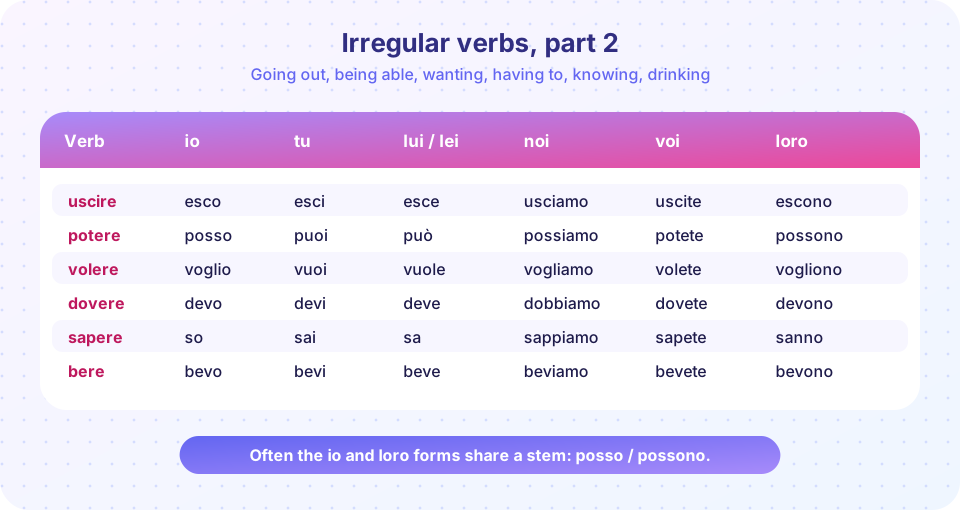
Part 2: go out, can, want, must, know, drink
| Person | uscire (go out) | potere (can) | volere (want) | dovere (must) | sapere (know) | bere (drink) |
|---|---|---|---|---|---|---|
| io | esco | posso | voglio | devo | so | bevo |
| tu | esci | puoi | vuoi | devi | sai | bevi |
| lui / lei | esce | può | vuole | deve | sa | beve |
| noi | usciamo | possiamo | vogliamo | dobbiamo | sappiamo | beviamo |
| voi | uscite | potete | volete | dovete | sapete | bevete |
| loro | escono | possono | vogliono | devono | sanno | bevono |
Uscire (to go out) changes its stem from usc- to esc- where the stress falls on the stem (io, tu, lui/lei, loro). Esco di casa alle otto. (I leave the house at eight.) Usciamo con gli amici. (We go out with friends.)
Bere (to drink) uses bev-: Bevo acqua e il caffè. Beviamo un tè.
Memory trick: io and loro share a stem
In many irregular verbs, the io and loro forms share the same irregular stem, and the others are closer to the infinitive: vengo / vengono, dico / dicono, esco / escono, posso / possono, voglio / vogliono. If you know the io form, you can build the loro form by adding -ono (or the matching ending): dico → dicono, posso → possono.
Can, want, must: modal verbs
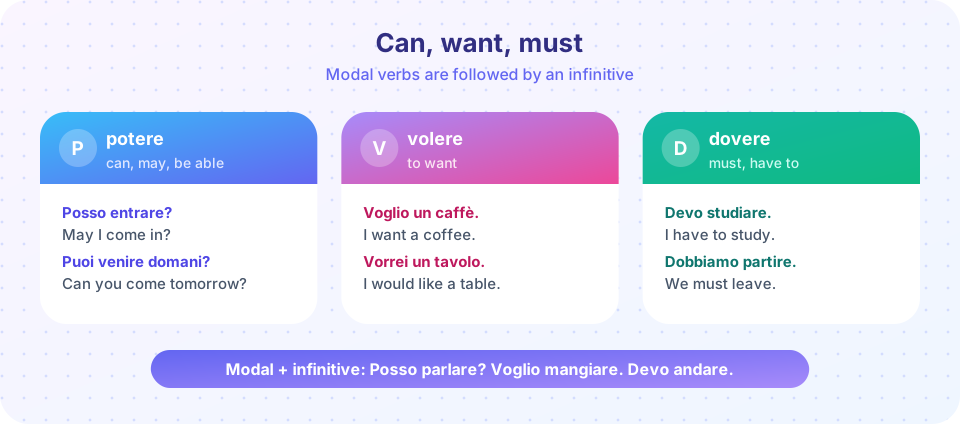
Potere, volere and dovere are always followed by an infinitive; only the modal verb is conjugated:
- Posso entrare? May I come in?
- Puoi venire domani? Can you come tomorrow?
- Non possiamo parlare adesso. We cannot talk now.
- Voglio mangiare una pizza. I want to eat a pizza.
- Vuoi un caffè? Do you want a coffee?
- Devo studiare. I have to study.
- Dobbiamo partire domani. We must leave tomorrow.
When you want to be polite, Italians use vorrei (I would like), a form of volere you can learn as a unit: Vorrei un caffè, per favore. (I would like a coffee, please.) Vorrei prenotare un tavolo. (I would like to book a table.) Vorrei is gentler than voglio, which sounds blunt in a restaurant.
Sapere or conoscere?
Both mean "to know", but Italian separates them:
- conoscere (regular -ere): to be acquainted with a person, a place or a thing. Conosco Marco. Conosci Roma? (Do you know Rome?)
- sapere (irregular): to know a fact, or to know how to do something. So che arrivi domani. (I know you arrive tomorrow.) Sai nuotare? (Can you swim?) Non so. (I do not know.)
Essere or stare?
You already use essere for identity, origin, description and time. Use stare for how you are and for staying: Come stai? Sto bene. (not sono bene), Sto a casa (I stay at home), State zitti! (Be quiet!). Both can translate "to be", but they are not interchangeable.
A short dialogue
- Luca: Ciao Sara! Che cosa fai stasera?
- Sara: Vado al cinema con Anna. Vuoi venire?
- Luca: Mi dispiace, non posso. Devo studiare. Esco domani.
- Sara: Va bene. Allora ci vediamo domani. Come stai?
- Luca: Sto bene, grazie, ma ho tanto da fare!
Translation: Luca: Hi Sara! What are you doing this evening? Sara: I am going to the cinema with Anna. Do you want to come? Luca: I am sorry, I cannot. I have to study. I go out tomorrow. Sara: All right. Then we will see each other tomorrow. How are you? Luca: I am fine, thanks, but I have a lot to do!
Common misconceptions
"Faccio is the same as fare." Faccio is the io form. Say Che cosa fai? (What are you doing?), Faccio colazione.
"I can swim" is posso nuotare. Posso nuotare means "I am allowed to / physically able to swim now". For a learned skill, use sapere: So nuotare.
"Voglio is always fine." It sounds direct. To order or ask for something, use vorrei or prendo.
"Volere needs a preposition." No: Voglio mangiare, not voglio di mangiare. The same goes for potere and dovere.
"Io vado in Roma." Cities take a: vado a Roma; countries take in: vado in Italia.
"Stare and essere are interchangeable." They are not: sto bene, but sono italiano.
Try it
First, find the memory pattern in code. The program below takes the io and loro forms of several irregular verbs and prints the stem they share. You will see that in many verbs the two forms begin the same way.
Press Run (or Ctrl + Enter) to see the result here.
Program input · what you'd type while the program runs
Type the answers before you press Run, one per line. Each time the program reads a line (with input()), it gets the next line from this box.
Second, use the conjugator to look up any of the twelve irregular verbs.
Third, translate. Remember that potere, volere and dovere are followed by an infinitive.
Check your understanding
Quick check · 6 questions
of 6 answered You scored / 6 · perfect!
-
1. What is the 'io' form of 'andare'?
Io vado, tu vai, lui va, noi andiamo, voi andate, loro vanno. -
2. Which sentence is correct?
Modal verbs are followed directly by the infinitive. -
3. How do you say 'How are you?' (informal)?
Use stare for how you are: Come stai? -
4. Which verb means 'to know how to do something'?
Sapere is for facts and skills. Conoscere is for people and places. -
5. What is the 'loro' form of 'fare'?
Fare, andare, stare and dare end in -nno in the loro form. -
6. Which is the polite way to ask for something?
Vorrei is more polite than voglio.
Summary
- Irregular essentials: vado, faccio, sto, do, vengo, dico, esco, posso, voglio, devo, so, bevo.
- Andare, fare, stare, dare end in -nno for loro; in many verbs io and loro share a stem (posso / possono).
- Potere, volere, dovere are followed by an infinitive; vorrei is the polite "I would like".
- Sapere is for facts and skills, conoscere for people and places; stare is for how you are, essere for what you are.
- Fare appears in many expressions: fare colazione, fare la spesa, fa caldo.
Track your progress
Create a free account to tick off lessons and pick up where you left off on any device.
of Italian for Beginners lessons completed