


















Lesson 26 of 50 · Daily Life and Questions
At the Café, the Restaurant and the Shops
Order a coffee, read an Italian menu, ask for the bill and shop for food with vorrei, quanto costa and quantities. Dialogues, a bill calculator and drills.
Food is the part of Italian life that visitors meet first, and it comes with its own customs. A bar is not a pub: it is a place to drink an espresso at the counter in two minutes, a restaurant meal has a fixed order of courses, and a market stall expects you to say how much you want in etti (hundreds of grams). Knowing the vocabulary and the rhythm of these places lets you order with confidence and also helps you understand what the people around you are saying.
In this lesson you will learn how to order politely with vorrei and prendo, how an Italian menu is organized, how to ask for the bill, and how to shop for food and clothes. Each section gives you model sentences with translations that you can reuse.
What you will learn
- How to order a drink or snack at an Italian bar, including the main coffee names.
- The five courses of a traditional menu and how to ask for the bill.
- Polite request forms: vorrei, prendo, mi porta, posso avere.
- Quantities for shopping (un etto, un chilo, una bottiglia) and how to ask prices.
Key terms
Vorrei: "I would like", the polite way to ask for something. You can learn it as a fixed phrase now; its grammar comes later in the course.
Il banco: the counter of a bar; drinking there is cheaper than sitting at a table.
Il coperto: a small cover charge per person that many restaurants add to the bill.
Un etto: 100 grams, the standard unit when buying cheese, ham or olives.
At the bar
A typical Italian morning starts at a bar: a quick coffee and a pastry, standing at the counter. In many bars in cities and tourist areas you first pay at the cassa (cash desk), take the receipt (lo scontrino) and hand it to the barista. In others you simply order and pay afterwards. If you are not sure, ask: Prima pago alla cassa? (Do I pay at the cash desk first?)
The coffee vocabulary is a rite of passage:
| Italian | What you get |
|---|---|
| un caffè | a short, strong espresso (not "espresso" in Italy: just caffè) |
| un caffè lungo | a longer espresso with more water |
| un caffè macchiato | espresso "stained" with a drop of milk |
| un cappuccino | espresso with steamed milk and foam, traditionally drunk in the morning |
| un caffè corretto | espresso "corrected" with a drop of liquor, such as grappa |
| un cornetto | a croissant-like pastry, often with jam or cream |
| una spremuta d'arancia | freshly squeezed orange juice |
Polite ordering formulas:
- Un caffè, per favore. A coffee, please. (Short and perfectly polite.)
- Vorrei un cappuccino e un cornetto. I would like a cappuccino and a croissant.
- Prendo un tè. I will have a tea. (Prendo: "I take".)
- Posso avere un bicchiere d'acqua? Can I have a glass of water?
- Mi dà un'acqua naturale? Could you give me a still water? (frizzante = sparkling)
The barista may say Altro? (Anything else?) or Ecco (Here you are). Answer with Grazie or No, grazie, basta così (No thanks, that's all).
At the restaurant
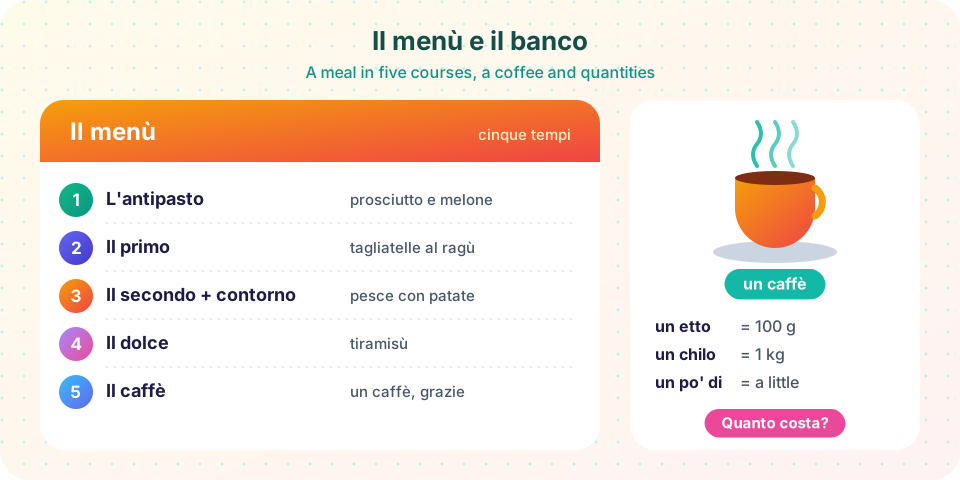
A traditional Italian meal is a sequence of courses. You do not have to order all of them, but the menu is organized this way:
- L'antipasto: a starter, such as cured ham and melon.
- Il primo: the first course, usually pasta, rice or soup.
- Il secondo: the main course of meat or fish.
- Il contorno: a side dish (vegetables, salad, potatoes) ordered separately.
- Il dolce: dessert, followed by il caffè (never a cappuccino after a meal, by custom).
Useful sentences, in the order of a meal:
| Italian | English |
|---|---|
| Un tavolo per due, per favore. | A table for two, please. |
| Avete un tavolo libero? | Do you have a free table? |
| Possiamo vedere il menù? | Can we see the menu? |
| Che cosa mi consiglia? | What do you recommend? (formal) |
| Come primo prendo gli spaghetti. | As a first course I will have the spaghetti. |
| Sono allergico ai frutti di mare. | I am allergic to seafood. (allergica if you are female) |
| Il conto, per favore. | The bill, please. |
| Il servizio è incluso? | Is the service included? |
Tipping is not expected the way it is in some countries; many restaurants add the coperto instead, and leaving a few extra coins is a friendly gesture, not an obligation.
A restaurant dialogue
Cameriere: Buonasera. Quanti siete? Luca: Siamo in due. Un tavolo vicino alla finestra, se possibile. Cameriere: Certo. Che cosa prendete da bere? Luca: Una bottiglia d'acqua frizzante e un bicchiere di vino rosso. Cameriere: Perfetto. Sono pronti per ordinare? Luca: Sì. Come primo prendo le tagliatelle al ragù, e lei? Sara: Per me una zuppa di verdure. Poi il pesce con le patate.
In English: "Good evening. How many are you?" "There are two of us. A table by the window, if possible." "Of course. What will you have to drink?" "A bottle of sparkling water and a glass of red wine." "Perfect. Are you ready to order?" "Yes. As a first course I will have the tagliatelle with ragù, and you?" "For me a vegetable soup. Then the fish with potatoes."
Shopping for food and clothes
At a market stall or an alimentari (grocery store) you ask for quantities with di:
- un chilo di a kilo of; mezzo chilo di half a kilo of
- un etto di 100 g of; due etti di 200 g of
- una bottiglia di, un pacco di, una scatola di, un po' di (a little of)
Examples: Vorrei un chilo di pomodori e due etti di prosciutto. (I would like a kilo of tomatoes and 200 g of ham.) Un po' di formaggio, per favore. (A little cheese, please.)
To ask prices: Quanto costa? for one item, Quanto costano? for several. The shopkeeper answers Costa quattro euro or Costano tre euro al chilo (three euros per kilo). To pay: Posso pagare con la carta? (Can I pay by card?) or in contanti (in cash).
In a clothing shop, say Posso provarlo? (Can I try it on? masculine thing) or provarla (feminine thing), Che taglia è? (What size is it?) and Avete una taglia più grande? (Do you have a bigger size?).
Common misconceptions
"Ask for an 'espresso' and a 'latte'." In Italy un caffè is the espresso, and un latte is only a glass of milk. For a milky coffee ask for un caffè latte or un cappuccino.
"A cappuccino after dinner is normal." Italians reserve it for the morning; it is not rude to order one, but it will draw a smile.
"Vorrei means 'I want'." It is softer: "I would like". The blunt form Voglio sounds like a demand in a shop.
Try it
Work out a restaurant bill. This helper formats amounts the Italian way, with a comma for decimals, and adds a cover charge of €2.00 per person. The menu items and prices are invented for practice.
Press Run (or Ctrl + Enter) to see the result here.
Program input · what you'd type while the program runs
Type the answers before you press Run, one per line. Each time the program reads a line (with input()), it gets the next line from this box.
Test your restaurant and shop phrases. Remember accents and the apostrophe in un po'.
And a flashcard deck for the menu words. Say each word out loud before flipping.
Check your understanding
Quick check · 5 questions
of 5 answered You scored / 5 · perfect!
-
1. What does 'Un etto di prosciutto' ask for?
An etto is a hectogram: 100 grams. Italians buy ham and cheese by the etto. -
2. What is the correct order of a traditional Italian meal?
The sequence is antipasto, primo, secondo (with contorno), dolce, then caffè. -
3. Which sentence is the most polite way to ask for a cappuccino?
Vorrei is the polite 'I would like', and per favore adds courtesy. -
4. How do you ask the price of several items?
Costa is for one item and costano for plural items. -
5. What do you get if you order 'un caffè' in an Italian bar?
Un caffè is the standard espresso.
Summary
- Order with Un caffè, per favore, Vorrei... or Prendo...; pay at the cassa first if asked.
- A traditional menu runs antipasto, primo, secondo (+ contorno), dolce, caffè.
- Use Il conto, per favore to ask for the bill; expect a coperto on the bill.
- Quantities take di: un chilo di, un etto di, una bottiglia di, un po' di.
- Quanto costa? for one item, Quanto costano? for several; Italian prices use a decimal comma.
Next: Chapter 5 review
Track your progress
Create a free account to tick off lessons and pick up where you left off on any device.
of Italian for Beginners lessons completed