


















Lesson 20 of 50 · Present Tense Verbs
Regular -ere and -ire verbs
Learn the present tense of regular Italian -ere and -ire verbs, the two kinds of -ire verbs (dormire and finire), stress, pronunciation changes and everyday examples.
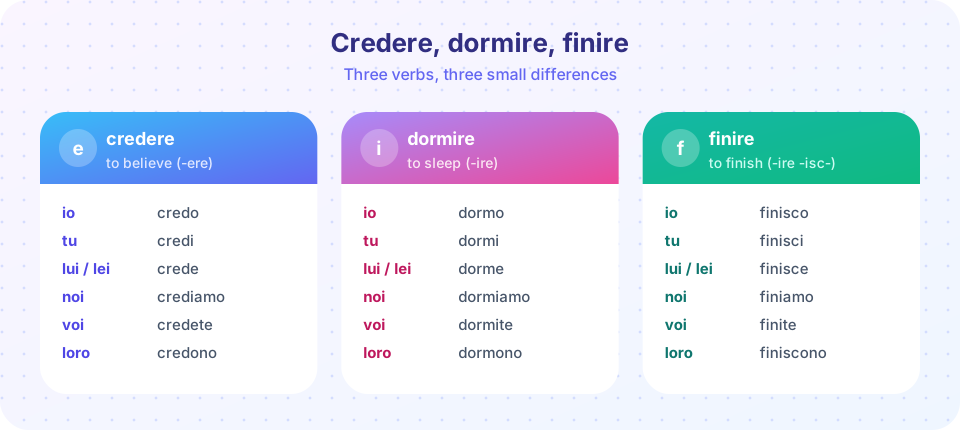
You know the -are family. Now meet the other two: -ere verbs such as credere (to believe), leggere (to read) and prendere (to take), and -ire verbs such as dormire (to sleep), partire (to leave) and finire (to finish). Both follow patterns very close to the one you have just learned, so you only need to learn a few new endings.
The only real surprise is that -ire verbs come in two types: those that behave like dormire, and those that add -isc- in some forms, like finire. This lesson shows you both, with the verbs you will use most often.
What you will learn
- The present tense endings of regular -ere verbs.
- The two kinds of -ire verbs, and the common -isc- verbs.
- Where the stress falls, and how the sound of c and g changes.
- About twenty useful -ere and -ire verbs.
- How the four patterns compare, so you can keep them apart.
Key terms
Second conjugation: verbs in -ere. Third conjugation: verbs in -ire.
-isc- verb: an -ire verb that inserts -isc- between stem and ending in io, tu, lui/lei and loro: finisco, finisci, finisce, finiscono.
Sound shift: a regular change in pronunciation, such as c or g turning from hard to soft depending on the vowel after it.
The -ere verbs
Remove -ere and add the endings. Compared with -are, the lui/lei form ends in -e (not -a) and the voi form in -ete (not -ate); the loro form ends in -ono (not -ano).
| Person | Ending | credere | vivere | prendere |
|---|---|---|---|---|
| io | -o | credo | vivo | prendo |
| tu | -i | credi | vivi | prendi |
| lui / lei / Lei | -e | crede | vive | prende |
| noi | -iamo | crediamo | viviamo | prendiamo |
| voi | -ete | credete | vivete | prendete |
| loro | -ono | credono | vivono | prendono |
Stress. As in -are verbs, the stress is on the stem in io, tu, lui/lei and loro, and on the ending in noi and voi: CRE-do, CRE-di, CRE-de, cre-DIA-mo, cre-DE-te, CRE-do-no. The loro form has stress on the third syllable from the end.
Useful -ere verbs
| Verb | Meaning | Verb | Meaning |
|---|---|---|---|
| credere | to believe | vedere | to see |
| vivere | to live | prendere | to take; to have (food, drink) |
| scrivere | to write | chiedere | to ask |
| leggere | to read | rispondere | to answer |
| vendere | to sell | perdere | to lose |
| mettere | to put | correre | to run |
| chiudere | to close | ripetere | to repeat |
| conoscere | to know (a person, a place) | decidere | to decide |
Examples: Leggo un libro ogni sera. (I read a book every evening.) Prendiamo un caffè? (Shall we have a coffee?) Vedi quel ragazzo? (Do you see that boy?) Rispondete alla domanda. (You answer the question.)
Remember that -ere verbs ending in -cere, -gere change sound (not spelling) between forms, following the rules you learned in Chapter 2:
- Conoscere: conosco (ko-NOS-ko, hard c before o), conosci (ko-NO-shee, sh before i), conosce, conosciamo, conoscete, conoscono.
- Leggere: leggo (LEG-go, hard g), leggi (LED-jee, soft g), legge, leggiamo, leggete, leggono.
- Vincere (to win): vinco (hard c), vinci (soft c as in ch).
The spelling stays regular; only the sound changes, which is exactly why you learned the c/g rules first.
The -ire verbs: two types
There are two kinds of regular -ire verbs, and the dictionary cannot always tell you which is which from the infinitive. Learn the type with the verb.
Type 1: like dormire
Endings: -o, -i, -e, -iamo, -ite, -ono: dormo, dormi, dorme, dormiamo, dormite, dormono. Stress as usual: DOR-mo, DOR-mi, DOR-me, dor-MIA-mo, dor-MI-te, DOR-mo-no.
Common verbs of this type: dormire (to sleep), partire (to leave), sentire (to hear, feel), aprire (to open), offrire (to offer), seguire (to follow), servire (to serve), vestire (to dress).
Parto domani. Che cosa senti? Aprite la finestra! (I leave tomorrow. What do you hear? Open the window!)
Type 2: like finire (-isc- verbs)
These verbs add -isc- in io, tu, lui/lei and loro: -isco, -isci, -isce, -iamo, -ite, -iscono. The noi and voi forms have no -isc-.
| Person | finire | capire | preferire |
|---|---|---|---|
| io | finisco | capisco | preferisco |
| tu | finisci | capisci | preferisci |
| lui / lei / Lei | finisce | capisce | preferisce |
| noi | finiamo | capiamo | preferiamo |
| voi | finite | capite | preferite |
| loro | finiscono | capiscono | preferiscono |
The stress is on the -i- of isc in the singular and in loro: fi-NI-sco, fi-NI-sci, fi-NI-sce, fi-NIA-mo, fi-NI-te, fi-NI-sco-no.
Common -isc- verbs: finire (to finish), capire (to understand), preferire (to prefer), pulire (to clean), spedire (to send, to mail), costruire (to build), restituire (to give back), ubbidire (to obey), distribuire (to distribute), suggerire (to suggest).
Non capisco la domanda. Preferisco il tè. Finiamo alle sei. (I do not understand the question. I prefer tea. We finish at six.)
How do I know whether an -ire verb has -isc-? There is no rule: it is simply part of the verb. A dictionary marks it as (-isc-). As a guide, the -isc- type is the majority (most new -ire verbs follow it). The smaller group of type 1 includes the very common dormire, partire, sentire, aprire, offrire, seguire, servire, and the irregular uscire and venire (next lesson).
Putting it together: four patterns at a glance
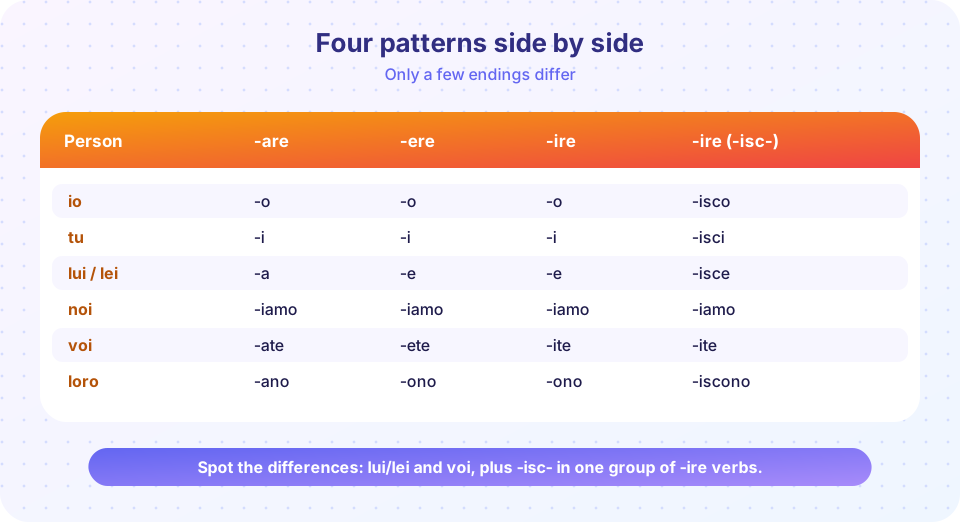
Compare the endings of all four groups in the picture above. The noi form is the same everywhere (-iamo). The patterns differ in only a few places:
- lui/lei: -a (-are) versus -e (-ere, -ire).
- voi: -ate / -ete / -ite, where the vowel matches the infinitive.
- loro: -ano versus -ono.
- -isc- verbs add -isc- in four of the six forms.
A memory trick: in -ere and -ire verbs the vowels are almost the same, except voi (-ete / -ite) and the -isc- verbs.
A short dialogue
- Cameriere: Buongiorno! Che cosa prendete?
- Anna: Io prendo un cappuccino. E tu, Marco?
- Marco: Io prendo un caffè. Quanto costa il cornetto?
- Cameriere: Costa un euro e dieci.
- Marco: Allora prendo anche un cornetto. Poi finisco il lavoro e parto per Roma.
- Anna: Capisco! Io leggo il giornale e aspetto il treno.
Translation: Waiter: Good morning! What will you have? Anna: I will have a cappuccino. And you, Marco? Marco: I will have a coffee. How much is the croissant? Waiter: It costs one euro ten. Marco: Then I will also have a croissant. Then I finish work and leave for Rome. Anna: I understand! I read the newspaper and wait for the train.
Common misconceptions
"All -ire verbs take -isc-." Many do, but dormire, partire, sentire, aprire and others do not. Say parto, not partisco.
"The voi form of -ere verbs is -ate." -ate is for -are verbs only. Voi credete, voi prendete, voi finite.
"Loro leggono is stressed on the ending." The stress is on the first syllable: LEG-go-no.
"Conoscere and sapere both mean to know." Conoscere is for people and places (Conosco Marco, conosco Roma); sapere is for facts and skills (So che arrivi, so nuotare). You will meet sapere in the next lesson.
"Prendere only means to take." It also means to have food or drink: Prendo un caffè. (I will have a coffee.)
"Leggi and leggo sound the same." The g is hard before o (leggo) and soft before i (leggi): LEG-go versus LED-jee.
Try it
First, run the verb machine below. It knows all four patterns (including the list of -isc- verbs), and prints the present tense of verbs from all three families. Try adding verbs, for instance vendere, aprire or pulire. A verb that is not in the -isc- list is treated as type 1, so add it to the list if it is an -isc- verb.
Press Run (or Ctrl + Enter) to see the result here.
Program input · what you'd type while the program runs
Type the answers before you press Run, one per line. Each time the program reads a line (with input()), it gets the next line from this box.
Second, practice the verbs with the flashcards. Say the infinitive, then one conjugated form.
Third, type the verb forms. Pay attention to the -isc- verbs.
Check your understanding
Quick check · 6 questions
of 6 answered You scored / 6 · perfect!
-
1. What is the 'voi' form of 'credere'?
Voi forms: -ate (are), -ete (ere), -ite (ire). -
2. Which verb takes -isc- in the present tense?
Finire is an -isc- verb: finisco, finisci, finisce, finiscono. -
3. What is the 'noi' form of 'dormire'?
The noi form is always -iamo, with no -isc-. -
4. How is 'leggi' (tu) pronounced?
G before i is soft: LED-jee. G before o is hard: leggo. -
5. Which sentence means 'I do not understand'?
Capire is an -isc- verb: capisco. -
6. What does 'prendo un caffè' most likely mean?
Prendere also means to have food or drink in a café.
Summary
- -ere verbs: -o, -i, -e, -iamo, -ete, -ono (credo, credi, crede, crediamo, credete, credono).
- -ire verbs, type 1: -o, -i, -e, -iamo, -ite, -ono (dormo, dormi, dorme, dormiamo, dormite, dormono).
- -ire verbs, type 2 (-isc-): finisco, finisci, finisce, finiamo, finite, finiscono.
- The sound of c and g changes before i/e versus a/o: leggo / leggi, conosco / conosci.
- Learn which -ire verbs take -isc- one by one: most do (capire, preferire, pulire).
Next: Irregular verbs
Track your progress
Create a free account to tick off lessons and pick up where you left off on any device.
of Italian for Beginners lessons completed