


















Lesson 38 of 50 · Future, Pronouns and Subjunctive Basics
The Subjunctive: First Steps
Learn the Italian present subjunctive: when it is needed (penso che, voglio che, spero che), regular and irregular forms, plus a preview of 'if I had' sentences.
The subjunctive (il congiuntivo) is a verb mood for things that are not stated as plain facts: opinions, wishes, doubts, hopes and feelings. English has only fragments of it ("I suggest that he be on time", "If I were you"). In Italian it is a living part of the language, and you will meet it in newspapers, in conversation and in songs. Native speakers of Italian are proud of using it correctly, and learners who use it earn instant respect.
You do not need to master it today. This lesson aims for three things: that you recognise the triggers, that you can form the present subjunctive of the most common verbs, and that you can use the pattern in a few high-frequency phrases such as Penso che sia vero and Voglio che tu venga.
What you will learn
- When the subjunctive is used and when an infinitive is better.
- The present subjunctive of regular verbs and of the most common irregular verbs.
- The most frequent trigger phrases and conjunctions.
- A first look at the imperfect subjunctive in "if" sentences.
Key terms
Congiuntivo: the subjunctive mood: che io parli, che tu sia.
Indicativo: the mood for facts and certainty: parlo, sei.
Verbo reggente: the main verb that triggers the subjunctive: penso, voglio, spero.
Soggetto diverso: a different subject in the second clause (Voglio che tu venga), which requires che and the subjunctive.
When to use it
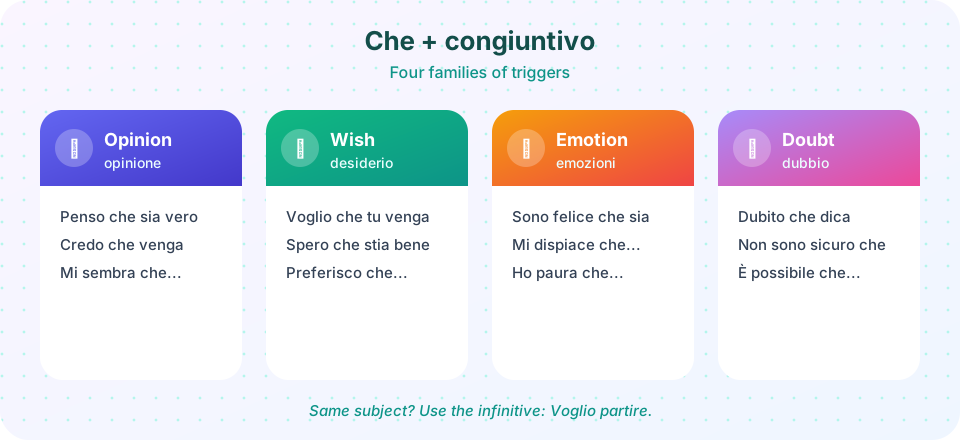
The subjunctive normally appears in a clause introduced by che, after a main verb that expresses something other than certainty, and when the two verbs have different subjects.
| Type of trigger | Main phrase | Example | English |
|---|---|---|---|
| Opinion | penso che, credo che, mi sembra che | Penso che Marco sia a casa. | I think Marco is at home. |
| Wish | voglio che, desidero che, preferisco che | Voglio che tu venga. | I want you to come. |
| Hope | spero che | Spero che tu stia bene. | I hope you are well. |
| Emotion | sono contento che, mi dispiace che, ho paura che | Sono felice che tu sia qui. | I am happy you are here. |
| Doubt | dubito che, non sono sicuro che | Dubito che lui dica la verità. | I doubt that he tells the truth. |
| Impersonal | è importante che, bisogna che, è meglio che | È importante che tu studi. | It is important that you study. |
Certainty uses the indicative: So che Marco è a casa. (I know Marco is at home.) È vero che lei parla bene. (It is true that she speaks well.)
Same subject? Use the infinitive. When both verbs share a subject, Italian uses di + infinitive (or just an infinitive) instead of the subjunctive:
- Voglio partire. (I want to leave.) but Voglio che tu parta. (I want you to leave.)
- Penso di essere pronto. (I think I am ready.) but Penso che tu sia pronto. (I think you are ready.)
- Sono contento di vederti. (I am glad to see you.) but Sono contento che tu venga. (I am glad you are coming.)
Certain conjunctions also take the subjunctive: affinché (so that), benché and sebbene (although), prima che (before), a meno che (unless), purché (provided that), senza che (without): Te lo dico affinché tu capisca. (I tell you so that you understand.) Esco prima che piova. (I am going out before it rains.)
Forming the present subjunctive
Regular endings (-are on top, -ere/-ire on the bottom):
| Person | parlare | vendere | dormire | finire |
|---|---|---|---|---|
| (che) io | parli | venda | dorma | finisca |
| (che) tu | parli | venda | dorma | finisca |
| (che) lui / lei | parli | venda | dorma | finisca |
| (che) noi | parliamo | vendiamo | dormiamo | finiamo |
| (che) voi | parliate | vendiate | dormiate | finiate |
| (che) loro | parlino | vendano | dormano | finiscano |
Two things to notice. First, the singular persons are identical, so use the pronoun (che io, che lui) when meaning could be unclear. Second, noi has the same form as in the present indicative (parliamo, vendiamo).
The most important irregular verbs
| Verb | io / tu / lui | noi | voi | loro |
|---|---|---|---|---|
| essere | sia | siamo | siate | siano |
| avere | abbia | abbiamo | abbiate | abbiano |
| andare | vada | andiamo | andiate | vadano |
| fare | faccia | facciamo | facciate | facciano |
| venire | venga | veniamo | veniate | vengano |
| potere | possa | possiamo | possiate | possano |
| volere | voglia | vogliamo | vogliate | vogliano |
| sapere | sappia | sappiamo | sappiate | sappiano |
| dire | dica | diciamo | diciate | dicano |
| stare | stia | stiamo | stiate | stiano |
Most of these irregular forms derive from the present io form: vengo → venga, dico → dica, faccio → faccia, vado → vada. The noi and voi forms are usually regular (andiamo, andiate).
In real life
Mamma: Penso che Luca abbia bisogno di riposo. Papà: Sì, spero che dorma bene stanotte. È importante che domani sia in forma. Mamma: Voglio che mangi qualcosa prima che vada a letto.
"I think Luca needs rest." "Yes, I hope he sleeps well tonight. It is important that he is in shape tomorrow." "I want him to eat something before he goes to bed."
A preview: "if I had..."
Another mood use is the hypothetical "if" clause, which uses the imperfect subjunctive with the conditional. You will not need to form it yet; recognise it:
- Se avessi tempo, viaggerei di più. If I had time, I would travel more.
- Se fossi ricco, comprerei una casa. If I were rich, I would buy a house.
- Se potessi, verrei volentieri. If I could, I would gladly come.
The imperfect subjunctive endings are -ssi, -ssi, -sse, -ssimo, -ste, -ssero (avessi, fossi, parlassi).
How to practice the subjunctive
Do not try to master the whole mood at once. A realistic method is to learn five frames and use them every day: Penso che..., Credo che..., Spero che..., Voglio che... and È importante che.... Finish each frame with a different verb, using the person you are talking about. For example, think of a friend and say Penso che Marco sia stanco, credo che abbia fame, spero che venga alla festa. When you read Italian texts, underline every che + subjunctive and name the trigger. After a few weeks you will begin to anticipate the subjunctive before you see it.
Listen for it as well. In conversation Italians say Magari venga! ("I hope he comes") and Chiunque sia, non aprire ("Whoever it is, do not open"). You do not have to use these yet, but recognizing the pattern makes you a better listener.
Common misconceptions
"The subjunctive is only written Italian." It appears in everyday conversation. In informal speech some people substitute the indicative (Penso che è vero), but that is considered a mistake in careful Italian.
"Always use the subjunctive after 'che'." Only after verbs that express doubt, opinion, wish or emotion. After verbs of certainty (so che, vedo che, è chiaro che), use the indicative.
"Spero che needs the future." Both Spero che tu stia bene and Spero che verrai are heard; for beginners the subjunctive is a safe, correct choice.
Try it
This generator builds the present subjunctive for regular verbs and the irregular ones listed above. It is a rule-based teaching model; check unusual verbs in a dictionary.
Press Run (or Ctrl + Enter) to see the result here.
Program input · what you'd type while the program runs
Type the answers before you press Run, one per line. Each time the program reads a line (with input()), it gets the next line from this box.
Fill in the subjunctive. Be careful with irregular forms.
Now a quick decision helper. It checks the opening words of a sentence and tells you which mood to expect. It is a simplified model of the trigger lists above, not a real grammar checker.
Press Run (or Ctrl + Enter) to see the console output here.
No output.
Check your understanding
Quick check · 5 questions
of 5 answered You scored / 5 · perfect!
-
1. Which sentence needs the subjunctive?
Pensare expresses an opinion, so the subjunctive sia follows. Sapere and vedere state facts. -
2. How do you say 'I want to leave' (same subject)?
When the subject is the same, use the infinitive: voglio partire. -
3. What is the subjunctive of 'venire' for 'che tu'?
Venire has the irregular subjunctive venga (from vengo). -
4. What does 'Se avessi tempo, viaggerei di più' mean?
An 'if I had' sentence uses the imperfect subjunctive (avessi) and the conditional (viaggerei). -
5. Which conjunction is followed by the subjunctive?
Affinché, benché, prima che and a meno che require the subjunctive.
Summary
- Use the subjunctive after che when the main verb expresses opinion, wish, hope, emotion or doubt and the subject changes: Penso che sia vero.
- With the same subject, use the infinitive: Voglio partire.
- Regular endings: -are → -i, -i, -i, -iamo, -iate, -ino; -ere/-ire → -a, -a, -a, -iamo, -iate, -ano (-isca for -isc- verbs).
- Key irregulars: sia, abbia, vada, faccia, venga, possa, voglia, sappia, dica, stia.
- Certainty uses the indicative; "if I had" sentences use the imperfect subjunctive plus the conditional.
Next: Chapter 7 review
Track your progress
Create a free account to tick off lessons and pick up where you left off on any device.
of Italian for Beginners lessons completed