


















Lesson 29 of 50 · Past Tenses
Passato Prossimo with Avere
Learn the Italian passato prossimo with avere: regular participles (-ato, -uto, -ito), common irregular ones, negatives, questions and time words, with drills.
The passato prossimo is the tense you will use most when you talk about the past. Italians use it to say what they did yesterday, what happened last week and what they have done so far. It is called "compound" because it has two parts: a helper verb in the present tense and a past participle. For most verbs the helper is avere (to have), and that is what this lesson covers. The next lesson deals with verbs that take essere.
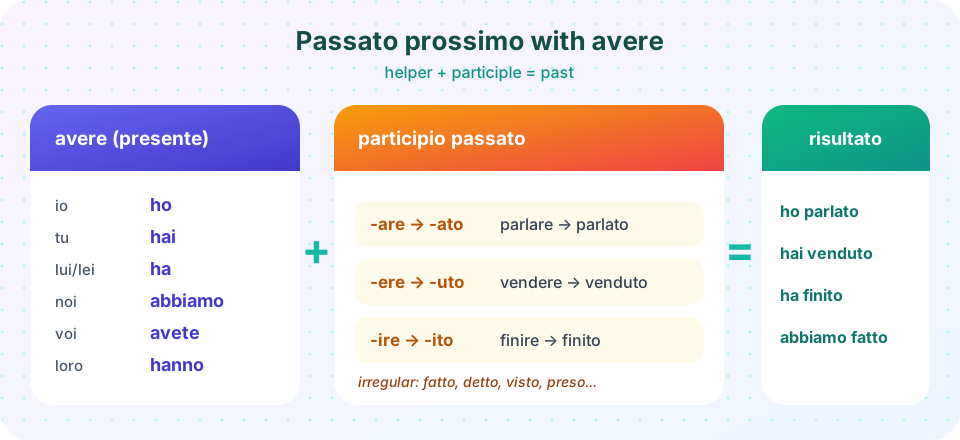
The recipe is easy: take the present tense of avere, add the participle of the verb you want. The only real work is learning the participles, and most of them follow a regular pattern.
What you will learn
- How to build the passato prossimo with avere and the present of avere.
- How to form regular participles for -are, -ere and -ire verbs.
- The most common irregular participles (fatto, detto, visto, preso, scritto...).
- How to make negatives and questions and where words like già and mai go.
Key terms
Participio passato: the verb form used after an auxiliary: parlato, venduto, finito.
Verbo transitivo: a verb that takes a direct object (mangiare una mela); these nearly always take avere.
Avverbi di tempo: words like già (already), ancora (yet), mai (ever) and appena (just).
Step 1: the present of avere
You already know avere, but now it plays the role of a helper:
| Person | Italian | Person | Italian | |
|---|---|---|---|---|
| io | ho | noi | abbiamo | |
| tu | hai | voi | avete | |
| lui / lei / Lei | ha | loro | hanno |
The h is silent: ho sounds like "oh", hai like "eye", ha like "ah", hanno like "AHN-no". The letter h is how Italian tells ho (I have) from o (or), and ha (has) from a (at, to).
Step 2: the regular past participle
Drop the ending of the infinitive and add:
| Infinitive ending | Participle ending | Example |
|---|---|---|
| -are | -ato | parlare → parlato, mangiare → mangiato, lavorare → lavorato |
| -ere | -uto | vendere → venduto, credere → creduto, ricevere → ricevuto |
| -ire | -ito | finire → finito, capire → capito, dormire → dormito |
Put the helper and the participle together:
- Ieri ho parlato con Marta. Yesterday I spoke with Marta.
- Hai mangiato? Did you eat? / Have you eaten?
- Mia madre ha venduto la casa. My mother sold the house.
- Abbiamo finito il lavoro. We finished the work.
- Avete capito? Did you understand?
- Gli studenti hanno dormito poco. The students slept little.
Notice that one Italian form covers three English ones: ho mangiato can mean "I ate", "I have eaten" and "I did eat". Context and time words tell you which one is intended.
Step 3: irregular participles
Many of the most common verbs have irregular participles. They are worth learning as a group, because you meet them constantly. Most of them are -ere verbs that end in -to, -so or -sto.
| Infinitive | Participle | Example |
|---|---|---|
| fare | fatto | Ho fatto la spesa. (I did the shopping.) |
| dire | detto | Che cosa hai detto? |
| scrivere | scritto | Ho scritto una lettera. |
| leggere | letto | Ha letto tutto il libro. |
| vedere | visto | Abbiamo visto un film. |
| prendere | preso | Ho preso il treno. |
| mettere | messo | Dove hai messo le chiavi? |
| aprire | aperto | Ha aperto la finestra. |
| chiudere | chiuso | Hanno chiuso il negozio. |
| bere | bevuto | Ho bevuto un tè. |
| chiedere | chiesto | Ho chiesto un caffè. |
| rispondere | risposto | Non ha risposto. |
| scegliere | scelto | Abbiamo scelto il vino. |
| perdere | perso | Ho perso il portafoglio. |
| vincere | vinto | Hanno vinto la partita. |
| avere | avuto | Ho avuto un problema. |
(Perdere also has the regular form perduto, and vedere also has veduto; the short forms are far more common.)
A good strategy is to learn each irregular participle inside a short sentence, such as Ho fatto colazione, rather than as an isolated list.
Negatives, questions and small words
To make a negative, put non before the auxiliary: Non ho mangiato. (I did not eat.) Non abbiamo capito. (We did not understand.)
To ask a question, keep the order and raise your voice, or add a question word: Hai finito? Che cosa hai fatto ieri? Quando hanno comprato la macchina?
Short adverbs go between the auxiliary and the participle: Ho già mangiato (I have already eaten), Non ho ancora finito (I have not finished yet), Hai mai visto Venezia? (Have you ever seen Venice?), Abbiamo appena comprato la casa (We have just bought the house).
Past time words (ieri, ieri sera, stamattina, la settimana scorsa, l'anno scorso, due giorni fa) usually appear at the start or end of the sentence: Due giorni fa ho incontrato Paolo. or Ho incontrato Paolo due giorni fa.
A short dialogue
Elena: Che cosa hai fatto ieri? Dario: Ho lavorato la mattina. Poi ho pranzato con un collega e ho scritto alcune email. Elena: E la sera? Dario: Non ho fatto niente di speciale. Ho guardato un film e ho dormito presto.
"What did you do yesterday?" "I worked in the morning. Then I had lunch with a colleague and wrote some emails." "And in the evening?" "I did nothing special. I watched a film and went to bed early."
Patterns that make participles easier to remember
Irregular participles look random until you group them by their endings. Many follow a handful of families:
| Ending | Verbs | Participles |
|---|---|---|
| -tto | fare, dire, scrivere, leggere | fatto, detto, scritto, letto |
| -so | prendere, chiudere, decidere, spendere | preso, chiuso, deciso, speso |
| -sto | vedere, chiedere, rispondere, porre | visto, chiesto, risposto, posto |
| -erto | aprire, offrire, coprire | aperto, offerto, coperto |
If you learn the family, new verbs become predictable: rimettere (to put back) behaves like mettere (rimesso), and riscrivere like scrivere (riscritto). Whenever you meet a new verb that ends in -ere, ask: is it a high-frequency verb? If so, it is probably irregular, and it is worth looking up the participle at once.
Telling a story about your day
The passato prossimo is the natural tense for a chain of events. Try to produce a short sequence in your head each evening: Stamattina ho preso il caffè. Ho lavorato fino all'una. Ho pranzato con un amico. Ho letto un po' e ho cucinato. Each sentence has the same two-part shape, so the pattern becomes automatic after a few days. Add time words (poi, dopo, infine) to link the events: Prima ho fatto colazione, poi ho letto la posta, infine ho chiamato mia madre. ("First I had breakfast, then I read the mail, finally I called my mother.")
Common misconceptions
"Ho mangiato" can only mean 'I have eaten'. It also covers "I ate" in everyday Italian. You do not need a separate past-simple form.
"The participle always ends in -ato." Only verbs in -are do. -ere verbs usually give -uto, and -ire verbs give -ito.
"I can drop the h in ho/hai/ha/hanno." The letter is silent, but it is part of the spelling. Ho and o are different words.
Try it
This conjugator builds the passato prossimo with avere for regular verbs and uses a dictionary for the irregular participles. It is a small rule-based helper, not a full grammar engine, so it works only for the verbs in the list.
Press Run (or Ctrl + Enter) to see the result here.
Program input · what you'd type while the program runs
Type the answers before you press Run, one per line. Each time the program reads a line (with input()), it gets the next line from this box.
Fill in the correct form. Watch the spelling of ho/hai/ha and the participle endings.
Test your memory with a matching game of irregular participles.
Check your understanding
Quick check · 5 questions
of 5 answered You scored / 5 · perfect!
-
1. What is the regular participle of 'vendere'?
Regular -ere verbs form the participle with -uto. -
2. How do you say 'I have not finished yet'?
Non goes before the auxiliary and ancora sits between auxiliary and participle. -
3. What does 'Abbiamo visto un film' mean?
Abbiamo visto is the passato prossimo of vedere: 'we saw / we have seen'. -
4. What is the participle of 'fare'?
Fare has the irregular participle fatto. -
5. Which sentence is correct for 'Yesterday she wrote a letter'?
Scrivere has the irregular participle scritto and takes avere.
Summary
- Passato prossimo with avere = present of avere + past participle: ho parlato, hai venduto, ha finito.
- Regular participles: -are → -ato, -ere → -uto, -ire → -ito.
- Learn the common irregulars: fatto, detto, letto, visto, preso, messo, scritto, aperto, bevuto.
- Negatives put non before the auxiliary; già, ancora, mai, appena sit between auxiliary and participle.
- One form translates "I ate", "I have eaten" and "I did eat".
Track your progress
Create a free account to tick off lessons and pick up where you left off on any device.
of Italian for Beginners lessons completed