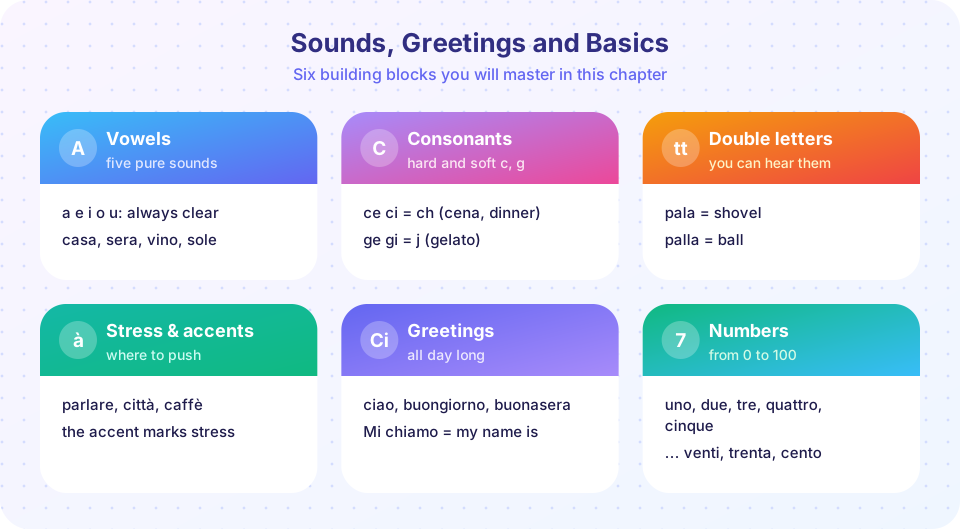
A map of Chapter 2: Italian vowels, consonants, double letters, stress, greetings, introductions and numbers, so you can pronounce and say your first sentences.
This chapter is the foundation of everything else. In six lessons you will learn to read any Italian word aloud, greet people at any time of day, introduce yourself, and count to one hundred. That is not a small thing: the pronunciation habits you form now will stay with you for years.
Italian is a very friendly language for this. It is written almost exactly the way it is pronounced. Once you know the handful of rules in this chapter, you will almost never meet a word whose sound you cannot predict from its spelling. That is very different from English, where the same letters can be read in many ways.
Six building blocks: vowels, consonants, double letters, stress, greetings and numbers.
The Italian alphabet and the vowels: the twenty-one native letters, the five foreign letters, how to spell your name aloud, and the five pure vowels, including how open and closed e and o work.
Consonants and double letters: the two sounds of c and g, the special groups gli, gn and sc, the letter h, and why the double consonants matter.
Stress and accents: where to put the emphasis in a word, how accent marks work, and the little words (è and e, dà and da) that accents keep apart.
Greetings and introductions: hello and goodbye at different times of day, formal and informal address, introducing yourself and your first full conversation.
Numbers from 0 to 100: counting, the patterns in the tens, telephone numbers, prices and ages.
Chapter review: a one-page summary and a ten-question test.
Read the pronunciation sections slowly and say every example. Italian is a syllable-timed language, which means that syllables come at an even pace, with less of the long-short rhythm that English has. Reading aloud at an even, calm tempo is the best way to get this feeling.
Our respellings are English-based and approximate. They show the rough sound, for example grazie as GRAH-tsee-eh. Capital letters mark the stressed syllable. The IPA symbols between slashes are more exact. If you do not know IPA, ignore it and use the respellings at first; as you meet the symbols over and over you will pick them up.
"Italian pronunciation is hard." For English speakers, the spelling is actually easier than English. The hard parts are the rolled r, the long double consonants and the soft c/g rules, and this chapter handles all of them.
"Stress and accents are the same." Stress is how you say a word; an accent mark is a written sign. Most Italian words are stressed without any mark. You will see the difference in lesson 3.
Warm up with this quick quiz on greetings. If you get any wrong, do not worry: the greetings lesson explains them all.
Greeting warm-up
<style>*{box-sizing:border-box}body{margin:0;padding:14px;font-family:system-ui,'Segoe UI',Arial,sans-serif;background:linear-gradient(135deg,#faf5ff,#eff6ff);color:#1e1b4b}.wrap{max-width:640px;margin:0 auto}.card{background:#fff;border-radius:20px;box-shadow:0 10px 24px rgba(67,56,202,.15);padding:18px}.big{font-size:30px;font-weight:700;color:#312e81;text-align:center;min-height:44px;margin:14px 0 4px}.sub{font-size:16px;color:#64748b;text-align:center;min-height:22px}.row{display:flex;gap:8px;flex-wrap:wrap;justify-content:center;margin-top:14px}button{font:inherit;font-weight:600;border:0;border-radius:999px;padding:9px 16px;cursor:pointer;color:#fff;background:linear-gradient(135deg,#6366f1,#a78bfa)}button.alt{background:#eef2ff;color:#3730a3}button.ok{background:linear-gradient(135deg,#10b981,#14b8a6)}button:disabled{opacity:.5;cursor:default}.meta{font-size:14px;color:#6366f1;text-align:center;margin-bottom:4px}.opt{display:block;width:100%;text-align:left;margin:8px 0;background:#eef2ff;color:#1e1b4b;border-radius:14px;padding:11px 14px}.opt.good{background:#d1fae5;color:#064e3b}.opt.bad{background:#fee2e2;color:#7f1d1d}.fb{min-height:24px;margin-top:10px;font-weight:600;text-align:center}input[type=text]{font:inherit;width:100%;padding:11px 14px;border:2px solid #c7d2fe;border-radius:14px;margin-top:10px;background:#fff;color:#1e1b4b}table{border-collapse:collapse;width:100%;margin-top:10px}td,th{padding:8px 10px;text-align:left;border-bottom:1px solid #e0e7ff;font-size:16px}th{color:#4f46e5;font-size:14px;text-transform:uppercase;letter-spacing:.04em}.mt{margin-top:10px}</style><divclass="wrap"><divclass="card"><divclass="meta"id="meta"></div><divid="q"style="font-size:19px;font-weight:700;margin:8px 0"></div><divid="opts"></div><divclass="fb"id="fb"></div><divclass="row"><buttonid="next"disabled>Next question</button></div></div></div><script>constITEMS=[{"q":"Which greeting is used in the morning and early afternoon?","options":["buonasera","buongiorno","buonanotte"],"a":1,"why":"Buongiorno literally means good day and is used from morning until about the middle of the afternoon."},{"q":"Which word means 'goodbye' in a polite way?","options":["arrivederci","ciao","prego"],"a":0,"why":"Arrivederci is the standard goodbye. Ciao works for friends; prego means you are welcome."},{"q":"Which is the informal 'hi'?","options":["salve","buongiorno","ciao"],"a":2,"why":"Ciao is for friends, family and people your age; salve is a neutral hello."}];let i=0,score=0,done=false;const$=id=>document.getElementById(id);functionshow(){const it=ITEMS[i];done=false;$('meta').textContent='Question '+(i+1)+' of '+ITEMS.length+' | score: '+score;$('q').textContent=it.q;$('opts').innerHTML='';$('fb').textContent='';$('next').disabled=true;
it.options.forEach((o,k)=>{const b=document.createElement('button');b.className='opt';b.textContent=o;b.onclick=()=>pick(k,b);$('opts').appendChild(b);});}functionpick(k,b){if(done)return;done=true;const it=ITEMS[i];const bs=$('opts').children;if(k===it.a){score++;b.classList.add('good');$('fb').textContent='Correct! '+it.why;}else{b.classList.add('bad');bs[it.a].classList.add('good');$('fb').textContent='Not quite. '+it.why;}$('meta').textContent='Question '+(i+1)+' of '+ITEMS.length+' | score: '+score;$('next').disabled=false;$('next').textContent=i===ITEMS.length-1?'See result':'Next question';}$('next').onclick=()=>{if(i===ITEMS.length-1){$('q').textContent='Finished: '+score+' out of '+ITEMS.length;$('opts').innerHTML='';$('fb').textContent=score===ITEMS.length?'Perfetto!':'Try again to improve your score.';$('next').textContent='Start again';i=-1;score=0;$('next').onclick=()=>{$('next').onclick=null;location.reload();};return;}i++;show();};show();</script>
Next, use the sound tool. It splits Italian words into their sounds. Run it as it is, then change the list of words and run it again; it only works on the spelling, so stress is not shown. You will learn how it works in the next lessons.
JS
Italian sound splitter
// Italian letters-to-sounds splitter (a teaching model, not a full phonetic engine)constVOWELS="aeiouàèéìòóù";constisV=c=> c !==undefined&& c !==""&&VOWELS.includes(c);constisFront=c=> c !==undefined&& c !==""&&"eiéèì".includes(c);constSAY={a:"ah",e:"eh",i:"ee",o:"oh",u:"oo","tʃ":"ch","dʒ":"j","ʃ":"sh","ʎ":"ly","ɲ":"ny","ttʃ":"tch","ddʒ":"dj","kw":"kw","ts/dz":"ts/dz"};constPLAIN={à:"a",è:"e",é:"e",ì:"i",ò:"o",ó:"o",ù:"u"};functionsounds(word){const w = word.toLowerCase().normalize("NFC");const out =[];let i =0;while(i < w.length){const c = w[i], n = w[i +1]||"", n2 = w[i +2]||"";if(isV(c)){ out.push(PLAIN[c]|| c); i++;continue;}let ipa =null, len =1;if(c ==="h"){ i++;continue;}if(c ==="c"&& n ==="q"&& n2 ==="u"){ ipa ="kkw"; len =3;}elseif(c ==="c"&& n ==="c"&& n2 ==="h"){ ipa ="kk"; len =3;}elseif(c ==="c"&& n ==="c"&&isFront(n2)){ ipa ="ttʃ"; len =2;}elseif(c ==="c"&& n ==="c"){ ipa ="kk"; len =2;}elseif(c ==="g"&& n ==="g"&& n2 ==="h"){ ipa ="gg"; len =3;}elseif(c ==="g"&& n ==="g"&&isFront(n2)){ ipa ="ddʒ"; len =2;}elseif(c ==="g"&& n ==="g"){ ipa ="gg"; len =2;}elseif(c ==="z"&& n ==="z"){ ipa ="ts/dz"; len =2;}elseif(c === n &&!isV(c)){ ipa = c + c; len =2;}elseif(c ==="c"&& n ==="h"){ ipa ="k"; len =2;}elseif(c ==="g"&& n ==="h"){ ipa ="g"; len =2;}elseif(c ==="s"&& n ==="c"&&isFront(n2)){ ipa ="ʃ"; len =2;}elseif(c ==="c"&&isFront(n)){ ipa ="tʃ"; len =1;}elseif(c ==="c"){ ipa ="k";}elseif(c ==="g"&& n ==="l"&& n2 ==="i"){ ipa ="ʎ"; len =2;}elseif(c ==="g"&& n ==="n"){ ipa ="ɲ"; len =2;}elseif(c ==="g"&&isFront(n)){ ipa ="dʒ";}elseif(c ==="g"){ ipa ="g";}elseif(c ==="q"&& n ==="u"){ ipa ="kw"; len =2;}elseif(c ==="z"){ ipa ="ts/dz";}else{ ipa = c;}
out.push(ipa);
i += len;// a silent i after a soft c, g, sc or gl when another vowel follows: ciao, giorno, sciare, figlioif(["tʃ","dʒ","ʃ","ʎ","ttʃ","ddʒ"].includes(ipa)&& w[i]==="i"&&isV(w[i +1])) i++;}return out;}functionshow(word){const s =sounds(word);
console.log(word.padEnd(12), s.join(" ").padEnd(22), s.map(x=>SAY[x]|| x).join("-"));}const words =["ciao","buongiorno","grazie","gelato","famiglia","scusi"];for(const w of words)show(w);
Press Run (or Ctrl + Enter) to see the console output here.