Learn the Italian definite and indefinite articles, how the first sound of the next word picks the form, when Italian uses an article and English does not, and how prepositions combine with them.
English has one word for "the" and two for "a" (a and an). Italian has seven forms of "the" and four forms of "a/an". That sounds like a lot, but the choice follows a clear rule: the article depends on the gender and number of the noun and on the first sound of the word that comes right after it.
Articles are everywhere in Italian, and they are tiny, so they are worth learning well. They also help you: from a single article (la, gli, una) you often learn the gender and number of the noun before you even hear it.
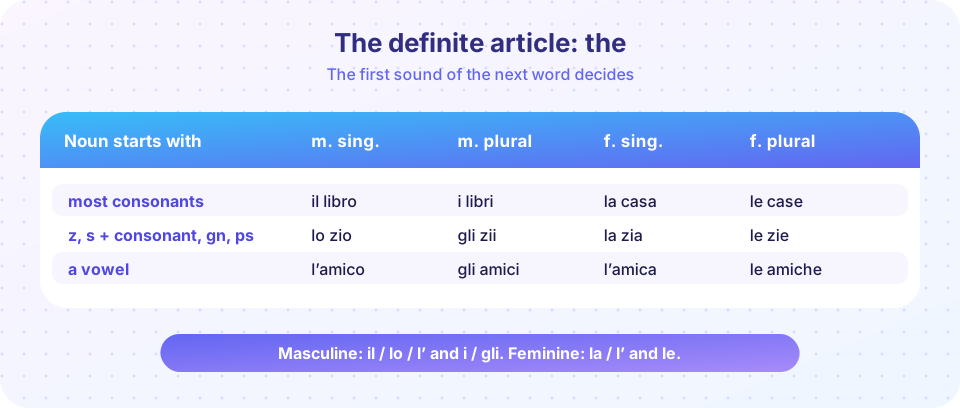
The definite article depends on gender, number and the first sound of the following word.
The table in the picture is your map. Here it is in words.
Masculine singular
il before most consonants: il libro, il tavolo, il ragazzo, il treno, il caffè.
lo before z, s + consonant (sc, sp, st, sb...), gn, ps, pn, x and y: lo zio (uncle), lo studente (student), lo sport, lo scontrino (receipt), lo gnocco, lo psicologo, lo yogurt.
l' before a vowel: l'amico, l'uomo, l'albero (tree), l'italiano.
Masculine plural
i replaces il: i libri, i tavoli, i ragazzi.
gli replaces lo and l': gli zii, gli studenti, gli amici, gli uomini, gli alberi.
Feminine singular
la before a consonant: la casa, la ragazza, la zia, la scuola, la strada (road).
l' before a vowel: l'amica, l'arancia, l'ora (hour).
Feminine plural
le for all: le case, le ragazze, le amiche, le arance, le ore.
The key is the first sound of the word that follows the article, which can be an adjective, not only the noun. So il ragazzo but lo stesso ragazzo (the same boy), l'amico but il vecchio amico (the old friend) and il buon amico. This is why Italian learners say "learn the article with the word".
If you are unsure, say the phrase out loud. Il zio is hard to say, so lo zio feels natural; lo libro sounds odd, so il libro is right. Italian articles exist to make the sentence flow.
un (masculine) before vowels and most consonants: un libro, un amico, un ragazzo.
uno (masculine) before z, s + consonant, gn, ps, x, y: uno zio, uno studente, uno sport.
una (feminine) before a consonant: una casa, una ragazza, una scuola.
un' (feminine) before a vowel: un'amica, un'arancia.
Careful: the masculine un amico has no apostrophe, but the feminine un'amica does. The apostrophe tells you the noun is feminine. Also notice that una before a vowel is shortened (un'), but uno is not shortened (uno studente).
There is no plural of un/una. To say "some", Italian uses the partitive forms dei, degli, delle (which are di + the plural article) or the words alcuni / alcune:
Ho dei libri. I have some books.
Ci sono degli studenti. There are some students.
Compro delle arance. I buy some oranges.
Often the article is simply omitted in the plural: Compro libri (I buy books).
When Italian uses the article and English does not#
The definite article is far more common in Italian. Use it in these cases:
General statements about a whole group or an idea:Il caffè è buono. (Coffee is good.) La musica è importante. (Music is important.) I gatti sono animali. (Cats are animals.)
With countries and many places:l'Italia, la Francia, la Spagna, il Giappone, gli Stati Uniti. (But not with most cities: Roma, Parigi.)
With titles when you talk about someone:Il signor Rossi è qui. (Mr. Rossi is here.) But not when you address the person: Buongiorno, signor Rossi.
With days of the week for habits:Il lunedì lavoro. (On Mondays I work.) For a single day, no article: Lunedì vado al cinema. (On Monday I go to the cinema.)
With dates and times:Il 5 maggio, Sono le tre (It is three o'clock), È l'una (It is one o'clock).
With languages as subjects:L'italiano è bello. But after parlare the article is usually omitted: Parlo italiano.
And Italian omits the article in a few cases where English uses one: before most professions after essere (Sono insegnante, "I am a teacher") and in fixed expressions like Ho fame (I am hungry).
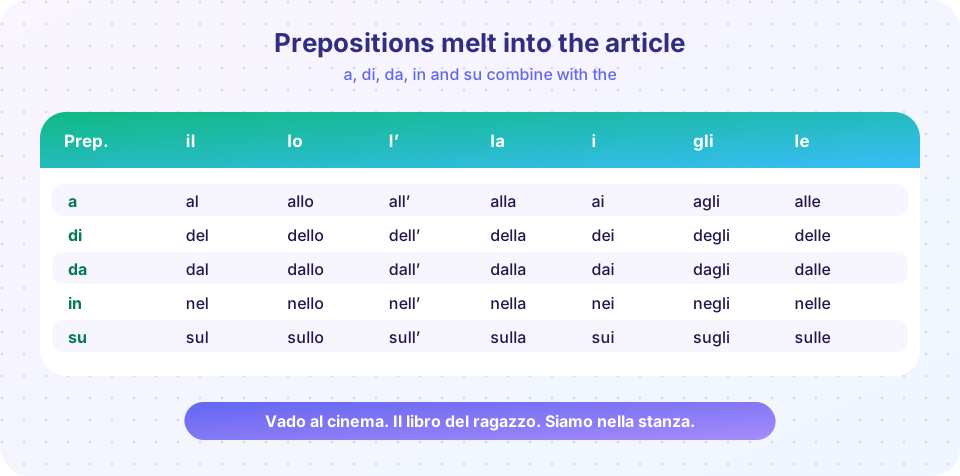
When the prepositions a, di, da, in, su meet a definite article, they usually fuse into a single word. This is one of the most important patterns in Italian grammar.
Five common prepositions fuse with the seven definite articles. The pattern is regular once you learn it.
Examples:
Vado al cinema. I go to the cinema. (a + il)
Il libro del ragazzo. The boy's book (the book of the boy). (di + il)
Sono nella stanza. I am in the room. (in + la)
Il gatto è sul tavolo. The cat is on the table. (su + il)
*Arrivo **dall'*aeroporto. I arrive from the airport. (da + l')
You do not need to memorize the table today; use it as a reference and notice the patterns in the lessons ahead. The preposition con (with) is usually not contracted (con il, con la), and neither is per (per il).
"Il is for all masculine nouns." It is for most, but lo and l' appear before z, s + consonant, gn, ps and vowels. Say lo zio, lo studente, l'amico.
"Un amica is correct, because un is just 'a'." For feminine nouns starting with a vowel you need un'amica, with an apostrophe. Un amica is an error.
"Uno before a vowel becomes un'." Only the feminine una is shortened; masculine uno stays whole (uno studente). Before a vowel the masculine is un: un amico.
"I can drop the article before a noun, like in English." In Italian you almost always need it: I like music is Mi piace la musica. Dropping it makes the sentence sound broken.
"Gli is only for plural nouns starting with a vowel."Gli is the plural of lo and l': gli zii (z), gli studenti (s + consonant), gli amici (vowel).
First, run the article chooser. It applies the rules above to any noun you give it and prints the definite article, the indefinite article and the plural definite article. Add your own nouns to the list at the bottom.
Press Run (or Ctrl + Enter) to see the result here.
Program input · what you'd type while the program runs
Type the answers before you press Run, one per line. Each time the program reads a line (with input()), it gets the next line from this box.
Second, choose the right article.
Which article?
<style>*{box-sizing:border-box}body{margin:0;padding:14px;font-family:system-ui,'Segoe UI',Arial,sans-serif;background:linear-gradient(135deg,#faf5ff,#eff6ff);color:#1e1b4b}.wrap{max-width:640px;margin:0 auto}.card{background:#fff;border-radius:20px;box-shadow:0 10px 24px rgba(67,56,202,.15);padding:18px}.big{font-size:30px;font-weight:700;color:#312e81;text-align:center;min-height:44px;margin:14px 0 4px}.sub{font-size:16px;color:#64748b;text-align:center;min-height:22px}.row{display:flex;gap:8px;flex-wrap:wrap;justify-content:center;margin-top:14px}button{font:inherit;font-weight:600;border:0;border-radius:999px;padding:9px 16px;cursor:pointer;color:#fff;background:linear-gradient(135deg,#6366f1,#a78bfa)}button.alt{background:#eef2ff;color:#3730a3}button.ok{background:linear-gradient(135deg,#10b981,#14b8a6)}button:disabled{opacity:.5;cursor:default}.meta{font-size:14px;color:#6366f1;text-align:center;margin-bottom:4px}.opt{display:block;width:100%;text-align:left;margin:8px 0;background:#eef2ff;color:#1e1b4b;border-radius:14px;padding:11px 14px}.opt.good{background:#d1fae5;color:#064e3b}.opt.bad{background:#fee2e2;color:#7f1d1d}.fb{min-height:24px;margin-top:10px;font-weight:600;text-align:center}input[type=text]{font:inherit;width:100%;padding:11px 14px;border:2px solid #c7d2fe;border-radius:14px;margin-top:10px;background:#fff;color:#1e1b4b}table{border-collapse:collapse;width:100%;margin-top:10px}td,th{padding:8px 10px;text-align:left;border-bottom:1px solid #e0e7ff;font-size:16px}th{color:#4f46e5;font-size:14px;text-transform:uppercase;letter-spacing:.04em}.mt{margin-top:10px}</style><divclass="wrap"><divclass="card"><divclass="meta"id="meta"></div><divid="q"style="font-size:19px;font-weight:700;margin:8px 0"></div><divid="opts"></div><divclass="fb"id="fb"></div><divclass="row"><buttonid="next"disabled>Next question</button></div></div></div><script>constITEMS=[{"q":"___ zio (the uncle)","options":["il","lo","l'"],"a":1,"why":"Z requires lo: lo zio."},{"q":"___ amica (the friend, f.)","options":["la","le","l'"],"a":2,"why":"Before a vowel, the feminine singular is l': l'amica."},{"q":"___ studenti (the students)","options":["i","gli","le"],"a":1,"why":"Gli is the plural of lo and l'. Studente takes lo, so the plural is gli studenti."},{"q":"___ amico (a friend, m.)","options":["un","un'","uno"],"a":0,"why":"The masculine un has no apostrophe: un amico."},{"q":"___ arancia (an orange, f.)","options":["un","un'","una"],"a":1,"why":"Feminine before a vowel: un'arancia."},{"q":"___ case (the houses)","options":["le","gli","i"],"a":0,"why":"Feminine plural: le case."}];let i=0,score=0,done=false;const$=id=>document.getElementById(id);functionshow(){const it=ITEMS[i];done=false;$('meta').textContent='Question '+(i+1)+' of '+ITEMS.length+' | score: '+score;$('q').textContent=it.q;$('opts').innerHTML='';$('fb').textContent='';$('next').disabled=true;
it.options.forEach((o,k)=>{const b=document.createElement('button');b.className='opt';b.textContent=o;b.onclick=()=>pick(k,b);$('opts').appendChild(b);});}functionpick(k,b){if(done)return;done=true;const it=ITEMS[i];const bs=$('opts').children;if(k===it.a){score++;b.classList.add('good');$('fb').textContent='Correct! '+it.why;}else{b.classList.add('bad');bs[it.a].classList.add('good');$('fb').textContent='Not quite. '+it.why;}$('meta').textContent='Question '+(i+1)+' of '+ITEMS.length+' | score: '+score;$('next').disabled=false;$('next').textContent=i===ITEMS.length-1?'See result':'Next question';}$('next').onclick=()=>{if(i===ITEMS.length-1){$('q').textContent='Finished: '+score+' out of '+ITEMS.length;$('opts').innerHTML='';$('fb').textContent=score===ITEMS.length?'Perfetto!':'Try again to improve your score.';$('next').textContent='Start again';i=-1;score=0;$('next').onclick=()=>{$('next').onclick=null;location.reload();};return;}i++;show();};show();</script>
Third, type the article and the noun together, as one phrase.
Article plus noun
<style>*{box-sizing:border-box}body{margin:0;padding:14px;font-family:system-ui,'Segoe UI',Arial,sans-serif;background:linear-gradient(135deg,#faf5ff,#eff6ff);color:#1e1b4b}.wrap{max-width:640px;margin:0 auto}.card{background:#fff;border-radius:20px;box-shadow:0 10px 24px rgba(67,56,202,.15);padding:18px}.big{font-size:30px;font-weight:700;color:#312e81;text-align:center;min-height:44px;margin:14px 0 4px}.sub{font-size:16px;color:#64748b;text-align:center;min-height:22px}.row{display:flex;gap:8px;flex-wrap:wrap;justify-content:center;margin-top:14px}button{font:inherit;font-weight:600;border:0;border-radius:999px;padding:9px 16px;cursor:pointer;color:#fff;background:linear-gradient(135deg,#6366f1,#a78bfa)}button.alt{background:#eef2ff;color:#3730a3}button.ok{background:linear-gradient(135deg,#10b981,#14b8a6)}button:disabled{opacity:.5;cursor:default}.meta{font-size:14px;color:#6366f1;text-align:center;margin-bottom:4px}.opt{display:block;width:100%;text-align:left;margin:8px 0;background:#eef2ff;color:#1e1b4b;border-radius:14px;padding:11px 14px}.opt.good{background:#d1fae5;color:#064e3b}.opt.bad{background:#fee2e2;color:#7f1d1d}.fb{min-height:24px;margin-top:10px;font-weight:600;text-align:center}input[type=text]{font:inherit;width:100%;padding:11px 14px;border:2px solid #c7d2fe;border-radius:14px;margin-top:10px;background:#fff;color:#1e1b4b}table{border-collapse:collapse;width:100%;margin-top:10px}td,th{padding:8px 10px;text-align:left;border-bottom:1px solid #e0e7ff;font-size:16px}th{color:#4f46e5;font-size:14px;text-transform:uppercase;letter-spacing:.04em}.mt{margin-top:10px}</style><divclass="wrap"><divclass="card"><divclass="meta"id="meta"></div><divclass="big"style="font-size:24px"id="p"></div><divclass="sub"id="h"></div><inputtype="text"id="in"autocomplete="off"autocapitalize="off"spellcheck="false"placeholder="Type your answer in Italian"><divclass="row"><buttonid="chk">Check</button><buttonclass="alt"id="nx">Next</button></div><divclass="fb"id="fb"></div></div></div><script>constITEMS=[["the uncle","lo zio"],["the friend (f.)","l'amica"],["the book","il libro"],["the houses","le case"],["a student (m.)","uno studente"],["a friend (f.)","un'amica"],["the students","gli studenti"],["a house","una casa"],["the books","i libri"],["the girl","la ragazza"]];let i=0,score=0,tried=false;const$=id=>document.getElementById(id);conststrip=s=>s.normalize('NFD').replace(/[\u0300-\u036f]/g,'');constnorm=s=>s.trim().toLowerCase().replace(/\s+/g,' ');functionshow(){const it=ITEMS[i];$('meta').textContent='Item '+(i+1)+' of '+ITEMS.length+' | score: '+score;$('p').textContent=it[0];$('h').textContent=it[2]||'';$('in').value='';$('fb').textContent='';tried=false;$('in').focus();}functioncheck(){const it=ITEMS[i];const a=norm($('in').value);if(!a)return;const ok=norm(it[1]).split('|');if(ok.includes(a)){if(!tried)score++;$('fb').style.color='#047857';$('fb').textContent='Correct: '+it[1].split('|')[0];tried=true;}elseif(ok.map(strip).includes(strip(a))){$('fb').style.color='#b45309';$('fb').textContent='Right letters, but check the accent: '+it[1].split('|')[0];tried=true;}else{$('fb').style.color='#b91c1c';$('fb').textContent='Not yet. Try again, or press Next to see the answer.';tried=true;}$('meta').textContent='Item '+(i+1)+' of '+ITEMS.length+' | score: '+score;}$('chk').onclick=check;$('in').onkeydown=e=>{if(e.key==='Enter')check();};$('nx').onclick=()=>{if(!$('fb').textContent.startsWith('Correct')){$('fb').style.color='#475569';$('fb').textContent='Answer: '+ITEMS[i][1].split('|')[0]+' (press Next again to continue)';if(!$('nx').dataset.s){$('nx').dataset.s='1';return;}}$('nx').dataset.s='';i=(i+1)%ITEMS.length;show();};show();</script>