Preview Italian past tenses for beginners: passato prossimo for finished events, imperfetto for habits and scenes, and how the two work together in stories.
So far you have talked about the present: what you do, what you have, where things are. To tell a story, report your weekend or explain what happened, you need the past. This chapter teaches the two past tenses that carry almost all everyday conversation in Italian: the passato prossimo ("near past") for events that happened and are finished, and the imperfetto ("imperfect") for habits, descriptions and scenes in the background.
English speakers often find this part of Italian harder than the present tense, because English chooses between past forms with different rules ("I played", "I was playing", "I used to play", "I have played"). The reward is large: once you see how the two Italian tenses divide the work, your sentences start to sound natural.
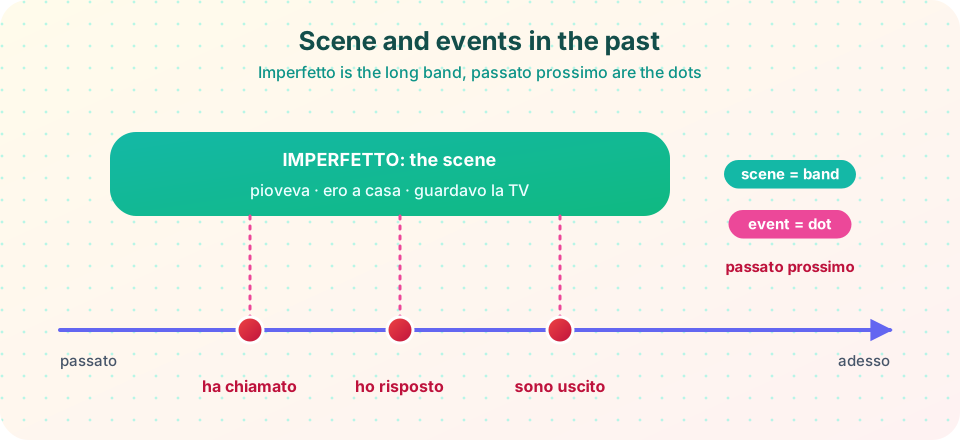
Imperfetto paints the scene (a long band). Passato prossimo marks the events that happen inside it (dots).
Think of a film. The scene is what is going on while the action happens: the weather, how people felt, what they used to do. The events are the moments that move the story forward: someone arrives, a phone rings, a door closes. Italian gives each its own tense.
Role
Tense
Example
English
Event, finished, happened once
passato prossimo
Ieri ho incontrato Anna.
Yesterday I met Anna.
Scene, background, ongoing
imperfetto
Pioveva e faceva freddo.
It was raining and it was cold.
Habit in the past
imperfetto
Da bambino giocavo sempre a calcio.
As a child I always played football.
Event inside a scene
both
Mentre camminavo, ho visto un gatto.
While I was walking, I saw a cat.
A short example shows both working together:
Ieri sera ero a casa. Guardavo la televisione quando il telefono ha squillato. Ho risposto subito.
"Last night I was at home. I was watching television when the phone rang. I answered immediately." The first two verbs (ero, guardavo) set the scene. The last two (ha squillato, ho risposto) are events.
Italian also has a third past tense, the passato remoto (parlai, andò, vendemmo). In writing, especially in novels and history books, it describes events that are far in the past. In speech it is common in southern Italy and Tuscany but rare in the north, where speakers use the passato prossimo instead. As a beginner, you do not need to produce it. You will see it in books and understand it more easily after you master the two tenses of this chapter.
Warm up with time expressions. They tell you the passato prossimo is probably coming.
Past-time expressions
<metacharset="utf-8"><style>*{box-sizing:border-box}body{margin:0;padding:14px;font:16px system-ui,-apple-system,'Segoe UI',sans-serif;color:#1e1b4b;background:linear-gradient(135deg,#f0fdfa,#ecfeff)}.card{background:#fff;border-radius:18px;padding:18px;box-shadow:0 10px 26px rgba(13,148,136,.18)}.n{color:#0d9488;font-size:14px;font-weight:600}.q{font-size:20px;margin:10px 0;min-height:30px}.h{color:#64748b;font-size:14px;min-height:20px}input{font:inherit;padding:8px 12px;border:2px solid #99f6e4;border-radius:12px;width:min(100%,22em)}button{font:inherit;font-weight:600;border:0;border-radius:12px;padding:9px 15px;color:#fff;background:linear-gradient(135deg,#14b8a6,#6366f1);cursor:pointer;margin:4px 4px 0 0}button.alt{background:linear-gradient(135deg,#f59e0b,#ef4444)}button.ghost{background:#e0f2fe;color:#075985}.ok{color:#047857;font-weight:600}.bad{color:#b91c1c;font-weight:600}.face{min-height:120px;display:flex;align-items:center;justify-content:center;text-align:center;font-size:30px;font-weight:700;border-radius:16px;background:linear-gradient(135deg,#ccfbf1,#e0e7ff);padding:14px;cursor:pointer;margin:10px 0}.note{color:#475569;font-size:15px;min-height:22px}.cols{display:grid;grid-template-columns:1fr 1fr;gap:10px}.cols button{display:block;width:100%;margin:0 0 8px;background:#f1f5f9;color:#1e1b4b;border:2px solid #cbd5e1;text-align:left}.cols button.sel{border-color:#6366f1;background:#e0e7ff}.cols button.done{border-color:#10b981;background:#d1fae5;color:#065f46}.cols button.wrong{border-color:#ef4444;background:#fee2e2}</style><divclass="card"><divclass="n"id="n"></div><divclass="face"id="f"tabindex="0"role="button"aria-label="Flip card"></div><divclass="note"id="note"></div><buttonid="flip">Flip</button><buttonid="know"class="alt">I knew it</button><buttonid="again"class="ghost">Again later</button><buttonid="say"class="ghost">Listen</button><pclass="note"id="m"></p></div><script>const items=[["ieri","yesterday","Ieri ho lavorato."],["ieri sera","last night","sera = evening"],["due giorni fa","two days ago","fa goes after the time"],["la settimana scorsa","last week","scorso agrees: scorsa/scorso"],["l'anno scorso","last year","masculine: scorso"],["stamattina","this morning","a contraction of questa mattina"],["già","already","Ho già mangiato."],["non ... ancora","not yet","Non ho ancora finito."]];let deck=items.map((_,k)=>k),flipped=false,known=0;const$=id=>document.getElementById(id);functionrender(){$("n").textContent="Known "+known+" of "+items.length+" - "+deck.length+" left";if(!deck.length){$("f").textContent="Tutto fatto! All cards known.";$("note").textContent="Press Again later to restart.";deck=items.map((_,k)=>k);known=0;flipped=false;return}const it=items[deck[0]];$("f").textContent=flipped?it[1]:it[0];$("note").textContent=flipped?(it[2]||""):"Tap the card to see the English.";}functionflip(){flipped=!flipped;render()}$("f").onclick=flip;$("flip").onclick=flip;$("know").onclick=()=>{deck.shift();known++;flipped=false;render()};$("again").onclick=()=>{deck.push(deck.shift());flipped=false;render()};$("say").onclick=()=>{try{if(!deck.length||!("speechSynthesis"in window)){$("m").textContent="Speech is not available in this preview.";return}const u=newSpeechSynthesisUtterance(items[deck[0]][0]);u.lang="it-IT";window.speechSynthesis.speak(u);$("m").textContent="";}catch(e){$("m").textContent="Speech is not available in this preview."}};render();</script>
Match each tense to its job.
Match the tense to its job
<metacharset="utf-8"><style>*{box-sizing:border-box}body{margin:0;padding:14px;font:16px system-ui,-apple-system,'Segoe UI',sans-serif;color:#1e1b4b;background:linear-gradient(135deg,#f0fdfa,#ecfeff)}.card{background:#fff;border-radius:18px;padding:18px;box-shadow:0 10px 26px rgba(13,148,136,.18)}.n{color:#0d9488;font-size:14px;font-weight:600}.q{font-size:20px;margin:10px 0;min-height:30px}.h{color:#64748b;font-size:14px;min-height:20px}input{font:inherit;padding:8px 12px;border:2px solid #99f6e4;border-radius:12px;width:min(100%,22em)}button{font:inherit;font-weight:600;border:0;border-radius:12px;padding:9px 15px;color:#fff;background:linear-gradient(135deg,#14b8a6,#6366f1);cursor:pointer;margin:4px 4px 0 0}button.alt{background:linear-gradient(135deg,#f59e0b,#ef4444)}button.ghost{background:#e0f2fe;color:#075985}.ok{color:#047857;font-weight:600}.bad{color:#b91c1c;font-weight:600}.face{min-height:120px;display:flex;align-items:center;justify-content:center;text-align:center;font-size:30px;font-weight:700;border-radius:16px;background:linear-gradient(135deg,#ccfbf1,#e0e7ff);padding:14px;cursor:pointer;margin:10px 0}.note{color:#475569;font-size:15px;min-height:22px}.cols{display:grid;grid-template-columns:1fr 1fr;gap:10px}.cols button{display:block;width:100%;margin:0 0 8px;background:#f1f5f9;color:#1e1b4b;border:2px solid #cbd5e1;text-align:left}.cols button.sel{border-color:#6366f1;background:#e0e7ff}.cols button.done{border-color:#10b981;background:#d1fae5;color:#065f46}.cols button.wrong{border-color:#ef4444;background:#fee2e2}</style><divclass="card"><divclass="n"id="n">Pick an Italian item, then its English match.</div><divclass="cols"style="margin-top:10px"><divid="L"></div><divid="R"></div></div><pid="m"class="note"></p><buttonid="re"class="ghost">Shuffle again</button></div><script>const pairs=[["passato prossimo","a finished event"],["imperfetto","a habit or scene"],["participio passato","the -ed form"],["ausiliare","avere or essere"],["ieri","yesterday"],["di solito","usually"]];const$=id=>document.getElementById(id);let sel=null,found=0;constshuffle=a=>{a=a.slice();for(let k=a.length-1;k>0;k--){const j=Math.floor(Math.random()*(k+1));[a[k],a[j]]=[a[j],a[k]]}return a};functionbuild(){
sel=null;found=0;$("m").textContent="";$("L").innerHTML="";$("R").innerHTML="";
pairs.forEach((p,k)=>{const b=document.createElement("button");b.textContent=p[0];b.onclick=()=>pick(b,k,"L");$("L").appendChild(b)});shuffle(pairs.map((p,k)=>k)).forEach(k=>{const b=document.createElement("button");b.textContent=pairs[k][1];b.onclick=()=>pick(b,k,"R");$("R").appendChild(b)});}functionpick(b,k,side){if(b.classList.contains("done"))return;if(!sel||sel.side===side){if(sel)sel.b.classList.remove("sel");sel={b,k,side};b.classList.add("sel");return}const a=sel;sel=null;a.b.classList.remove("sel");if(a.k===k){a.b.classList.add("done");b.classList.add("done");found++;$("m").textContent=found===pairs.length?"Bravo! All pairs matched.":found+" of "+pairs.length+" matched."}else{a.b.classList.add("wrong");b.classList.add("wrong");setTimeout(()=>{a.b.classList.remove("wrong");b.classList.remove("wrong")},600);$("m").textContent="Not a pair - try again."}}$("re").onclick=build;build();</script>