Practice Italian with translation drills, error correction, dialogue matching and guided writing tasks covering questions, past tenses, pronouns and travel.
Understanding a rule and using it under time pressure are different skills. This practice set mixes everything from chapters 5 to 8 and asks you to produce Italian, not just recognise it. There are four kinds of tasks: translating short sentences, correcting errors, matching questions with answers, and writing short texts of your own. Do them in order, and do them without looking at the lessons first. Then check yourself and go back to the lessons for anything you missed.
Mistakes are valuable here. Each wrong answer points to something your brain has not yet automated, and that is where the next study session should go. Treat the exercises as a diagnostic tool.
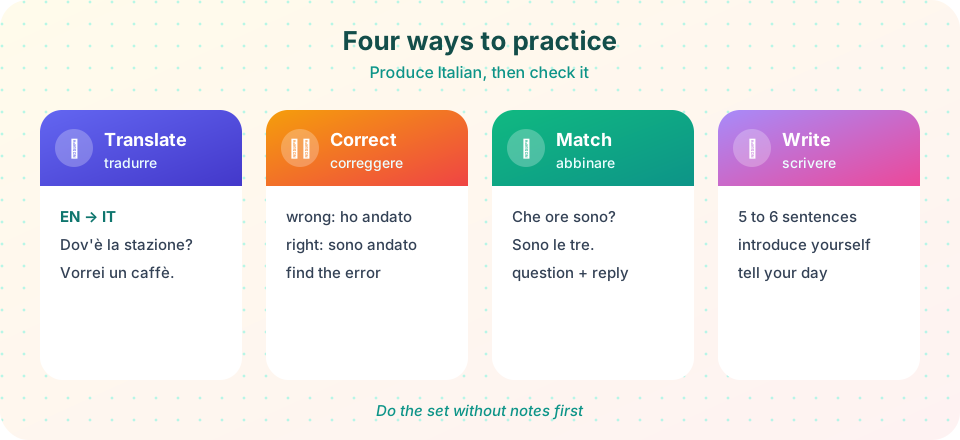
Four ways to practice: translate, correct, match and write. The more you produce, the faster the forms become automatic.
Translate each English sentence. You may use accents, and punctuation does not matter. If your answer differs from the key but is correct, that is fine; the checker accepts a few variants and shows the main answer.
Translation set
<metacharset="utf-8"><style>*{box-sizing:border-box}body{margin:0;padding:14px;font:16px system-ui,-apple-system,'Segoe UI',sans-serif;color:#1e1b4b;background:linear-gradient(135deg,#f0fdfa,#ecfeff)}.card{background:#fff;border-radius:18px;padding:18px;box-shadow:0 10px 26px rgba(13,148,136,.18)}.n{color:#0d9488;font-size:14px;font-weight:600}.q{font-size:20px;margin:10px 0;min-height:30px}.h{color:#64748b;font-size:14px;min-height:20px}input{font:inherit;padding:8px 12px;border:2px solid #99f6e4;border-radius:12px;width:min(100%,22em)}button{font:inherit;font-weight:600;border:0;border-radius:12px;padding:9px 15px;color:#fff;background:linear-gradient(135deg,#14b8a6,#6366f1);cursor:pointer;margin:4px 4px 0 0}button.alt{background:linear-gradient(135deg,#f59e0b,#ef4444)}button.ghost{background:#e0f2fe;color:#075985}.ok{color:#047857;font-weight:600}.bad{color:#b91c1c;font-weight:600}.face{min-height:120px;display:flex;align-items:center;justify-content:center;text-align:center;font-size:30px;font-weight:700;border-radius:16px;background:linear-gradient(135deg,#ccfbf1,#e0e7ff);padding:14px;cursor:pointer;margin:10px 0}.note{color:#475569;font-size:15px;min-height:22px}.cols{display:grid;grid-template-columns:1fr 1fr;gap:10px}.cols button{display:block;width:100%;margin:0 0 8px;background:#f1f5f9;color:#1e1b4b;border:2px solid #cbd5e1;text-align:left}.cols button.sel{border-color:#6366f1;background:#e0e7ff}.cols button.done{border-color:#10b981;background:#d1fae5;color:#065f46}.cols button.wrong{border-color:#ef4444;background:#fee2e2}</style><divclass="card"><divclass="n"id="n"></div><divclass="q"id="q"></div><divclass="h"id="h"></div><inputid="a"autocomplete="off"autocapitalize="off"spellcheck="false"aria-label="Your answer"><buttonid="b">Check</button><pid="m"class="note"></p></div><script>const items=[["Translate: Where is the station?","dov'è la stazione|dove è la stazione","Use a contraction"],["Translate: I would like a coffee, please.","vorrei un caffè per favore|un caffè per favore","polite request"],["Translate: What time is it?","che ore sono|che ora è",""],["Translate: Yesterday I ate pizza (man).","ieri ho mangiato la pizza|ieri ho mangiato pizza","passato prossimo with avere"],["Translate: She went to Rome.","è andata a roma|lei è andata a roma","essere + agreement"],["Translate: Tomorrow we will leave.","domani partiremo","future of partire"],["Translate: I see him every day.","lo vedo ogni giorno|lo vedo tutti i giorni","pronoun before the verb"],["Translate: I think he is tired.","penso che sia stanco|credo che sia stanco","subjunctive after penso che"]];let i=0,score=0,checked=false;const$=id=>document.getElementById(id);constnorm=s=>s.toLowerCase().replace(/[.,;!?]/g,"").replace(/[\u2018\u2019]/g,"'").replace(/\s+/g," ").trim();conststrip=s=>norm(s).normalize("NFD").replace(/[\u0300-\u036f]/g,"");functionrender(){const it=items[i];$("n").textContent="Question "+(i+1)+" of "+items.length+" - score "+score;$("q").textContent=it[0];$("h").textContent=it[2]?"Hint: "+it[2]:"";$("a").style.display="";$("a").value="";$("m").textContent="";$("m").className="note";$("b").textContent="Check";checked=false;$("a").focus();}functionact(){if(i>=items.length){i=0;score=0;render();return}if(checked){
i++;if(i>=items.length){$("n").textContent="";$("h").textContent="";$("q").textContent="Finished! Score: "+score+" / "+items.length;$("a").style.display="none";$("m").textContent="";$("b").textContent="Try again";return}render();return;}const opts=items[i][1].split("|"),g=norm($("a").value);if(!g){return}if(opts.some(o=>norm(o)===g)){score++;$("m").className="ok";$("m").textContent="Corretto! "+opts[0]}elseif(opts.some(o=>strip(o)===strip(g))){$("m").className="bad";$("m").textContent="Almost - watch the accent: "+opts[0]}else{$("m").className="bad";$("m").textContent="Not quite. Answer: "+opts.join(" / ")}$("n").textContent="Question "+(i+1)+" of "+items.length+" - score "+score;
checked=true;$("b").textContent="Next";}$("b").onclick=act;$("a").addEventListener("keydown",e=>{if(e.key==="Enter")act()});render();</script>
Each sentence below contains one typical learner error. Type the corrected sentence in full.
Error correction
<metacharset="utf-8"><style>*{box-sizing:border-box}body{margin:0;padding:14px;font:16px system-ui,-apple-system,'Segoe UI',sans-serif;color:#1e1b4b;background:linear-gradient(135deg,#f0fdfa,#ecfeff)}.card{background:#fff;border-radius:18px;padding:18px;box-shadow:0 10px 26px rgba(13,148,136,.18)}.n{color:#0d9488;font-size:14px;font-weight:600}.q{font-size:20px;margin:10px 0;min-height:30px}.h{color:#64748b;font-size:14px;min-height:20px}input{font:inherit;padding:8px 12px;border:2px solid #99f6e4;border-radius:12px;width:min(100%,22em)}button{font:inherit;font-weight:600;border:0;border-radius:12px;padding:9px 15px;color:#fff;background:linear-gradient(135deg,#14b8a6,#6366f1);cursor:pointer;margin:4px 4px 0 0}button.alt{background:linear-gradient(135deg,#f59e0b,#ef4444)}button.ghost{background:#e0f2fe;color:#075985}.ok{color:#047857;font-weight:600}.bad{color:#b91c1c;font-weight:600}.face{min-height:120px;display:flex;align-items:center;justify-content:center;text-align:center;font-size:30px;font-weight:700;border-radius:16px;background:linear-gradient(135deg,#ccfbf1,#e0e7ff);padding:14px;cursor:pointer;margin:10px 0}.note{color:#475569;font-size:15px;min-height:22px}.cols{display:grid;grid-template-columns:1fr 1fr;gap:10px}.cols button{display:block;width:100%;margin:0 0 8px;background:#f1f5f9;color:#1e1b4b;border:2px solid #cbd5e1;text-align:left}.cols button.sel{border-color:#6366f1;background:#e0e7ff}.cols button.done{border-color:#10b981;background:#d1fae5;color:#065f46}.cols button.wrong{border-color:#ef4444;background:#fee2e2}</style><divclass="card"><divclass="n"id="n"></div><divclass="q"id="q"></div><divclass="h"id="h"></div><inputid="a"autocomplete="off"autocapitalize="off"spellcheck="false"aria-label="Your answer"><buttonid="b">Check</button><pid="m"class="note"></p></div><script>const items=[["Fix: Io sono mangiato la pizza.","io ho mangiato la pizza|ho mangiato la pizza","wrong helper verb"],["Fix: Ho andato al cinema ieri (man).","sono andato al cinema ieri|ieri sono andato al cinema","andare takes essere"],["Fix: Penso che lui è stanco.","penso che lui sia stanco","subjunctive"],["Fix: Vedo lo.","lo vedo","pronoun position"],["Fix: Sono fame.","ho fame","avere for physical states"],["Fix: Quanto persone siete?","quante persone siete","agreement"],["Fix: Voglio che io parto.","voglio partire","same subject"],["Fix: Non mi piace i gatti.","non mi piacciono i gatti","plural subject"]];let i=0,score=0,checked=false;const$=id=>document.getElementById(id);constnorm=s=>s.toLowerCase().replace(/[.,;!?]/g,"").replace(/[\u2018\u2019]/g,"'").replace(/\s+/g," ").trim();conststrip=s=>norm(s).normalize("NFD").replace(/[\u0300-\u036f]/g,"");functionrender(){const it=items[i];$("n").textContent="Question "+(i+1)+" of "+items.length+" - score "+score;$("q").textContent=it[0];$("h").textContent=it[2]?"Hint: "+it[2]:"";$("a").style.display="";$("a").value="";$("m").textContent="";$("m").className="note";$("b").textContent="Check";checked=false;$("a").focus();}functionact(){if(i>=items.length){i=0;score=0;render();return}if(checked){
i++;if(i>=items.length){$("n").textContent="";$("h").textContent="";$("q").textContent="Finished! Score: "+score+" / "+items.length;$("a").style.display="none";$("m").textContent="";$("b").textContent="Try again";return}render();return;}const opts=items[i][1].split("|"),g=norm($("a").value);if(!g){return}if(opts.some(o=>norm(o)===g)){score++;$("m").className="ok";$("m").textContent="Corretto! "+opts[0]}elseif(opts.some(o=>strip(o)===strip(g))){$("m").className="bad";$("m").textContent="Almost - watch the accent: "+opts[0]}else{$("m").className="bad";$("m").textContent="Not quite. Answer: "+opts.join(" / ")}$("n").textContent="Question "+(i+1)+" of "+items.length+" - score "+score;
checked=true;$("b").textContent="Next";}$("b").onclick=act;$("a").addEventListener("keydown",e=>{if(e.key==="Enter")act()});render();</script>
Each question has a natural reply. Match them. Click an Italian question, then its answer.
Questions and answers
<metacharset="utf-8"><style>*{box-sizing:border-box}body{margin:0;padding:14px;font:16px system-ui,-apple-system,'Segoe UI',sans-serif;color:#1e1b4b;background:linear-gradient(135deg,#f0fdfa,#ecfeff)}.card{background:#fff;border-radius:18px;padding:18px;box-shadow:0 10px 26px rgba(13,148,136,.18)}.n{color:#0d9488;font-size:14px;font-weight:600}.q{font-size:20px;margin:10px 0;min-height:30px}.h{color:#64748b;font-size:14px;min-height:20px}input{font:inherit;padding:8px 12px;border:2px solid #99f6e4;border-radius:12px;width:min(100%,22em)}button{font:inherit;font-weight:600;border:0;border-radius:12px;padding:9px 15px;color:#fff;background:linear-gradient(135deg,#14b8a6,#6366f1);cursor:pointer;margin:4px 4px 0 0}button.alt{background:linear-gradient(135deg,#f59e0b,#ef4444)}button.ghost{background:#e0f2fe;color:#075985}.ok{color:#047857;font-weight:600}.bad{color:#b91c1c;font-weight:600}.face{min-height:120px;display:flex;align-items:center;justify-content:center;text-align:center;font-size:30px;font-weight:700;border-radius:16px;background:linear-gradient(135deg,#ccfbf1,#e0e7ff);padding:14px;cursor:pointer;margin:10px 0}.note{color:#475569;font-size:15px;min-height:22px}.cols{display:grid;grid-template-columns:1fr 1fr;gap:10px}.cols button{display:block;width:100%;margin:0 0 8px;background:#f1f5f9;color:#1e1b4b;border:2px solid #cbd5e1;text-align:left}.cols button.sel{border-color:#6366f1;background:#e0e7ff}.cols button.done{border-color:#10b981;background:#d1fae5;color:#065f46}.cols button.wrong{border-color:#ef4444;background:#fee2e2}</style><divclass="card"><divclass="n"id="n">Pick an Italian item, then its English match.</div><divclass="cols"style="margin-top:10px"><divid="L"></div><divid="R"></div></div><pid="m"class="note"></p><buttonid="re"class="ghost">Shuffle again</button></div><script>const pairs=[["Come ti chiami?","Mi chiamo Luca."],["Dove abiti?","Abito a Roma."],["Che ore sono?","Sono le tre e mezza."],["Quanto costa?","Costa due euro."],["Hai fratelli?","Sì, ho una sorella."],["Che tempo fa?","Fa caldo."],["Che cosa hai fatto ieri?","Ho lavorato tutto il giorno."],["Scusi, dov'è la farmacia?","Vada dritto e giri a sinistra."]];const$=id=>document.getElementById(id);let sel=null,found=0;constshuffle=a=>{a=a.slice();for(let k=a.length-1;k>0;k--){const j=Math.floor(Math.random()*(k+1));[a[k],a[j]]=[a[j],a[k]]}return a};functionbuild(){
sel=null;found=0;$("m").textContent="";$("L").innerHTML="";$("R").innerHTML="";
pairs.forEach((p,k)=>{const b=document.createElement("button");b.textContent=p[0];b.onclick=()=>pick(b,k,"L");$("L").appendChild(b)});shuffle(pairs.map((p,k)=>k)).forEach(k=>{const b=document.createElement("button");b.textContent=pairs[k][1];b.onclick=()=>pick(b,k,"R");$("R").appendChild(b)});}functionpick(b,k,side){if(b.classList.contains("done"))return;if(!sel||sel.side===side){if(sel)sel.b.classList.remove("sel");sel={b,k,side};b.classList.add("sel");return}const a=sel;sel=null;a.b.classList.remove("sel");if(a.k===k){a.b.classList.add("done");b.classList.add("done");found++;$("m").textContent=found===pairs.length?"Bravo! All pairs matched.":found+" of "+pairs.length+" matched."}else{a.b.classList.add("wrong");b.classList.add("wrong");setTimeout(()=>{a.b.classList.remove("wrong");b.classList.remove("wrong")},600);$("m").textContent="Not a pair - try again."}}$("re").onclick=build;build();</script>
Writing makes you choose every word. Use a sheet of paper or a notes app. Aim for correctness, not length, and use only words you are sure about.
Task A: Introduce yourself (5 to 6 sentences). Give your name, where you are from, your job or studies, your family and one thing you like. Use Mi chiamo..., Sono di..., Faccio... / Studio..., Ho..., Mi piace...
Model answer: "Mi chiamo Chris e sono di Toronto. Studio informatica all'università. Ho una sorella e un fratello. Nel tempo libero mi piace suonare la chitarra. Studio italiano da tre mesi."
Task B: What did you do yesterday? (5 to 6 sentences). Use the passato prossimo for events and the imperfetto for the scene.
Model answer: "Ieri mi sono svegliato presto. Pioveva, quindi sono andato al lavoro in autobus. Ho lavorato fino alle cinque. Poi ho incontrato un amico e abbiamo mangiato insieme. Eravamo stanchi, ma contenti."
Task C: A dialogue at a restaurant. Write six lines between a waiter and a customer, including the order of a first course, a drink and the bill.
Model answer: "Cameriere: Buonasera, un tavolo per due? / Cliente: Sì, grazie. Possiamo vedere il menù? / Cameriere: Certo. Che cosa prendete da bere? / Cliente: Una bottiglia d'acqua frizzante, per favore. Come primo prendo gli spaghetti. / Cameriere: Perfetto. Altro? / Cliente: No, grazie. Il conto, per favore."
Task D: Give directions. Write three sentences telling a stranger how to get from the station to a hotel, using the formal imperative.
Model answer: "Vada sempre dritto per due strade. Poi giri a destra al semaforo. L'hotel è accanto alla piazza."
Count how many items you got right in each part and enter the numbers. The tool prints a short study suggestion. It is a rule-of-thumb model, not an assessment: use it to decide what to review, not to judge yourself.
JS
Self-check calculator
const parts =[{name:"Part 1 (translation)",score:6,max:8,review:"chapters 5 to 7: questions, past tenses, pronouns"},{name:"Part 2 (corrections)",score:5,max:8,review:"avere/essere, subjunctive, pronoun position"},{name:"Part 3 (dialogues)",score:7,max:8,review:"chapter 8: travel and small talk"},];for(const p of parts){const pct = Math.round(100* p.score / p.max);let advice ="Solid. Keep practicing.";if(pct <60) advice =`Review ${p.review} and try again.`;elseif(pct <85) advice =`Nearly there. Look again at ${p.review}.`;
console.log(`${p.name}: ${p.score}/${p.max} (${pct}%) -> ${advice}`);}
Press Run (or Ctrl + Enter) to see the console output here.
When you compare your texts with the models, look at four things in this order:
Verb forms and helpers. Is it ho or sono? Does the participle agree?
Tense choice. Are scene and events separated (imperfetto vs passato prossimo)?
Small words. Did you put pronouns before the verb? Did you use di, a, in correctly?
Spelling and accents.è versus e, perché, città, sì.
If you can, ask an Italian speaker or a tutor to read your texts. A native reader notices unnatural phrasing that no checklist will catch. Remember that this course, however carefully made, cannot replace speaking with real people.
Use the set in three passes. In the first pass, work without notes and time yourself: aim for a quick, instinctive answer, because this shows what you can really produce. In the second pass, look up the items you missed in the lessons and the cheat sheet, and write the rule next to each mistake in your own words. In the third pass, a few days later, redo only the items you missed. If you get them right again, move on; if not, create flashcards for them.
Keep a small error log: a table with the wrong sentence, the corrected sentence and the rule. After a few weeks you will see patterns, for example that you often forget the participle agreement with essere, or that you place pronouns after the verb. Patterns tell you exactly what to practice. The goal of practice is not to avoid errors, but to find them early and turn them into habits that stay.
"A correct translation is word for word." Italian often needs different structures: Ho fame, not "I am hunger"; Mi piace il caffè, not "I like coffee" word for word.
"If my answer differs from the key, it is wrong." Check whether it is a valid variant. Italian allows many ways to say the same thing.
"I should avoid mistakes." Mistakes in practice are useful. Correct them, note the rule and move on.