


















Lesson 6 of 50 · Sounds, Greetings and Basics
The Italian alphabet and the vowels
Learn the 21-letter Italian alphabet, how to spell a name aloud, and the five pure Italian vowels, including open and closed e and o.
Every language has two layers: the letters on the page and the sounds in the air. In Italian, the link between the two is unusually tight. In this lesson you will learn the alphabet and its letter names, how to spell a word aloud over the phone, and the five vowels that carry the sound of the language.
If you master the vowels in this lesson, you will already sound much more Italian than most beginners. Italian is a very vowel-rich language: almost every word ends in a vowel, and vowels make up the melody.
What you will learn
- The 21 native letters of Italian and the five foreign letters, with their Italian names.
- How to spell a name aloud using the traditional city names.
- The five vowel sounds and how to pronounce each one clearly.
- The difference between open and closed e and o.
- How vowels combine into one syllable (diphthongs) or two (hiatus).
Key terms
Vowel (vocale): a sound made with open air flow, written a, e, i, o, u in Italian.
Consonant (consonante): a sound made with some closing or narrowing of the mouth.
Diphthong (dittongo): two vowels pronounced together in a single syllable, such as ia in piano.
Hiatus (iato): two vowels next to each other that belong to different syllables, such as ae in paese.
Syllable (sillaba): a beat of a word, built around one vowel sound, such as pa-e-se.
The alphabet
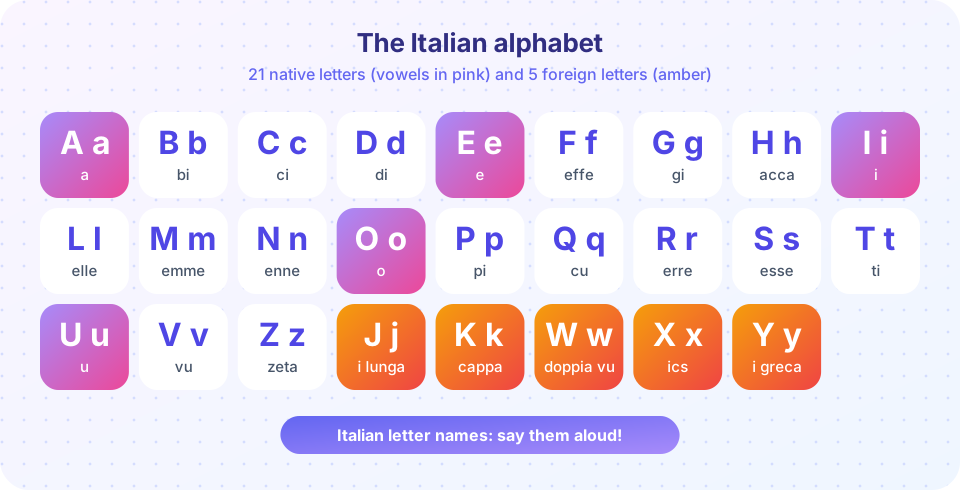
The traditional Italian alphabet has 21 letters: a, b, c, d, e, f, g, h, i, l, m, n, o, p, q, r, s, t, u, v, z. The letters j, k, w, x and y are not native; they appear in foreign words used in Italian, such as jeans, kiwi, whisky, taxi and yogurt. So the modern alphabet used for dictionaries and computers has 26 letters, but only 21 are "Italian" letters.
Each letter has an Italian name, which you need when you spell. Most are easy: a, bi, ci, di, e, effe, gi, acca, i, elle, emme, enne, o, pi, cu, erre, esse, ti, u, vu, zeta. A few names deserve attention:
- h is called acca, and it is silent in Italian words (ho "I have" is said /ɔ/).
- q is called cu; it is nearly always followed by u (quando, questo).
- v is vu (a few people say vi).
- j, k, w, x, y are i lunga (long i), cappa, doppia vu (double v), ics and i greca (Greek i, also ipsilon).
Spelling aloud
When you have to give your name over the phone, Italians do not say "A as in apple". They use city names: A come Ancona, B come Bologna, C come Como, D come Domodossola, E come Empoli, F come Firenze, G come Genova, H come hotel, I come Imola, L come Livorno, M come Milano, N come Napoli, O come Otranto, P come Palermo, Q come Quarto, R come Roma, S come Savona, T come Torino, U come Udine, V come Venezia, Z come Zara.
Useful phrases for spelling:
| Italian | English |
|---|---|
| Come si scrive? | How is it written? |
| Come si scrive il tuo nome? | How do you write your name? |
| Può fare lo spelling, per favore? | Can you spell it, please? |
| Si scrive con due t. | It is written with two t's. |
| Con la acca. | With the h. |
The five vowels
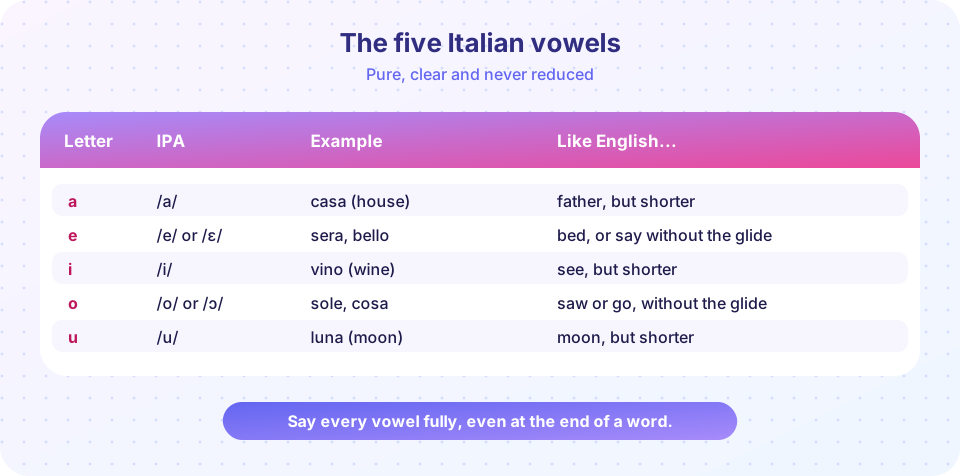
Italian has five vowel letters (a, e, i, o, u) and, in careful speech, seven vowel sounds, because e and o each have an open and a closed version. Their key quality is purity: an Italian vowel does not glide or change while you say it, and it is not shortened to a weak "uh" when it is unstressed.
Practice each one slowly:
- a /a/: open mouth, tongue low, like the a in father, but a little shorter. casa (KAH-zah), mare (MAH-reh).
- i /i/: lips spread, like the ee in see, but shorter. vino (VEE-no), mila (MEE-lah).
- u /u/: lips rounded and pushed forward, like the oo in moon. luna (LOO-nah), uno (OO-no).
- e: either closed /e/ (like the first half of English say, without the glide to ee) or open /ɛ/ (like e in bed). sera (SEH-rah) uses closed /e/; bello (BEL-lo) uses open /ɛ/.
- o: either closed /o/ (like the o in go, without the glide to oo) or open /ɔ/ (like aw in saw, but shorter). sole (SOH-leh) uses closed /o/; cosa (KAW-zah) uses open /ɔ/.
English speakers' typical errors
English vowels glide: no is really "noh-oo", say is "seh-ee". Do not do this in Italian. Say no and keep your lips and tongue still until the sound ends. English also shortens unstressed vowels to a lazy "uh" (the a in banana). In Italian every vowel keeps its full quality, even when it is not stressed: banana is bah-NAH-nah, all clear a's.
Open and closed e and o
For a beginner, the best advice is: learn them gradually and do not stress about them. In everyday speech, the difference rarely causes confusion, and the exact pattern varies from region to region. (People in northern Italy and in Rome often make different choices in some words.) Still, there are a few pairs where the choice distinguishes words in standard pronunciation, and dictionaries mark the vowel with an accent: the grave accent (è, ò) for open vowels and the acute accent (é, ó) for closed ones.
- pésca /ˈpeska/ (fishing) and pèsca /ˈpɛska/ (peach).
- còrso /ˈkɔrso/ (a Corsican) and córso /ˈkorso/ (course, or street in "Corso Italia").
In ordinary writing, you do not see these marks inside words. They show up at the end of words, such as caffè (an open e, written with a grave accent) and perché (a closed e, written with an acute accent). Stress and accents get their own lesson later.
Diphthongs and hiatus
Italian divides its vowels into strong (a, e, o) and weak (i, u). The rule for beginners is:
- Weak + strong (or strong + weak) in the same syllable make a diphthong, which counts as one syllable: pia-no (2 syllables), buo-no (2), uo-mo (2), Eu-ro-pa (3).
- Strong + strong are always in different syllables (hiatus): pa-e-se (3), le-o-ne (3), po-e-ta (3).
- A stressed i or u next to another vowel also forms a hiatus: mi-o (my), pa-u-ra (fear), far-ma-ci-a (pharmacy), zi-o (uncle), ma-ri-a.
Do not worry about perfecting this now. When you are not sure, say the vowels one by one and keep them clear: a hiatus pronounced as a quick diphthong is a minor error, while a blurred vowel sounds foreign immediately.
Italians pronounce every vowel letter they see. In aiuola (flower bed) three vowel letters stand in a row, and all three are heard.
Common misconceptions
"The final e is silent, as in English." It is never silent. Mare is MAH-reh, with two syllables, and come is KOH-meh. If you drop the last vowel you may be misunderstood.
"I is always long and u is always long." The two weak vowels are short, clear sounds. English "long and short" labels do not apply.
"There are only five vowel sounds, so e is just e." In careful speech there are seven. You do not need to master all seven today, but listen for the difference between bello (open e) and sera (closed e).
"H must be pronounced." H is silent. Hotel in Italian is "otel", ho is "o", and hanno (they have) is ANN-no.
Try it
First, practice the vowels in real words. Flip each card after saying the Italian word aloud.
Second, try the spelling tool. It writes how you would spell any name over the phone, using the Italian city names. Change the names and run it again. Letters outside the Italian alphabet are marked as foreign.
Press Run (or Ctrl + Enter) to see the console output here.
No output.
Third, a quick choice game on syllables, diphthongs and hiatus.
Check your understanding
Quick check · 5 questions
of 5 answered You scored / 5 · perfect!
-
1. How many native letters does the traditional Italian alphabet have?
The traditional alphabet has 21 letters. J, k, w, x and y appear only in foreign words. -
2. What is the Italian name of the letter h?
H is acca. Cappa is k and effe is f. -
3. What is special about Italian vowels compared with English vowels?
Italian vowels do not glide and are not reduced to a weak 'uh' when unstressed. -
4. How would you spell the name 'Ada' using the Italian city names?
A is Ancona and D is Domodossola. -
5. Which pair of vowels is always split into two syllables?
Two strong vowels (a, e, o) form a hiatus: pa-e-se.
Summary
- The traditional alphabet has 21 letters; j, k, w, x, y are foreign. Letter names include acca (h), cu (q) and zeta (z).
- To spell aloud, Italians use city names: A come Ancona, B come Bologna, C come Como...
- Five pure vowels: a, e, i, o, u; e and o can be open or closed.
- Weak vowels i and u form diphthongs with strong ones; two strong vowels (a, e, o) are separate syllables.
- Never drop the final vowel and never reduce an unstressed vowel to "uh".
Track your progress
Create a free account to tick off lessons and pick up where you left off on any device.
of Italian for Beginners lessons completed