


















Lesson 13 of 50 · Nouns, Articles and Adjectives
Noun gender and plurals
Learn how to tell masculine from feminine Italian nouns by their endings, how to form plurals (-i, -e), and the common exceptions and irregular nouns.
Every Italian noun is either masculine or feminine. There is no neuter group like the English "it" for objects. Once a noun has a gender, it keeps it, and the words around it (articles and adjectives) take matching endings. In this lesson you learn how to guess the gender from the ending of a noun and how to form the plural.
The system is more regular than you might fear. A few endings tell you almost everything, and the exceptions form small, memorable groups. By the end, you will be able to sort and pluralize most everyday nouns.
What you will learn
- How to guess gender from endings: -o, -a, -e, and a few special endings.
- The common exceptions (la mano, il problema, la radio).
- How to form masculine and feminine versions of people nouns.
- The regular plural rules and the spelling changes of -ca/-ga, -cia/-gia, -io.
- Nouns that do not change in the plural, and the main irregular plurals.
Key terms
Masculine / feminine (maschile / femminile): the two genders of Italian nouns.
Invariable noun: a noun with the same form in the singular and the plural, such as la città / le città.
Irregular plural: a plural that does not follow the usual endings, such as l'uomo / gli uomini.
Collective plural: a feminine plural in -a for some masculine nouns, such as il dito / le dita.
Gender from the ending
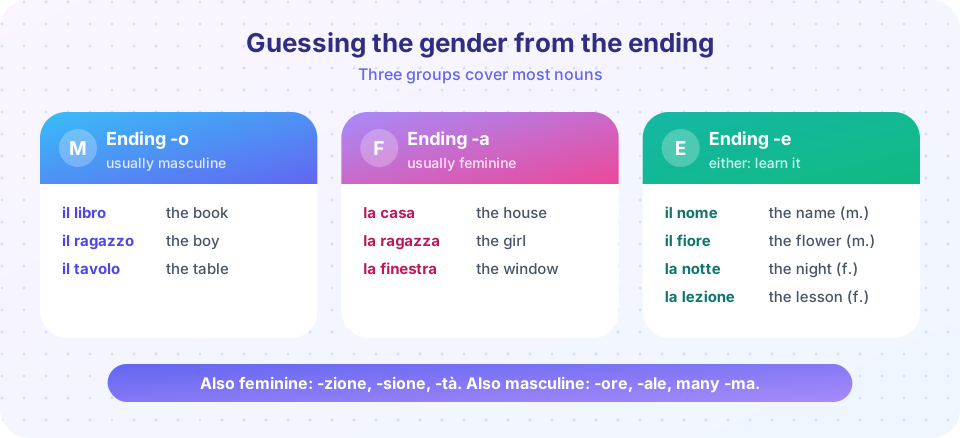
Nouns ending in -o are usually masculine. il libro (book), il ragazzo (boy), il tavolo (table), il gatto (cat), il treno (train), il vino (wine).
Nouns ending in -a are usually feminine. la casa (house), la ragazza (girl), la finestra (window), la penna (pen), la scuola (school), la birra (beer).
Nouns ending in -e can be either gender. There is no way to tell from the letter alone, so learn the article with the noun: il nome (name, m.), il mare (sea, m.), il cane (dog, m.), la notte (night, f.), la madre (mother, f.), la chiave (key, f.). However, some endings help:
- Feminine: -zione and -sione (la lezione, la stazione, la televisione), -tà and -tù (la città, l'università, la virtù), -ie (la serie), -i (la crisi, la tesi).
- Masculine: -ore (il fiore flower, il colore, il dottore), -ale and -ile often (il giornale newspaper, il canale), nouns in -ma from Greek (il problema, il tema, il sistema, il programma), and nearly all foreign words (il computer, il film, il bar, lo sport).
- Days and many names: the days of the week except Sunday are masculine (il lunedì), while la domenica is feminine.
Exceptions
A few nouns break the -o/-a rule. They are common words, so learn them early:
- Feminine nouns ending in -o: la mano (hand), and shortened words: la radio, la foto (from fotografia), la moto (from motocicletta), l'auto (from automobile).
- Masculine nouns ending in -a: il problema, il programma, il sistema, il tema, il panorama, il cinema, il pianeta (planet), il poeta, il papa, and many people words (see below).
Masculine and feminine for people and animals
For people, the gender usually follows the biological sex, and the ending shows it.
| Masculine | Feminine | Meaning |
|---|---|---|
| il ragazzo | la ragazza | boy / girl |
| l'amico | l'amica | friend |
| il figlio | la figlia | son / daughter |
| il gatto | la gatta | cat |
| lo studente | la studentessa | student |
| il professore | la professoressa | teacher, professor |
| il dottore | la dottoressa | doctor |
| l'attore | l'attrice | actor |
| il turista | la turista | tourist (same form) |
| il cantante | la cantante | singer (same form) |
Notice the patterns: -o becomes -a, -e becomes -essa for many professions (-tore often becomes -trice), and many nouns in -ista and -ante/-ente have one form for both genders and are distinguished by the article only.
Making the plural
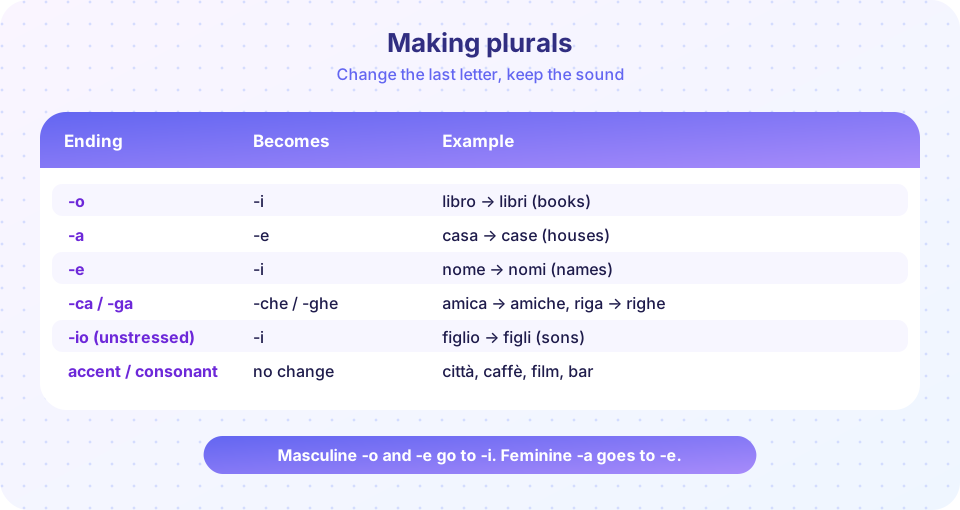
The three main rules:
- -o becomes -i: il libro → i libri, il ragazzo → i ragazzi, il gatto → i gatti.
- -a becomes -e: la casa → le case, la ragazza → le ragazze, la penna → le penne.
- -e becomes -i: il nome → i nomi, la lezione → le lezioni, il cane → i cani, la notte → le notti.
(Both genders end in -i in the third rule: masculine and feminine nouns in -e make their plural in -i.)
Spelling follows the sound
The hard and soft c and g from Chapter 2 influence plurals. The aim is to keep the sound of the singular:
- -ca → -che, -ga → -ghe (the h keeps the hard sound): l'amica → le amiche, la banca → le banche, la riga → le righe.
- -co and -go → -chi, -ghi in most words with stress on the second to last syllable: il gioco → i giochi (game), il lago → i laghi (lake), il fungo → i funghi.
- -co → -ci in many words stressed on the third to last syllable, such as il medico → i medici. There are well-known exceptions: l'amico → gli amici, il nemico → i nemici, il greco → i greci. When in doubt, check a dictionary.
- -cia and -gia: if a consonant comes before, the plural is -ce, -ge: l'arancia → le arance, la spiaggia → le spiagge. If a vowel comes before, or the i is stressed, the i stays: la camicia → le camicie (shirt), la valigia → le valigie, la farmacia → le farmacie.
- -io with unstressed i loses one i: il figlio → i figli, il negozio → i negozi. When the i is stressed, the plural has -ii: lo zio → gli zii.
Nouns that do not change
Some nouns have the same form in the singular and the plural. The article tells you which:
- Nouns ending in an accented vowel: la città → le città, il caffè → i caffè, l'università → le università, il papà → i papà.
- Nouns of one syllable: il re → i re (king).
- Nouns that end in a consonant (foreign words): il film → i film, il bar → i bar, lo sport → gli sport, il computer → i computer.
- Shortened words: la foto → le foto, la moto → le moto, il cinema → i cinema, la bici → le bici.
- Nouns in -i: la crisi → le crisi, l'analisi → le analisi.
Irregular plurals
| Singular | Plural | Meaning |
|---|---|---|
| l'uomo | gli uomini | man, men |
| l'uovo | le uova | egg (feminine plural) |
| la mano | le mani | hand |
| il dito | le dita | finger |
| il braccio | le braccia | arm |
| il paio | le paia | pair |
| il problema | i problemi | problem |
| il turista | i turisti / le turiste | tourist |
The nouns in -a (uova, dita, braccia, paia) are neuter plurals inherited from Latin; they behave like feminine plurals: le uova fresche (the fresh eggs).
A mixed group is masculine
When a group contains both males and females, Italian uses the masculine plural: i figli (sons, or sons and daughters), gli amici (male friends, or a mixed group), i genitori (parents), i ragazzi (boys, or boys and girls). To be clear, you can say amici e amiche.
Plural-only nouns
Some things are only plural in Italian: i pantaloni (trousers), gli occhiali (glasses), le forbici (scissors), le vacanze (holidays), i soldi (money).
Common misconceptions
"All nouns in -a are feminine." Most are, but il problema, il programma, il cinema and il poeta are masculine. Always learn the article.
"The plural of amico is amichi." The sound of c before i would be wrong: the plural is amici (an exception to the -co → -chi pattern). The feminine plural is amiche.
"Add -s for plurals." Italian never adds -s. The ending changes: libro → libri, casa → case. The -s in pizzas is English; Italian says le pizze.
"The plural of città must look different." It does not: only the article changes, la città, le città.
Try it
First, run the plural generator. It applies the rules of this lesson plus a small dictionary of exceptions, and prints the plural of many words. Add words of your own to the list and run it again. Words that break the rules need an entry in the dictionary at the top.
Press Run (or Ctrl + Enter) to see the result here.
Program input · what you'd type while the program runs
Type the answers before you press Run, one per line. Each time the program reads a line (with input()), it gets the next line from this box.
Second, type the plural. Each prompt shows a singular noun with its article.
Third, test your gender instincts.
Check your understanding
Quick check · 6 questions
of 6 answered You scored / 6 · perfect!
-
1. What gender are nouns ending in -zione, such as 'la stazione'?
Nouns in -zione and -sione are feminine. -
2. What is the plural of 'la penna' (pen)?
Feminine nouns in -a make the plural in -e. -
3. What is the plural of 'l'amica' (friend, f.)?
The h keeps the hard c sound: amiche. -
4. Which noun does not change in the plural?
Nouns ending in an accented vowel are invariable: la città, le città. -
5. How do you say 'the eggs'?
L'uovo has an irregular feminine plural: le uova. -
6. A group of male and female friends is...
A mixed group takes the masculine plural.
Summary
- Nouns in -o are usually masculine, in -a usually feminine, in -e either; endings like -zione and -tà (f.) and -ore (m.) help.
- Exceptions: la mano, la radio, la foto, il problema, il cinema.
- Plurals: -o → -i, -a → -e, -e → -i; spelling follows sound (amiche, laghi, arance, camicie).
- Invariable: nouns with a final accent, a final consonant, one syllable, or shortened (la città, il film, la foto).
- Irregulars: uomo → uomini, uovo → uova, mano → mani, dito → dita. A mixed group is masculine.
Next: Articles: the, a and an
Track your progress
Create a free account to tick off lessons and pick up where you left off on any device.
of Italian for Beginners lessons completed