


















Lesson 9 of 50 · Sounds, Greetings and Basics
Greetings and introductions
Learn Italian greetings for every time of day, the difference between informal tu and formal Lei, how to ask how someone is, and how to introduce yourself.
Now you can read Italian aloud, so it is time to use it. Greetings are the first thing you say to anyone, and they are the part of the language Italians notice most. A warm buongiorno to a shopkeeper can change the whole encounter.
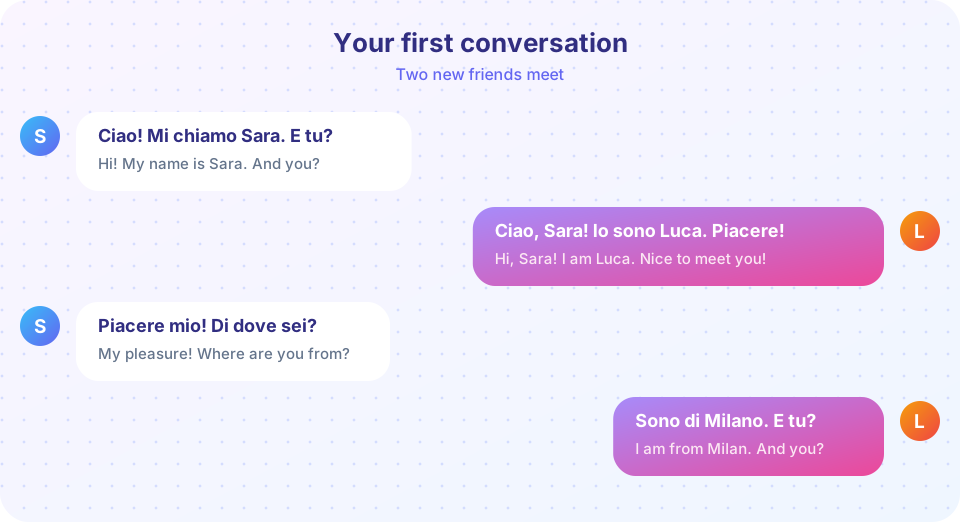
In this lesson you will learn how to say hello and goodbye at every time of day, how to choose between the informal tu and the formal Lei, how to ask and answer "How are you?", how to say your name and where you are from, and how to be polite. At the end you will read two complete mini conversations.
What you will learn
- Greetings and goodbyes for different times of day and different people.
- When to use tu (informal) and Lei (formal).
- How to ask "How are you?" and answer in several ways.
- How to say your name, your nationality and where you are from.
- The key words of politeness: per favore, grazie, prego, scusi, permesso.
Key terms
Tu: informal "you", for friends, family, children, and people your own age in casual settings.
Lei: formal "you" (singular), for strangers, older people, officials and customers. It is written with a capital L in letters to distinguish it from lei (she).
Voi: "you" for more than one person.
Piacere: literally "pleasure"; what you say when you meet someone.
Hello and goodbye
The right hello depends on the time of day and on how well you know the person.
| Italian | Meaning | When |
|---|---|---|
| Buongiorno | Good morning, good day | From morning until about the early afternoon; any formal situation. |
| Buon pomeriggio | Good afternoon | Afternoon; less common than buongiorno or buonasera. |
| Buonasera | Good evening | From the late afternoon on, usually after about 4 or 5 pm. |
| Buonanotte | Good night | Only when you go to bed or say goodbye for the night. |
| Ciao | Hi, bye | Informal, any time of day, hello and goodbye. |
| Salve | Hello | Neutral, between formal and informal. |
| Arrivederci | Goodbye | Standard, polite. Formal: ArrivederLa. |
| A presto | See you soon | Friends, or in a written message. |
| A domani | See you tomorrow | When you will really meet tomorrow. |
| Ci vediamo | See you (later) | Friends. |
| Buona giornata | Have a nice day | Leaving someone in the morning. |
| Buona serata | Have a nice evening | Leaving someone in the evening. |
There is no sharp border between buongiorno and buonasera; it varies by region and by habit. A safe rule is buongiorno until lunch, and buonasera when the afternoon turns into evening. Buonanotte is never a greeting on arrival.
Ciao has a nice history. It comes from a Venetian phrase meaning "I am your servant" (a very polite goodbye); it spread through Italy and now the whole world says it. In Italian, though, it is for friends and family. To a stranger or a client, say buongiorno or buonasera.
Tu or Lei?
English has one "you". Italian has several, and the choice shows the relationship.
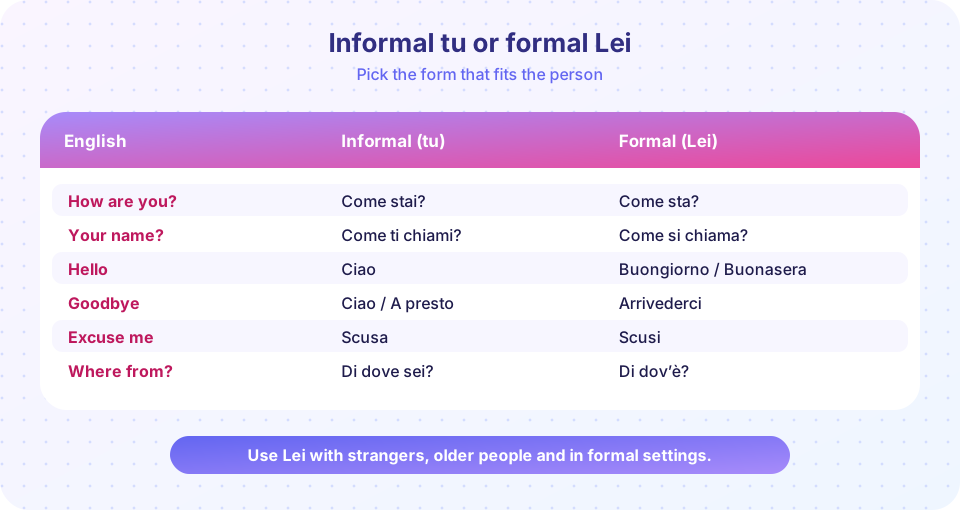
- Use tu with friends, family, children, classmates and people your own age in a relaxed setting. Young people often use tu with everyone.
- Use Lei with strangers, older people, teachers, doctors, customers, officials and in any formal situation. When in doubt, begin with Lei; if the other person wants tu, they will say Possiamo darci del tu (we can use tu) or just start using it.
- Use voi for more than one person ("you all").
The grammar side of Lei is easy to start with: it uses the same verb form as lei (she) and lui (he). You will learn the forms in Chapter 4. For now just remember the pairs in the table.
How are you?
| Informal | Formal | Plural |
|---|---|---|
| Come stai? | Come sta? | Come state? |
Casual friends also say Come va? (How is it going?) and Tutto bene? (All well?). Answers:
- Sto bene, grazie. E tu? I am fine, thanks. And you?
- Molto bene! Very well!
- Non c'è male. Not bad.
- Così così. So-so.
- Sto male. I am not well.
- Tutto bene, grazie. All well, thanks.
When someone asks E tu? or E Lei?, they hand the question back, as in English "And you?".
Saying your name
The Italian way to say "My name is Anna" is Mi chiamo Anna (literally "I call myself Anna"). Another way is Sono Anna (I am Anna).
To ask the name:
- Come ti chiami? What is your name? (informal)
- Come si chiama? What is your name? (formal)
Then you say the magic word Piacere! (Nice to meet you). The other person can answer Piacere mio! (the pleasure is mine) or Molto piacere (very pleased). A longer version is Piacere di conoscerti (informal) or Piacere di conoscerLa (formal).
Italians often say their surname when introducing themselves formally: Buongiorno, sono Maria Bianchi. (Good morning, I am Maria Bianchi.) Use the titles signor (Mr.) and signora (Mrs., Ms.), dottore (m.) or dottoressa (f.) for professional people, professore or professoressa for teachers. Before a surname these titles drop the final vowel: signor Rossi, dottor Verdi.
Where are you from?
- Di dove sei? Where are you from? (informal)
- Di dov'è? Where are you from? (formal)
- Sono di Roma. I am from Rome. (di + city)
- Sono americano / americana. I am American (male / female).
- Sono inglese. I am English / British.
Nationality adjectives change their ending to match the gender of the person: italiano (m.) / italiana (f.), americano / americana, spagnolo / spagnola, but adjectives in -e stay the same: inglese, francese, canadese. You will meet this rule properly in Chapter 3. Notice that nationalities are not capitalized in Italian, and that there is no article after sono (I am English = Sono inglese).
Being polite
| Italian | English |
|---|---|
| Per favore / Per piacere | Please |
| Grazie / Grazie mille | Thanks / Thanks a lot (literally a thousand thanks) |
| Prego | You are welcome; please (go ahead); can I help you? |
| Scusa / Scusi | Sorry, excuse me (informal / formal) |
| Permesso? | May I come in? / May I pass? |
| Mi dispiace | I am sorry |
| Non importa | Never mind |
Prego is a friendly word with many uses. It answers grazie, but it also means "after you", "please go ahead", and in a shop "How can I help you?". Learn it by listening.
Two short dialogues
At a café (informal)
- Sara: Ciao Luca! Come stai?
- Luca: Ciao Sara! Sto bene, grazie. E tu?
- Sara: Non c'è male. Questa è Giulia.
- Luca: Piacere, Giulia!
- Giulia: Piacere mio!
Translation: Sara: Hi Luca! How are you? Luca: Hi Sara! I am fine, thanks. And you? Sara: Not bad. This is Giulia. Luca: Nice to meet you, Giulia! Giulia: The pleasure is mine!
At an office (formal)
- Dott.ssa Bianchi: Buongiorno, signor Rossi. Come sta?
- Signor Rossi: Buongiorno, dottoressa. Bene, grazie. E Lei?
- Dott.ssa Bianchi: Molto bene, grazie. Prego, si accomodi.
- Signor Rossi: Grazie mille.
Translation: Dr. Bianchi: Good morning, Mr. Rossi. How are you? Mr. Rossi: Good morning, doctor. Well, thank you. And you? Dr. Bianchi: Very well, thanks. Please, take a seat. Mr. Rossi: Thank you very much.
A cultural note
Italians greet with warmth. Among friends and family it is common to kiss on the cheeks (often both cheeks, starting with the right) when meeting; in business and with strangers a handshake is the norm. Eye contact and a smile matter. People greet shopkeepers when entering a shop (Buongiorno!) and say goodbye when leaving (Arrivederci, Buona giornata). Skipping the greeting can feel rude.
Common misconceptions
"Buonanotte means good evening." No. Buonasera is the evening greeting. Buonanotte is for the moment someone goes to bed.
"Ciao is always safe." It is informal. To a stranger, a client or an older person you do not know, use buongiorno or buonasera.
"Piacere means please." It means "nice to meet you" (literally pleasure). Please is per favore.
"Sono bene" for "I am well". To say how you are, Italian uses stare, not essere: sto bene. You will meet both verbs in Chapter 4.
"Sono Americano with a capital letter." In Italian, nationalities are written in lowercase: sono americano.
Try it
First, practice the core greetings with flashcards.
Second, read these situations and choose the best greeting. This is where tu and Lei matter.
Third, build introductions. The tool below writes a short self-introduction. Change the people and run it: it adjusts the nationality for the gender of the speaker.
Press Run (or Ctrl + Enter) to see the console output here.
No output.
Check your understanding
Quick check · 6 questions
of 6 answered You scored / 6 · perfect!
-
1. Which greeting do you use for 'good evening'?
Buonasera is the evening greeting. Buonanotte is only for going to bed. -
2. How do you ask a stranger 'What is your name?' politely?
Come si chiama? is the formal (Lei) form. Come ti chiami? is informal. -
3. What does 'Mi chiamo Anna' mean?
Mi chiamo literally means I call myself. -
4. Which sentence means 'I am from Rome'?
Use sono di + city. -
5. Which answer to 'Grazie' is correct?
Prego means you are welcome. Scusi is sorry, and piacere is nice to meet you. -
6. Which form of 'you' do you use with a doctor you just met?
Lei is the formal singular form, used with strangers and professionals.
Summary
- Hello and goodbye: buongiorno, buonasera, ciao (informal), salve, arrivederci; buonanotte only at bedtime.
- Use tu with friends and family, Lei with strangers and in formal situations, voi for several people.
- Come stai? / Come sta?: Sto bene, grazie. E tu?
- Introduce yourself with Mi chiamo... or Sono..., then Piacere!; say Sono di Roma and Sono italiano / italiana.
- Politeness: per favore, grazie, prego, scusi, permesso.
Next: Numbers from 0 to 100
Track your progress
Create a free account to tick off lessons and pick up where you left off on any device.
of Italian for Beginners lessons completed