


















Lesson 42 of 50 · Conversation and Culture
Talking About People and Life
Learn Italian small talk: family words and possessives, jobs, hobbies with mi piace, weather, feelings, opinions and telephone phrases, with dialogues and drills.
After the greeting comes the conversation. Italians love to chat, and the topics are predictable and friendly: family, work or study, free time, the weather, how you feel, and what you think. These are the topics of small talk everywhere, but in Italy the family and the food usually come first. If you can handle them, you can keep a conversation going for a surprisingly long time.
This lesson gives you the vocabulary and the sentence patterns for each topic, with a model dialogue at the end. You will meet a few small grammar points on the way: possessive adjectives with family words, the profession construction (Sono insegnante, no article), piacere with infinitives, and avere for physical states (Ho fame).
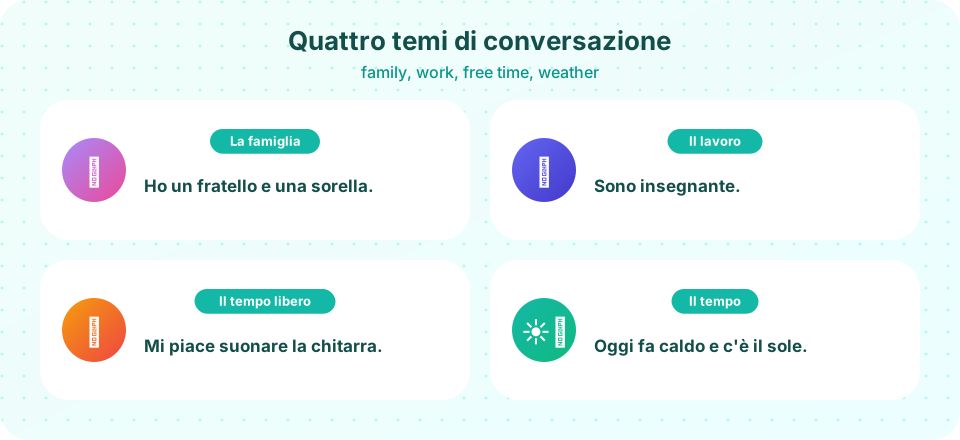
What you will learn
- Family words and how possessives work with them.
- How to talk about jobs, studies and free time.
- Weather, feelings and physical states (Fa caldo, Ho fame, Sono stanco).
- How to give opinions, agree or disagree, and make a phone call.
Key terms
Aggettivo possessivo: mio, tuo, suo, nostro, vostro, loro; it agrees with the thing possessed.
Il tempo libero: free time.
Il tempo: the weather (and also "time", as in non ho tempo).
Pronto?: the usual way to answer the phone in Italy.
Family
| Singular | Plural | English |
|---|---|---|
| il padre / il papà | i genitori | father / parents |
| la madre / la mamma | mother | |
| il fratello | i fratelli | brother (also: brothers and sisters) |
| la sorella | le sorelle | sister |
| il figlio / la figlia | i figli | son / daughter / children |
| il nonno / la nonna | i nonni | grandfather / grandmother / grandparents |
| lo zio / la zia | gli zii | uncle / aunt |
| il cugino / la cugina | i cugini | cousin |
| il marito / la moglie | husband / wife |
Use possessives with the article in most cases: la mia casa, il tuo libro, i suoi amici. But with singular family members the article is dropped: mia madre, tuo fratello, sua sorella, nostro zio. With the plural the article returns: i miei fratelli, le tue sorelle. With loro the article is always used: la loro madre. Possessives agree with the thing possessed, not with the owner: sua sorella means both "his sister" and "her sister".
Useful questions and answers:
- Hai fratelli o sorelle? Do you have brothers or sisters? — Ho un fratello e due sorelle. I have a brother and two sisters.
- Sei figlio unico? Are you an only child? — Sì, sono figlia unica. Yes (a woman says figlia).
- Come si chiama tua madre? What is your mother called?
- Quanti anni ha tuo nonno? How old is your grandfather?
Work and study
Ask Che lavoro fai? (informal) or Che lavoro fa? (formal), or Di cosa ti occupi? There are two common constructions in the answer:
- Sono + profession with no article: Sono insegnante. Sono ingegnere. Sono studente. Women use the feminine form where it exists: Sono studentessa. Sono dottoressa.
- Faccio + article + profession: Faccio l'infermiere. Faccio il cuoco.
To say where you work: Lavoro in un ufficio / in un ospedale / in una scuola. To say what you study: Studio medicina all'università. Studio italiano da due mesi. (da + a time period for something you have been doing and still do: da due mesi, for two months.)
Free time
Ask Che cosa fai nel tempo libero? (What do you do in your free time?) Answer with a verb or with mi piace:
- Mi piace leggere. I like reading. (piace + infinitive or a singular noun)
- Mi piacciono i film d'azione. I like action films. (piacciono + plural noun)
- Gioco a calcio. I play football. (giocare a + sport)
- Suono la chitarra. I play the guitar. (suonare + instrument)
- Cucino, viaggio, vado in bicicletta e guardo serie. I cook, travel, ride my bike and watch series.
- Non mi piace svegliarmi presto. I do not like getting up early.
The weather and the seasons
Che tempo fa? (What is the weather like?) The answer uses fa (it makes), c'è (there is) or a verb:
| Italian | English |
|---|---|
| Fa caldo / Fa freddo | It is hot / cold |
| Fa bel tempo / Fa brutto tempo | The weather is good / bad |
| C'è il sole / C'è vento / C'è nebbia | It is sunny / windy / foggy |
| Piove / Nevica | It rains / snows |
| È nuvoloso / È coperto | It is cloudy / overcast |
Feelings and physical states
Come stai? (informal) and Come sta? (formal) invite short answers: Sto bene, grazie. Sto così così. Non sto molto bene. For physical states Italian uses avere, not essere: Ho fame (I am hungry), Ho sete (thirsty), Ho sonno (sleepy), Ho caldo (hot), Ho freddo (cold), Ho paura (afraid), Ho fretta (in a hurry). For moods use essere: Sono felice / stanco / triste / arrabbiato / preoccupato.
Opinions
- Secondo me, è una buona idea. In my opinion, it is a good idea.
- Penso che sia interessante. I think it is interesting. (note the subjunctive after penso che)
- Sono d'accordo. I agree. Non sono d'accordo. I disagree.
- Hai ragione. You are right. Hai torto. You are wrong.
- Dipende. It depends. Forse. Maybe. Certo! Of course!
On the telephone
- Pronto? Hello? (when you answer)
- Pronto, sono Marco. Posso parlare con Anna? Hello, it's Marco. Can I speak to Anna?
- Un attimo, per favore. Gliela passo. One moment, please. I will put her through.
- Può richiamare più tardi? Can you call back later?
- Non ti sento bene. I cannot hear you well.
- Ci sentiamo! Talk soon!
A model conversation
Marta: Ciao, io sono Marta. E tu come ti chiami? Jack: Mi chiamo Jack. Piacere! Marta: Piacere mio! Di dove sei? Jack: Sono americano, di Boston. Studio italiano da sei mesi. Marta: Parli bene! Hai fratelli? Jack: Sì, ho una sorella. Si chiama Emma. E tu? Marta: Io ho due fratelli. Mio fratello maggiore fa l'ingegnere. Nel tempo libero mi piace suonare la chitarra. Jack: Che bello! Anch'io suono, ma non molto bene.
"Hi, I'm Marta. And what is your name?" "My name is Jack. Nice to meet you!" "My pleasure! Where are you from?" "I'm American, from Boston. I have been studying Italian for six months." "You speak well! Do you have siblings?" "Yes, I have a sister. Her name is Emma. And you?" "I have two brothers. My older brother is an engineer. In my free time I like playing the guitar." "How nice! I play too, but not very well."
Common misconceptions
"I am hungry" is 'Sono fame'. Italian uses avere: Ho fame.
"Mi piace takes a person as its subject." It does not: Mi piace il caffè means "coffee pleases me". Use piacciono for plural things.
"Sua sorella is only 'his sister'." It also means "her sister" and, with a capital letter (Sua), the formal "your".
Try it
This tool assembles a short self-introduction from your details. It is a simple template model: the verbs and endings are fixed, and you supply the data.
Press Run (or Ctrl + Enter) to see the console output here.
No output.
Fill in the missing words from this lesson.
Match the topic words.
Check your understanding
Quick check · 5 questions
of 5 answered You scored / 5 · perfect!
-
1. How do you say 'I am hungry'?
Italian uses avere for physical states: ho fame, ho sete, ho sonno. -
2. Which is correct for 'my mother'?
Singular family members drop the article: mia madre. -
3. What does 'Mi piacciono i gatti' mean?
Piacciono agrees with the plural subject 'i gatti': the cats please me, i.e. I like cats. -
4. How do you answer the phone in Italian?
Pronto? is the standard phone greeting. -
5. Which sentence means 'It is hot'?
For the weather Italian uses fa: Fa caldo. (Ho caldo means I feel hot.)
Summary
- Family words drop the article with singular possessives (mia madre) but keep it in the plural (i miei fratelli).
- Jobs: Sono insegnante (no article) or Faccio l'infermiere.
- Free time: Mi piace + infinitive, Mi piacciono + plural noun, giocare a, suonare.
- Weather uses fa, c'è or a verb; physical states use avere (ho fame).
- Opinions: secondo me, sono d'accordo, hai ragione; telephone: Pronto?
Next: Italian life and customs
Track your progress
Create a free account to tick off lessons and pick up where you left off on any device.
of Italian for Beginners lessons completed