Review the Italian passato prossimo with avere and essere, the imperfetto and how to choose between them, with a recap table, drills and a ten-question quiz.
You can now talk about the past in Italian. This review gathers the whole chapter into one picture, shows the forms side by side and gives you a longer quiz. Use it to find the soft spots before moving on to the future, pronouns and the subjunctive in the next chapter.
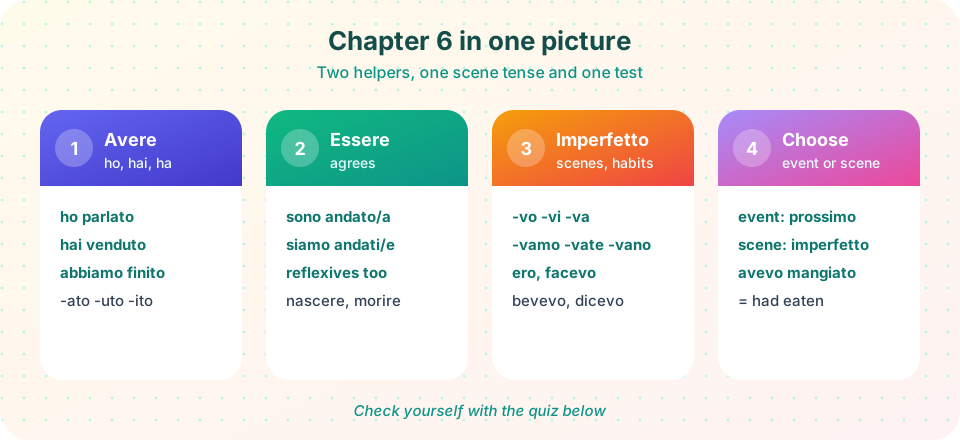
Chapter 6 in one picture: the two helpers, the imperfetto endings and the event-versus-scene test.
Quando ero piccola, abitavamo in campagna. Ogni mattina mi svegliavo presto e aiutavo mia nonna con le galline. Un giorno, mentre giocavo nel giardino, ho trovato un gattino piccolissimo. L'ho portato a casa e la nonna ha detto: "Va bene, lo teniamo!"
"When I was little, we lived in the country. Every morning I woke up early and helped my grandmother with the hens. One day, while I was playing in the garden, I found a tiny kitten. I took it home and Grandma said: 'Fine, we are keeping it!'" Spot the pattern: habits and setting use the imperfetto (abitavamo, mi svegliavo, aiutavo, giocavo); the unique day and its events use the passato prossimo (ho trovato, ho portato, ha detto).
Begin with the helper verbs: write ten sentences with avere and ten with essere, making the participle agree. Then add the scene: choose three of your sentences and add an imperfetto background (Pioveva. Ero stanco. Erano le otto.). On the third day retell your weekend in two versions, skeleton and full. Keep a list of irregular participles and verbs, and review it with flashcards. Finish by taking the quiz and reading your wrong answers aloud with the correction.
A mixed drill: passato prossimo, imperfetto and the helper verb.
Chapter 6 mixed drill
<metacharset="utf-8"><style>*{box-sizing:border-box}body{margin:0;padding:14px;font:16px system-ui,-apple-system,'Segoe UI',sans-serif;color:#1e1b4b;background:linear-gradient(135deg,#f0fdfa,#ecfeff)}.card{background:#fff;border-radius:18px;padding:18px;box-shadow:0 10px 26px rgba(13,148,136,.18)}.n{color:#0d9488;font-size:14px;font-weight:600}.q{font-size:20px;margin:10px 0;min-height:30px}.h{color:#64748b;font-size:14px;min-height:20px}input{font:inherit;padding:8px 12px;border:2px solid #99f6e4;border-radius:12px;width:min(100%,22em)}button{font:inherit;font-weight:600;border:0;border-radius:12px;padding:9px 15px;color:#fff;background:linear-gradient(135deg,#14b8a6,#6366f1);cursor:pointer;margin:4px 4px 0 0}button.alt{background:linear-gradient(135deg,#f59e0b,#ef4444)}button.ghost{background:#e0f2fe;color:#075985}.ok{color:#047857;font-weight:600}.bad{color:#b91c1c;font-weight:600}.face{min-height:120px;display:flex;align-items:center;justify-content:center;text-align:center;font-size:30px;font-weight:700;border-radius:16px;background:linear-gradient(135deg,#ccfbf1,#e0e7ff);padding:14px;cursor:pointer;margin:10px 0}.note{color:#475569;font-size:15px;min-height:22px}.cols{display:grid;grid-template-columns:1fr 1fr;gap:10px}.cols button{display:block;width:100%;margin:0 0 8px;background:#f1f5f9;color:#1e1b4b;border:2px solid #cbd5e1;text-align:left}.cols button.sel{border-color:#6366f1;background:#e0e7ff}.cols button.done{border-color:#10b981;background:#d1fae5;color:#065f46}.cols button.wrong{border-color:#ef4444;background:#fee2e2}</style><divclass="card"><divclass="n"id="n"></div><divclass="q"id="q"></div><divclass="h"id="h"></div><inputid="a"autocomplete="off"autocapitalize="off"spellcheck="false"aria-label="Your answer"><buttonid="b">Check</button><pid="m"class="note"></p></div><script>const items=[["Ieri io (man) ___ andato al cinema.","sono",""],["Ieri noi ___ mangiato la pizza. (avere)","abbiamo",""],["Maria è ___ a Roma. (partire, feminine)","partita",""],["Da piccolo io ___ sempre a calcio. (giocare)","giocavo",""],["Che cosa ___ tu ieri? (fare, passato prossimo)","hai fatto",""],["Pioveva quando ___ di casa. (io, uscire, woman)","sono uscita",""],["Quando ___ giovane, vivevo a Milano. (io, essere)","ero",""],["Avevo già ___ quando sei arrivato. (mangiare)","mangiato","trapassato prossimo"]];let i=0,score=0,checked=false;const$=id=>document.getElementById(id);constnorm=s=>s.toLowerCase().replace(/[.,;!?]/g,"").replace(/[\u2018\u2019]/g,"'").replace(/\s+/g," ").trim();conststrip=s=>norm(s).normalize("NFD").replace(/[\u0300-\u036f]/g,"");functionrender(){const it=items[i];$("n").textContent="Question "+(i+1)+" of "+items.length+" - score "+score;$("q").textContent=it[0];$("h").textContent=it[2]?"Hint: "+it[2]:"";$("a").style.display="";$("a").value="";$("m").textContent="";$("m").className="note";$("b").textContent="Check";checked=false;$("a").focus();}functionact(){if(i>=items.length){i=0;score=0;render();return}if(checked){
i++;if(i>=items.length){$("n").textContent="";$("h").textContent="";$("q").textContent="Finished! Score: "+score+" / "+items.length;$("a").style.display="none";$("m").textContent="";$("b").textContent="Try again";return}render();return;}const opts=items[i][1].split("|"),g=norm($("a").value);if(!g){return}if(opts.some(o=>norm(o)===g)){score++;$("m").className="ok";$("m").textContent="Corretto! "+opts[0]}elseif(opts.some(o=>strip(o)===strip(g))){$("m").className="bad";$("m").textContent="Almost - watch the accent: "+opts[0]}else{$("m").className="bad";$("m").textContent="Not quite. Answer: "+opts.join(" / ")}$("n").textContent="Question "+(i+1)+" of "+items.length+" - score "+score;
checked=true;$("b").textContent="Next";}$("b").onclick=act;$("a").addEventListener("keydown",e=>{if(e.key==="Enter")act()});render();</script>
A deck of high-frequency irregular participles to revise.
Participle flashcards
<metacharset="utf-8"><style>*{box-sizing:border-box}body{margin:0;padding:14px;font:16px system-ui,-apple-system,'Segoe UI',sans-serif;color:#1e1b4b;background:linear-gradient(135deg,#f0fdfa,#ecfeff)}.card{background:#fff;border-radius:18px;padding:18px;box-shadow:0 10px 26px rgba(13,148,136,.18)}.n{color:#0d9488;font-size:14px;font-weight:600}.q{font-size:20px;margin:10px 0;min-height:30px}.h{color:#64748b;font-size:14px;min-height:20px}input{font:inherit;padding:8px 12px;border:2px solid #99f6e4;border-radius:12px;width:min(100%,22em)}button{font:inherit;font-weight:600;border:0;border-radius:12px;padding:9px 15px;color:#fff;background:linear-gradient(135deg,#14b8a6,#6366f1);cursor:pointer;margin:4px 4px 0 0}button.alt{background:linear-gradient(135deg,#f59e0b,#ef4444)}button.ghost{background:#e0f2fe;color:#075985}.ok{color:#047857;font-weight:600}.bad{color:#b91c1c;font-weight:600}.face{min-height:120px;display:flex;align-items:center;justify-content:center;text-align:center;font-size:30px;font-weight:700;border-radius:16px;background:linear-gradient(135deg,#ccfbf1,#e0e7ff);padding:14px;cursor:pointer;margin:10px 0}.note{color:#475569;font-size:15px;min-height:22px}.cols{display:grid;grid-template-columns:1fr 1fr;gap:10px}.cols button{display:block;width:100%;margin:0 0 8px;background:#f1f5f9;color:#1e1b4b;border:2px solid #cbd5e1;text-align:left}.cols button.sel{border-color:#6366f1;background:#e0e7ff}.cols button.done{border-color:#10b981;background:#d1fae5;color:#065f46}.cols button.wrong{border-color:#ef4444;background:#fee2e2}</style><divclass="card"><divclass="n"id="n"></div><divclass="face"id="f"tabindex="0"role="button"aria-label="Flip card"></div><divclass="note"id="note"></div><buttonid="flip">Flip</button><buttonid="know"class="alt">I knew it</button><buttonid="again"class="ghost">Again later</button><buttonid="say"class="ghost">Listen</button><pclass="note"id="m"></p></div><script>const items=[["fare","fatto","Ho fatto la spesa."],["dire","detto","Che cosa hai detto?"],["vedere","visto","Ho visto un film."],["prendere","preso","Ho preso il treno."],["scrivere","scritto","Ho scritto una email."],["aprire","aperto","Ha aperto la porta."],["essere","stato","Sono stato a Roma."],["nascere","nato","Sono nata a Torino."]];let deck=items.map((_,k)=>k),flipped=false,known=0;const$=id=>document.getElementById(id);functionrender(){$("n").textContent="Known "+known+" of "+items.length+" - "+deck.length+" left";if(!deck.length){$("f").textContent="Tutto fatto! All cards known.";$("note").textContent="Press Again later to restart.";deck=items.map((_,k)=>k);known=0;flipped=false;return}const it=items[deck[0]];$("f").textContent=flipped?it[1]:it[0];$("note").textContent=flipped?(it[2]||""):"Tap the card to see the English.";}functionflip(){flipped=!flipped;render()}$("f").onclick=flip;$("flip").onclick=flip;$("know").onclick=()=>{deck.shift();known++;flipped=false;render()};$("again").onclick=()=>{deck.push(deck.shift());flipped=false;render()};$("say").onclick=()=>{try{if(!deck.length||!("speechSynthesis"in window)){$("m").textContent="Speech is not available in this preview.";return}const u=newSpeechSynthesisUtterance(items[deck[0]][0]);u.lang="it-IT";window.speechSynthesis.speak(u);$("m").textContent="";}catch(e){$("m").textContent="Speech is not available in this preview."}};render();</script>
And a quick exploration in code. This list sorts verbs into avere and essere using the categories of lesson 2 (a teaching model with a small vocabulary).
JS
Which helper? A sorting model
const essere =["andare","venire","partire","arrivare","uscire","tornare","nascere","morire","restare","diventare"];const reflexive =["alzarsi","svegliarsi","vestirsi","lavarsi","divertirsi"];functionhelper(verb){if(verb.endsWith("si"))return"essere (reflexive)";if(essere.includes(verb))return"essere (movement/change)";return"avere";}["mangiare","andare","svegliarsi","camminare","nascere","vedere","divertirsi"].forEach(v=>
console.log(v.padEnd(12),"->",helper(v)));
Press Run (or Ctrl + Enter) to see the console output here.