


















Lesson 4 of 50 · Getting Started
Getting Started: chapter review
Review Chapter 1 of Italian for Beginners: the history of Italian, where it is spoken, cognates and false friends, and a daily routine that works.
You have finished the first chapter. It was about orientation: what Italian is, where it comes from, who speaks it, and how to study it without burning out. This review pulls the key ideas together on one page, lets you test yourself, and points to Chapter 2, where you start to speak.
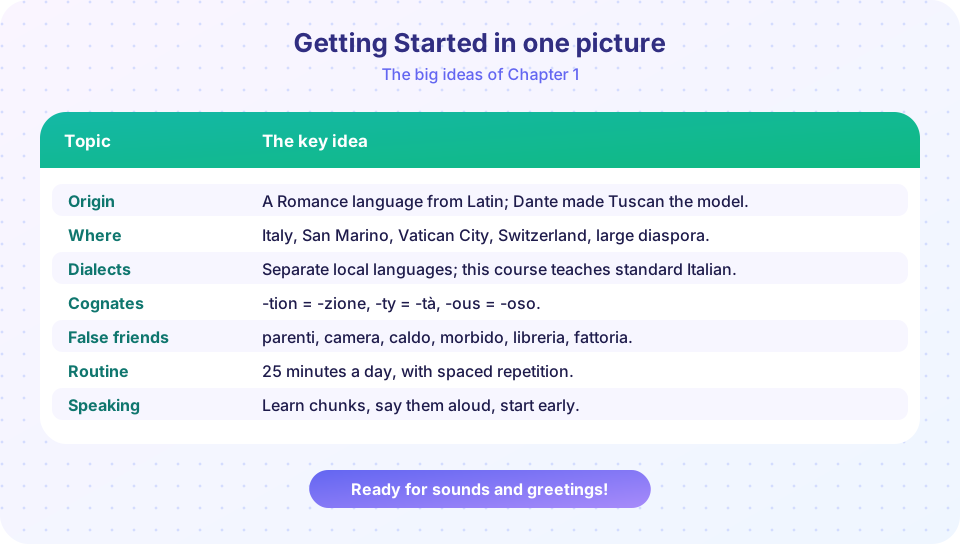
Recap
| Topic | What to remember |
|---|---|
| Origin | Italian is a Romance language that grew out of Latin. Dante's Divina Commedia (early 1300s) made the Tuscan vernacular the model for written Italian. |
| Unification | Italy became one state in 1861. Schools and mass media later spread standard Italian. |
| Where | Official in Italy, San Marino and Vatican City; a national language of Switzerland; spoken by many emigrant communities. |
| Varieties | Standard Italian, regional Italian (accent and local words) and dialects (separate local languages). |
| Cognates | English -tion matches Italian -zione; -ty matches -tà; -ous matches -oso. |
| False friends | parenti (relatives), camera (room), caldo (hot), morbido (soft), libreria (bookshop), fattoria (farm). |
| Study | About 25 minutes a day: listen, learn, speak, review. Use spaced repetition. |
| Speaking | Learn chunks, include the article with each noun, say everything aloud, and start talking early. |
Looking back
Think about the three lessons as one story. The course map gave you the plan of nine chapters and warned you that a course cannot replace speaking with people. The language lesson showed that Italian is Latin that never stopped changing and that you already know hundreds of words through cognates. The study lesson gave you a daily loop and a calendar for reviewing.
Together they give you three promises to yourself:
- I will study a little every day.
- I will say what I learn out loud.
- I will look for a real person to speak with.
Mistakes to avoid at this stage
A few habits are worth catching early, before they harden:
- Waiting to speak. Do not postpone speaking until you feel ready. Say your first sentences aloud today, even to an empty room.
- Trusting look-alike words blindly. Camera, parenti and libreria are not what they seem. When a word looks too easy, check it once.
- Treating Italian like accented English. The vowels are pure, the double consonants are real sounds, and the standard language has many regional accents; aim for clarity, not for a stage accent.
- Studying only on weekends. Twenty-five minutes on five days is worth more than two hours once a week.
- Learning nouns without articles. Write la casa and il libro, not casa and libro. Chapter 3 will show why this one habit pays off.
What comes next
Chapter 2 is about sounds, greetings and basics. You will meet the Italian alphabet, the five pure vowels, the consonants that change before e and i, double letters, stress and accents, the greetings for every time of day, and numbers. By the end you will be able to introduce yourself and read any Italian word aloud with confidence.
Try it
Match each Italian word from this chapter with its English meaning. A wrong match shows in red; a right one stays green.
Check your understanding
Quick check · 9 questions
of 9 answered You scored / 9 · perfect!
-
1. Which language is the direct ancestor of Italian?
Italian is a Romance language: it developed from spoken Latin. -
2. Which poem did most to make Tuscan the model for written Italian?
Dante wrote the Divine Comedy in Tuscan in the early 1300s. Boccaccio's Decameron also helped, but Dante is the usual answer. -
3. In what year did Italy become a single state?
The Kingdom of Italy was proclaimed in 1861. -
4. Which of these is NOT a place where Italian is an official or national language?
Spain's official language is Spanish (Castilian), with regional co-official languages. Italian is not among them. -
5. What does 'camera' mean in Italian?
Camera means room, usually a bedroom. A photo camera is a macchina fotografica. -
6. English 'nation' corresponds to Italian 'nazione'. Which rule does this follow?
Words ending in -tion in English often end in -zione in Italian. -
7. Which pair describes spaced repetition correctly?
Growing intervals refresh the memory just before it fades. -
8. Why learn 'la casa' instead of just 'casa'?
The article la tells you casa is feminine, which matters for adjectives and other words. -
9. Which phrase means 'Can you speak more slowly?'
Più lentamente means more slowly, and può parlare means can you speak (formal).
Summary
- Italian descends from Latin; Dante's Tuscan became the model for the standard language, and unification in 1861 plus modern media spread it.
- It is spoken in Italy, San Marino, Vatican City and parts of Switzerland, and across the Italian diaspora.
- Standard Italian, regional Italian and dialects are different; you learn the standard.
- Cognates give a head start; false friends need caution.
- A small daily routine, spaced review, chunks, and early speaking are the habits that work.
Track your progress
Create a free account to tick off lessons and pick up where you left off on any device.
of Italian for Beginners lessons completed