Understand Italian culture for learners: regions and dialects, tu versus Lei, greetings, meal times, holidays, gestures and manners, with phrases to use.
A language lives inside a culture. You can say every word correctly and still feel out of step if you do not know when Italians eat, when they use Lei, how they greet each other or what Ferragosto is. This lesson is a friendly tour of the customs that matter most to a visitor or a learner. It also shows you the Italian phrases that go with each custom.
One caution first: everything here is a generalization. Italy has been a single country only since 1861 and a republic since 1946, and it still contains very different regions, cities and families. Habits in Milan differ from those in Palermo, and a student's habits differ from those of a grandmother. Use this tour as a map, not as a rulebook, and watch what the people around you do.
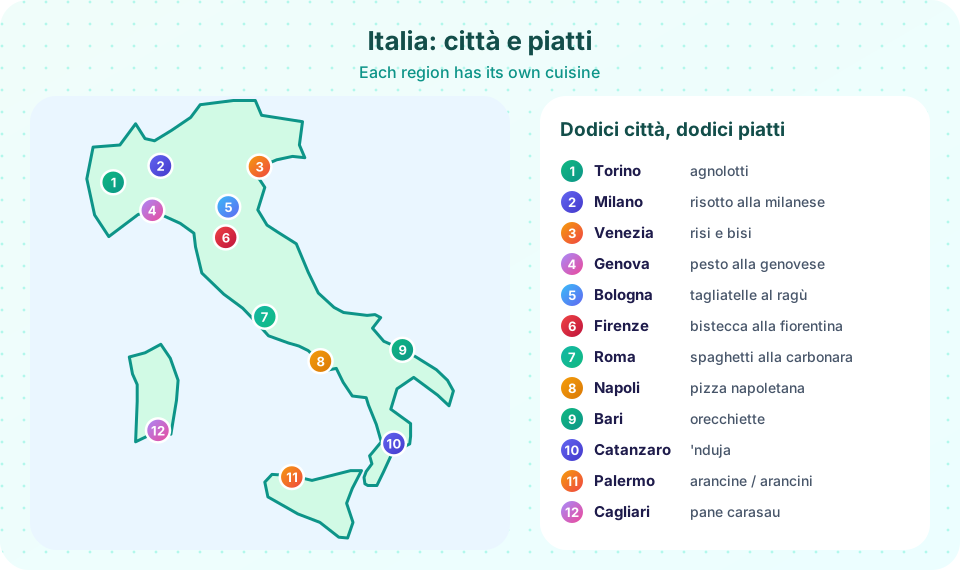
Italy by dishes: each region has its own cuisine, and often its own dialect.
Italy has 20 regions, from Valle d'Aosta and Piemonte in the northwest to Sicilia and Sardegna on the islands. Each has a capital city and its own food, festivals and history. People talk about three broad areas: il Nord (the north), il Centro (the center) and il Sud (the south, with the islands), though the differences inside each area are large.
Standard Italian grew out of the Tuscan (Florentine) language of writers such as Dante, and it is what you hear on television and in schools. But Italy is also home to many regional languages and dialects: Neapolitan, Sicilian, Venetian, Friulian, Sardinian (usually classified as a separate Romance language) and many others. Some are very different from standard Italian, and speakers from distant regions may not understand each other's dialect. Most Italians today use standard Italian with a regional accent and may switch to dialect at home or among friends. As a learner you will be understood everywhere with standard Italian, and you will hear a lot of variety.
Pick a region to see its capital, its area and a typical dish. This is a simple lookup tool for the twelve regions on the map, not a complete guide.
Region explorer
<metacharset="utf-8"><style>*{box-sizing:border-box}body{margin:0;padding:14px;font:16px system-ui,sans-serif;color:#1e1b4b;background:linear-gradient(135deg,#f0fdfa,#ecfeff)}.wrap{display:grid;grid-template-columns:1fr 1.2fr;gap:12px}.list{display:flex;flex-wrap:wrap;gap:6px;align-content:flex-start}button{font:inherit;font-size:14px;border:2px solid #99f6e4;background:#fff;border-radius:999px;padding:6px 12px;cursor:pointer}button.on{background:linear-gradient(135deg,#14b8a6,#6366f1);color:#fff;border-color:transparent}.card{background:#fff;border-radius:18px;padding:16px;box-shadow:0 10px 26px rgba(13,148,136,.18)}h3{margin:0 0 6px;font-size:22px}.tag{display:inline-block;background:#ccfbf1;color:#0f766e;border-radius:999px;padding:2px 10px;font-size:13px;font-weight:600}p{margin:8px 0}.it{font-size:18px;font-weight:700;color:#4338ca}@media(max-width:560px){.wrap{grid-template-columns:1fr}}</style><divclass="wrap"><divclass="list"id="list"></div><divclass="card"id="card"></div></div><script>const data=[["Piemonte","Torino","Nord","agnolotti"],["Lombardia","Milano","Nord","risotto alla milanese"],["Veneto","Venezia","Nord","risi e bisi"],["Liguria","Genova","Nord","pesto alla genovese"],["Emilia-Romagna","Bologna","Nord","tagliatelle al ragù"],["Toscana","Firenze","Centro","bistecca alla fiorentina"],["Lazio","Roma","Centro","spaghetti alla carbonara"],["Campania","Napoli","Sud","pizza napoletana"],["Puglia","Bari","Sud","orecchiette con le cime di rapa"],["Calabria","Catanzaro","Sud","'nduja"],["Sicilia","Palermo","Isole","arancine / arancini"],["Sardegna","Cagliari","Isole","pane carasau"]];const$=id=>document.getElementById(id);functionshow(i){const[r,c,z,d]=data[i];
document.querySelectorAll("button").forEach((b,k)=>b.classList.toggle("on",k===i));$("card").innerHTML="<h3>"+r+"</h3><span class='tag'>"+z+"</span><p>Capoluogo (capital): <b>"+c+"</b></p><p>Typical dish:</p><p class='it'>"+d+"</p><p style='color:#475569;font-size:14px'>Every region has more than one famous dish; this is just one example.</p>";}
data.forEach((d,i)=>{const b=document.createElement("button");b.textContent=d[0];b.onclick=()=>show(i);$("list").appendChild(b)});show(0);</script>
Italian has two ways to say "you" to one person. Use tu with friends, family, children and, increasingly, among young people and colleagues of the same age. Use Lei with strangers, older people, in shops, offices, hotels and with people in authority. With Lei, the verb is in the third person singular: Come sta? (How are you?), Può ripetere? (Can you repeat?), Mi scusi.
If someone says Dammi del tu or Possiamo darci del tu?, they invite you to use tu. When in doubt with an adult stranger, start with Lei; it is easier to relax later than to be too familiar at first. In writing, Lei is often capitalized, especially in formal letters.
Titles are common: signor / signora (Mr. / Mrs.), signorina (Miss, less used now), and dottore / dottoressa for someone with a university degree, a habit that surprises visitors. Professore / professoressa for teachers.
Handshake (una stretta di mano) for first meetings and formal situations.
Two kisses on the cheeks (due baci) among friends and family, and often between a man and a woman or two women. People often say ciao or ciao, come stai? at the same time.
Buongiorno until early afternoon, buonasera from afternoon, buonanotte only when leaving for bed.
Permesso? ("May I?") when entering a room or squeezing past someone; Prego as the answer.
Salute! ("Health!") when someone sneezes, and Cin cin! or Salute! for a toast; many people look others in the eye while clinking glasses.
Buon appetito! before a meal, answered with Grazie, altrettanto!
In bocca al lupo! ("Into the mouth of the wolf!") wishes someone good luck. The answer is Crepi! (May it die!), not "thank you".
Dress and behavior in churches are traditional: shoulders and knees are expected to be covered in many places of worship.
Meals are social events. Colazione (breakfast) is light, often a coffee or cappuccino with a pastry, usually standing at a bar. Pranzo (lunch) is traditionally the main meal, around 12:30-14:00; in some towns shops close for a lunch break, though in large cities this has faded. Cena (dinner) is typically between 19:30 and 21:00 and often later in summer and in the south. Before dinner many people enjoy an aperitivo, a drink with small snacks, which is especially popular in cities like Milan.
Italian cooking is really many regional cuisines: pasta shapes and sauces change from valley to valley, and locals are proud and opinionated about their own version. Bread and water are served with the meal, and Italians usually do not order a milky coffee after lunch or dinner.
Epiphany; children get gifts from la Befana, a friendly witch
March or April
Pasqua, Pasquetta
Easter, and Easter Monday (often a picnic day)
25 April
Festa della Liberazione
Liberation Day
1 May
Festa dei lavoratori
Labor Day
2 June
Festa della Repubblica
Republic Day
15 August
Ferragosto
mid-summer holiday; many cities empty out
1 November
Ognissanti
All Saints' Day
25 December
Natale
Christmas; 26 December is Santo Stefano
Other celebrated events include Carnevale (famously in Venice) and the Palio di Siena, a horse race held twice each summer, on 2 July and 16 August. Football (il calcio) is a national passion, and the national team is called gli Azzurri.
Italians use their hands a lot when they speak. A famous gesture is bringing the fingertips of one hand together and moving the hand up and down, which can mean "What do you want?" or "What are you saying?". Gestures differ between regions and can be misunderstood, so use them sparingly until you know the local meaning.
This small advisor suggests tu or Lei from a few facts about the situation. It is a rule-of-thumb model of the guidelines above, not a law of Italian manners.
JS
Tu or Lei?
functionchooseForm({ age, relation, setting }){if(["friend","family","child"].includes(relation))return"tu";if(setting ==="formal"|| relation ==="authority")return"Lei";if(relation ==="stranger"&& age ==="older")return"Lei";if(relation ==="stranger"&& age ==="same")return"tu is common, but Lei is safe";return"Lei";}const cases =[{age:"same",relation:"friend",setting:"casual"},{age:"older",relation:"stranger",setting:"casual"},{age:"same",relation:"stranger",setting:"casual"},{age:"older",relation:"authority",setting:"formal"},{age:"younger",relation:"child",setting:"casual"},];for(const c of cases) console.log(JSON.stringify(c).padEnd(70),"->",chooseForm(c));
Press Run (or Ctrl + Enter) to see the console output here.
No output.
Match the custom to its meaning.
Customs and phrases
<metacharset="utf-8"><style>*{box-sizing:border-box}body{margin:0;padding:14px;font:16px system-ui,-apple-system,'Segoe UI',sans-serif;color:#1e1b4b;background:linear-gradient(135deg,#f0fdfa,#ecfeff)}.card{background:#fff;border-radius:18px;padding:18px;box-shadow:0 10px 26px rgba(13,148,136,.18)}.n{color:#0d9488;font-size:14px;font-weight:600}.q{font-size:20px;margin:10px 0;min-height:30px}.h{color:#64748b;font-size:14px;min-height:20px}input{font:inherit;padding:8px 12px;border:2px solid #99f6e4;border-radius:12px;width:min(100%,22em)}button{font:inherit;font-weight:600;border:0;border-radius:12px;padding:9px 15px;color:#fff;background:linear-gradient(135deg,#14b8a6,#6366f1);cursor:pointer;margin:4px 4px 0 0}button.alt{background:linear-gradient(135deg,#f59e0b,#ef4444)}button.ghost{background:#e0f2fe;color:#075985}.ok{color:#047857;font-weight:600}.bad{color:#b91c1c;font-weight:600}.face{min-height:120px;display:flex;align-items:center;justify-content:center;text-align:center;font-size:30px;font-weight:700;border-radius:16px;background:linear-gradient(135deg,#ccfbf1,#e0e7ff);padding:14px;cursor:pointer;margin:10px 0}.note{color:#475569;font-size:15px;min-height:22px}.cols{display:grid;grid-template-columns:1fr 1fr;gap:10px}.cols button{display:block;width:100%;margin:0 0 8px;background:#f1f5f9;color:#1e1b4b;border:2px solid #cbd5e1;text-align:left}.cols button.sel{border-color:#6366f1;background:#e0e7ff}.cols button.done{border-color:#10b981;background:#d1fae5;color:#065f46}.cols button.wrong{border-color:#ef4444;background:#fee2e2}</style><divclass="card"><divclass="n"id="n">Pick an Italian item, then its English match.</div><divclass="cols"style="margin-top:10px"><divid="L"></div><divid="R"></div></div><pid="m"class="note"></p><buttonid="re"class="ghost">Shuffle again</button></div><script>const pairs=[["Buon appetito!","Enjoy your meal!"],["In bocca al lupo!","Good luck!"],["Crepi!","the reply to good luck"],["Permesso?","May I (come in)?"],["Cin cin!","a toast"],["Ferragosto","15 August"],["la Befana","the Epiphany witch"],["il calcio","football"]];const$=id=>document.getElementById(id);let sel=null,found=0;constshuffle=a=>{a=a.slice();for(let k=a.length-1;k>0;k--){const j=Math.floor(Math.random()*(k+1));[a[k],a[j]]=[a[j],a[k]]}return a};functionbuild(){
sel=null;found=0;$("m").textContent="";$("L").innerHTML="";$("R").innerHTML="";
pairs.forEach((p,k)=>{const b=document.createElement("button");b.textContent=p[0];b.onclick=()=>pick(b,k,"L");$("L").appendChild(b)});shuffle(pairs.map((p,k)=>k)).forEach(k=>{const b=document.createElement("button");b.textContent=pairs[k][1];b.onclick=()=>pick(b,k,"R");$("R").appendChild(b)});}functionpick(b,k,side){if(b.classList.contains("done"))return;if(!sel||sel.side===side){if(sel)sel.b.classList.remove("sel");sel={b,k,side};b.classList.add("sel");return}const a=sel;sel=null;a.b.classList.remove("sel");if(a.k===k){a.b.classList.add("done");b.classList.add("done");found++;$("m").textContent=found===pairs.length?"Bravo! All pairs matched.":found+" of "+pairs.length+" matched."}else{a.b.classList.add("wrong");b.classList.add("wrong");setTimeout(()=>{a.b.classList.remove("wrong");b.classList.remove("wrong")},600);$("m").textContent="Not a pair - try again."}}$("re").onclick=build;build();</script>
And revise the regions with flashcards.
Regions and capitals
<metacharset="utf-8"><style>*{box-sizing:border-box}body{margin:0;padding:14px;font:16px system-ui,-apple-system,'Segoe UI',sans-serif;color:#1e1b4b;background:linear-gradient(135deg,#f0fdfa,#ecfeff)}.card{background:#fff;border-radius:18px;padding:18px;box-shadow:0 10px 26px rgba(13,148,136,.18)}.n{color:#0d9488;font-size:14px;font-weight:600}.q{font-size:20px;margin:10px 0;min-height:30px}.h{color:#64748b;font-size:14px;min-height:20px}input{font:inherit;padding:8px 12px;border:2px solid #99f6e4;border-radius:12px;width:min(100%,22em)}button{font:inherit;font-weight:600;border:0;border-radius:12px;padding:9px 15px;color:#fff;background:linear-gradient(135deg,#14b8a6,#6366f1);cursor:pointer;margin:4px 4px 0 0}button.alt{background:linear-gradient(135deg,#f59e0b,#ef4444)}button.ghost{background:#e0f2fe;color:#075985}.ok{color:#047857;font-weight:600}.bad{color:#b91c1c;font-weight:600}.face{min-height:120px;display:flex;align-items:center;justify-content:center;text-align:center;font-size:30px;font-weight:700;border-radius:16px;background:linear-gradient(135deg,#ccfbf1,#e0e7ff);padding:14px;cursor:pointer;margin:10px 0}.note{color:#475569;font-size:15px;min-height:22px}.cols{display:grid;grid-template-columns:1fr 1fr;gap:10px}.cols button{display:block;width:100%;margin:0 0 8px;background:#f1f5f9;color:#1e1b4b;border:2px solid #cbd5e1;text-align:left}.cols button.sel{border-color:#6366f1;background:#e0e7ff}.cols button.done{border-color:#10b981;background:#d1fae5;color:#065f46}.cols button.wrong{border-color:#ef4444;background:#fee2e2}</style><divclass="card"><divclass="n"id="n"></div><divclass="face"id="f"tabindex="0"role="button"aria-label="Flip card"></div><divclass="note"id="note"></div><buttonid="flip">Flip</button><buttonid="know"class="alt">I knew it</button><buttonid="again"class="ghost">Again later</button><buttonid="say"class="ghost">Listen</button><pclass="note"id="m"></p></div><script>const items=[["Piemonte","Torino","north"],["Lombardia","Milano","north"],["Veneto","Venezia","north"],["Toscana","Firenze","center"],["Lazio","Roma","center"],["Campania","Napoli","south"],["Puglia","Bari","south"],["Sicilia","Palermo","island"]];let deck=items.map((_,k)=>k),flipped=false,known=0;const$=id=>document.getElementById(id);functionrender(){$("n").textContent="Known "+known+" of "+items.length+" - "+deck.length+" left";if(!deck.length){$("f").textContent="Tutto fatto! All cards known.";$("note").textContent="Press Again later to restart.";deck=items.map((_,k)=>k);known=0;flipped=false;return}const it=items[deck[0]];$("f").textContent=flipped?it[1]:it[0];$("note").textContent=flipped?(it[2]||""):"Tap the card to see the English.";}functionflip(){flipped=!flipped;render()}$("f").onclick=flip;$("flip").onclick=flip;$("know").onclick=()=>{deck.shift();known++;flipped=false;render()};$("again").onclick=()=>{deck.push(deck.shift());flipped=false;render()};$("say").onclick=()=>{try{if(!deck.length||!("speechSynthesis"in window)){$("m").textContent="Speech is not available in this preview.";return}const u=newSpeechSynthesisUtterance(items[deck[0]][0]);u.lang="it-IT";window.speechSynthesis.speak(u);$("m").textContent="";}catch(e){$("m").textContent="Speech is not available in this preview."}};render();</script>