Preview chapter 8 of Italian for Beginners: travel and directions, talking about yourself and others, and Italian customs, regions and etiquette, with a lesson roadmap.
Grammar gives you the bricks. Conversation is the house. In this chapter you put everything you have learned to work in real situations: finding your way, taking a train, booking a room, chatting about family and free time, and understanding the customs that shape how Italians speak and behave. Language and culture are one subject: a phrase that is correct but impolite in the wrong setting will not work, and a custom you do not know can leave you puzzled when you hear a simple sentence.
You will also see how the same Italian shifts with the speaker, the region and the formality of the situation. Italians use tu with friends and Lei with strangers, say Buongiorno until about lunchtime and Buonasera afterwards, and greet each other with a kiss on both cheeks or a handshake depending on who they are. Knowing these small facts makes you sound natural and helps you feel at ease.
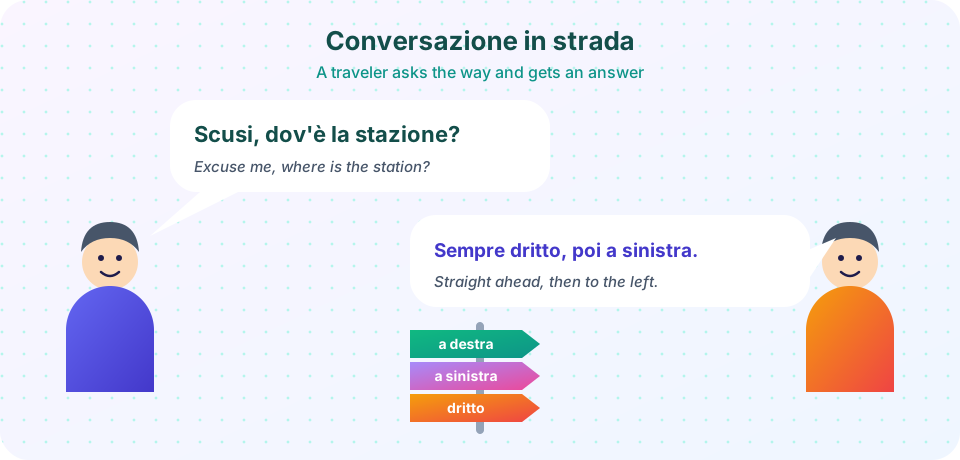
Language in action: a traveler asks for directions and gets an answer built from phrases you already know.
Everything in the culture lessons is a generalization. Italy is a country of 20 regions with very different histories and habits: northern and southern Italians, big-city and village people, young and old speakers all behave a little differently. Treat these lessons as a starting map, not as a rulebook. When in doubt, watch what the people around you do and politely follow their lead; Italians are usually delighted that a visitor is trying.
A course cannot replace speaking with real people, but you can still rehearse. Read each dialogue aloud and swap in your own details. Record yourself and listen back. Talk to yourself in Italian about your day, using the routine verbs from the previous chapter. And, whenever you can, find a language partner or a tutor, because real conversation teaches you to listen as well as to speak.
Review the chapter's core travel and politeness phrases.
Chapter 8 warm-up cards
<metacharset="utf-8"><style>*{box-sizing:border-box}body{margin:0;padding:14px;font:16px system-ui,-apple-system,'Segoe UI',sans-serif;color:#1e1b4b;background:linear-gradient(135deg,#f0fdfa,#ecfeff)}.card{background:#fff;border-radius:18px;padding:18px;box-shadow:0 10px 26px rgba(13,148,136,.18)}.n{color:#0d9488;font-size:14px;font-weight:600}.q{font-size:20px;margin:10px 0;min-height:30px}.h{color:#64748b;font-size:14px;min-height:20px}input{font:inherit;padding:8px 12px;border:2px solid #99f6e4;border-radius:12px;width:min(100%,22em)}button{font:inherit;font-weight:600;border:0;border-radius:12px;padding:9px 15px;color:#fff;background:linear-gradient(135deg,#14b8a6,#6366f1);cursor:pointer;margin:4px 4px 0 0}button.alt{background:linear-gradient(135deg,#f59e0b,#ef4444)}button.ghost{background:#e0f2fe;color:#075985}.ok{color:#047857;font-weight:600}.bad{color:#b91c1c;font-weight:600}.face{min-height:120px;display:flex;align-items:center;justify-content:center;text-align:center;font-size:30px;font-weight:700;border-radius:16px;background:linear-gradient(135deg,#ccfbf1,#e0e7ff);padding:14px;cursor:pointer;margin:10px 0}.note{color:#475569;font-size:15px;min-height:22px}.cols{display:grid;grid-template-columns:1fr 1fr;gap:10px}.cols button{display:block;width:100%;margin:0 0 8px;background:#f1f5f9;color:#1e1b4b;border:2px solid #cbd5e1;text-align:left}.cols button.sel{border-color:#6366f1;background:#e0e7ff}.cols button.done{border-color:#10b981;background:#d1fae5;color:#065f46}.cols button.wrong{border-color:#ef4444;background:#fee2e2}</style><divclass="card"><divclass="n"id="n"></div><divclass="face"id="f"tabindex="0"role="button"aria-label="Flip card"></div><divclass="note"id="note"></div><buttonid="flip">Flip</button><buttonid="know"class="alt">I knew it</button><buttonid="again"class="ghost">Again later</button><buttonid="say"class="ghost">Listen</button><pclass="note"id="m"></p></div><script>const items=[["Dov'è la stazione?","Where is the station?","dov'è = dove è"],["a destra","to the right","opposite: a sinistra"],["sempre dritto","straight ahead","literally always straight"],["Mi sono perso.","I am lost (man).","Mi sono persa for a woman"],["Hai fratelli?","Do you have siblings?","informal; Ha fratelli? formal"],["Che tempo fa?","What is the weather like?","Fa caldo. Fa freddo."],["Buon appetito!","Enjoy your meal!","reply: Altrettanto!"],["Ci vediamo!","See you!","between friends"]];let deck=items.map((_,k)=>k),flipped=false,known=0;const$=id=>document.getElementById(id);functionrender(){$("n").textContent="Known "+known+" of "+items.length+" - "+deck.length+" left";if(!deck.length){$("f").textContent="Tutto fatto! All cards known.";$("note").textContent="Press Again later to restart.";deck=items.map((_,k)=>k);known=0;flipped=false;return}const it=items[deck[0]];$("f").textContent=flipped?it[1]:it[0];$("note").textContent=flipped?(it[2]||""):"Tap the card to see the English.";}functionflip(){flipped=!flipped;render()}$("f").onclick=flip;$("flip").onclick=flip;$("know").onclick=()=>{deck.shift();known++;flipped=false;render()};$("again").onclick=()=>{deck.push(deck.shift());flipped=false;render()};$("say").onclick=()=>{try{if(!deck.length||!("speechSynthesis"in window)){$("m").textContent="Speech is not available in this preview.";return}const u=newSpeechSynthesisUtterance(items[deck[0]][0]);u.lang="it-IT";window.speechSynthesis.speak(u);$("m").textContent="";}catch(e){$("m").textContent="Speech is not available in this preview."}};render();</script>
Match the situation to the phrase.
Match the phrase
<metacharset="utf-8"><style>*{box-sizing:border-box}body{margin:0;padding:14px;font:16px system-ui,-apple-system,'Segoe UI',sans-serif;color:#1e1b4b;background:linear-gradient(135deg,#f0fdfa,#ecfeff)}.card{background:#fff;border-radius:18px;padding:18px;box-shadow:0 10px 26px rgba(13,148,136,.18)}.n{color:#0d9488;font-size:14px;font-weight:600}.q{font-size:20px;margin:10px 0;min-height:30px}.h{color:#64748b;font-size:14px;min-height:20px}input{font:inherit;padding:8px 12px;border:2px solid #99f6e4;border-radius:12px;width:min(100%,22em)}button{font:inherit;font-weight:600;border:0;border-radius:12px;padding:9px 15px;color:#fff;background:linear-gradient(135deg,#14b8a6,#6366f1);cursor:pointer;margin:4px 4px 0 0}button.alt{background:linear-gradient(135deg,#f59e0b,#ef4444)}button.ghost{background:#e0f2fe;color:#075985}.ok{color:#047857;font-weight:600}.bad{color:#b91c1c;font-weight:600}.face{min-height:120px;display:flex;align-items:center;justify-content:center;text-align:center;font-size:30px;font-weight:700;border-radius:16px;background:linear-gradient(135deg,#ccfbf1,#e0e7ff);padding:14px;cursor:pointer;margin:10px 0}.note{color:#475569;font-size:15px;min-height:22px}.cols{display:grid;grid-template-columns:1fr 1fr;gap:10px}.cols button{display:block;width:100%;margin:0 0 8px;background:#f1f5f9;color:#1e1b4b;border:2px solid #cbd5e1;text-align:left}.cols button.sel{border-color:#6366f1;background:#e0e7ff}.cols button.done{border-color:#10b981;background:#d1fae5;color:#065f46}.cols button.wrong{border-color:#ef4444;background:#fee2e2}</style><divclass="card"><divclass="n"id="n">Pick an Italian item, then its English match.</div><divclass="cols"style="margin-top:10px"><divid="L"></div><divid="R"></div></div><pid="m"class="note"></p><buttonid="re"class="ghost">Shuffle again</button></div><script>const pairs=[["Un biglietto, per favore","buying a ticket"],["Sempre dritto","giving directions"],["Pronto?","answering the phone"],["Buon appetito!","starting a meal"],["Piacere!","meeting someone"],["Permesso?","entering or passing"],["In bocca al lupo!","wishing good luck"],["Salute!","a toast or after a sneeze"]];const$=id=>document.getElementById(id);let sel=null,found=0;constshuffle=a=>{a=a.slice();for(let k=a.length-1;k>0;k--){const j=Math.floor(Math.random()*(k+1));[a[k],a[j]]=[a[j],a[k]]}return a};functionbuild(){
sel=null;found=0;$("m").textContent="";$("L").innerHTML="";$("R").innerHTML="";
pairs.forEach((p,k)=>{const b=document.createElement("button");b.textContent=p[0];b.onclick=()=>pick(b,k,"L");$("L").appendChild(b)});shuffle(pairs.map((p,k)=>k)).forEach(k=>{const b=document.createElement("button");b.textContent=pairs[k][1];b.onclick=()=>pick(b,k,"R");$("R").appendChild(b)});}functionpick(b,k,side){if(b.classList.contains("done"))return;if(!sel||sel.side===side){if(sel)sel.b.classList.remove("sel");sel={b,k,side};b.classList.add("sel");return}const a=sel;sel=null;a.b.classList.remove("sel");if(a.k===k){a.b.classList.add("done");b.classList.add("done");found++;$("m").textContent=found===pairs.length?"Bravo! All pairs matched.":found+" of "+pairs.length+" matched."}else{a.b.classList.add("wrong");b.classList.add("wrong");setTimeout(()=>{a.b.classList.remove("wrong");b.classList.remove("wrong")},600);$("m").textContent="Not a pair - try again."}}$("re").onclick=build;build();</script>