


















Lesson 15 of 50 · Nouns, Articles and Adjectives
Adjectives and agreement
Learn how Italian adjectives agree with nouns in gender and number, where they go in a sentence, the colors, and the special adjectives bello and buono.
Adjectives describe nouns: a big house, a red book, a friendly girl. In English adjectives never change. In Italian they must agree with the noun they describe: they take the same gender and number. A red book is un libro rosso, but a red house is una casa rossa, and red houses are case rosse.
You already know the idea from the previous lessons: nouns and articles change their endings. Adjectives simply join in. The patterns are very regular, and once you know three families (adjectives in -o, in -e, and invariable ones) you can handle almost any adjective.
What you will learn
- How adjectives in -o and in -e change for gender and number.
- Where to put an adjective: usually after the noun, sometimes before.
- The colors, including the invariable ones.
- How to use adjectives with essere (to be).
- The special forms of bello and buono before a noun.
Key terms
Adjective (aggettivo): a word that describes a noun.
Agreement: the adjective matches the noun in gender (masculine or feminine) and number (singular or plural).
Invariable adjective: an adjective with only one form, such as blu or rosa.
Predicate adjective: an adjective after a verb such as essere: La casa è grande.
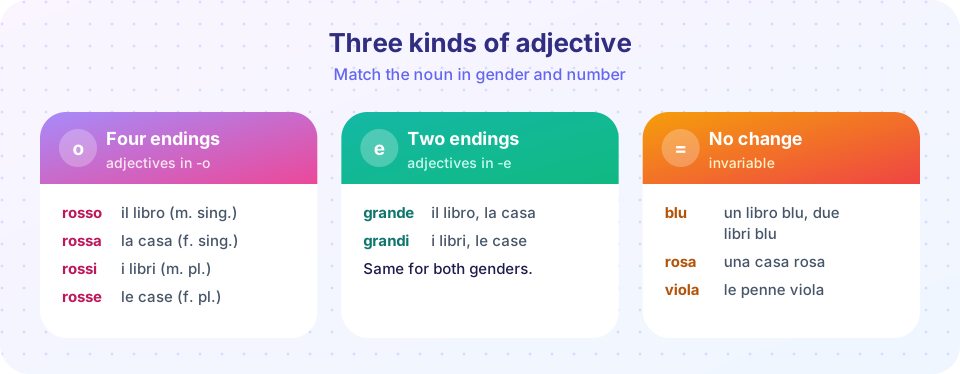
Adjectives in -o: four forms
Most adjectives end in -o in the dictionary. They have four forms:
| Masculine | Feminine | |
|---|---|---|
| Singular | rosso | rossa |
| Plural | rossi | rosse |
il libro rosso, la casa rossa, i libri rossi, le case rosse.
More adjectives that follow the same pattern: alto (tall), basso (short), nuovo (new), piccolo (small), lento (slow), pigro (lazy), simpatico (nice, friendly), stanco (tired), nero (black), bianco (white), giallo (yellow), italiano, americano.
The spelling rules from the lesson on plurals apply here too:
- -co / -go adjectives: the plural is usually -chi / -ghi and the feminine plural -che / -ghe: bianco → bianchi, bianche; stanco → stanchi, stanche; lungo → lunghi, lunghe. Words stressed on the third to last syllable usually take -ci: simpatico → simpatici (but simpatiche for feminine plural).
- -io adjectives with an unstressed i lose it in the masculine plural: vecchio → vecchi, and keep it in the feminine: vecchia, vecchie.
Adjectives in -e: two forms
Adjectives that end in -e have the same form for both genders and a plural in -i:
| Masculine and feminine | |
|---|---|
| Singular | grande |
| Plural | grandi |
il libro grande, la casa grande, i libri grandi, le case grandi.
Common examples: verde (green), felice (happy), triste (sad), facile (easy), difficile (difficult), interessante (interesting), intelligente (intelligent), gentile (kind), forte (strong), veloce (fast), giovane (young), marrone (brown), arancione (orange).
Invariable adjectives
A small group of adjectives never changes: blu (dark blue), rosa (pink), viola (purple), beige, and many loanwords like chic. They stay the same in all four positions: una camicia rosa (a pink shirt), due camicie rosa, il libro blu, i libri blu.
The colors
| Italian | English | Notes |
|---|---|---|
| rosso | red | four forms |
| giallo | yellow | four forms |
| verde | green | two forms (verdi) |
| blu | dark blue | invariable |
| azzurro | light blue | four forms |
| nero | black | four forms |
| bianco | white | bianchi, bianche |
| grigio | grey | grigi, grigie |
| marrone | brown | two forms (marroni) |
| arancione | orange | two forms (arancioni) |
| rosa | pink | invariable |
| viola | purple | invariable |
Italian blue deserves a note: blu is dark blue and azzurro or celeste is light blue, like the sky. The Italian national sports teams wear azzurro and are called gli Azzurri.
Where does the adjective go?
The normal position is after the noun: una casa grande, un libro interessante, la pizza italiana, una macchina rossa. This is true for colors, nationalities, shapes and most descriptive adjectives.
A group of short, common adjectives usually goes before the noun: bello (beautiful), brutto (ugly), buono (good), cattivo (bad), bravo (good at something), grande (big, great), piccolo (small), giovane (young), vecchio (old), nuovo (new), lungo (long), stesso (same): una bella casa, un buon caffè, un grande artista, una nuova amica.
When the adjective is separated from the noun by essere (to be), it follows the verb but still agrees with the subject: La casa è grande. Il libro è rosso. Le ragazze sono stanche. Marco e Luca sono simpatici.
Position changes the meaning
For a handful of adjectives, position changes the meaning. Before the noun the meaning is often figurative; after it is literal:
- un grande uomo (a great man) / un uomo grande (a big, tall man)
- un vecchio amico (a long-time friend) / un amico vecchio (an elderly friend)
- un povero uomo (an unfortunate man) / un uomo povero (a man without money)
- una nuova macchina (another car, a new one for me) / una macchina nuova (a brand-new car)
Do not memorize all of these. Just know that English "great", "old" and "poor" can have two senses, and Italian shows the difference by word order.
Agreement with several nouns
When one adjective describes both a masculine and a feminine noun, it takes the masculine plural: Il libro e la penna sono nuovi. (The book and the pen are new.) Marco e Anna sono stanchi. (Marco and Anna are tired.) With only feminine nouns, it is feminine plural: La casa e la macchina sono nuove.
Bello and buono
Two very common adjectives change their forms when they stand before a noun. They follow the pattern of the definite article (or of un/uno/una):
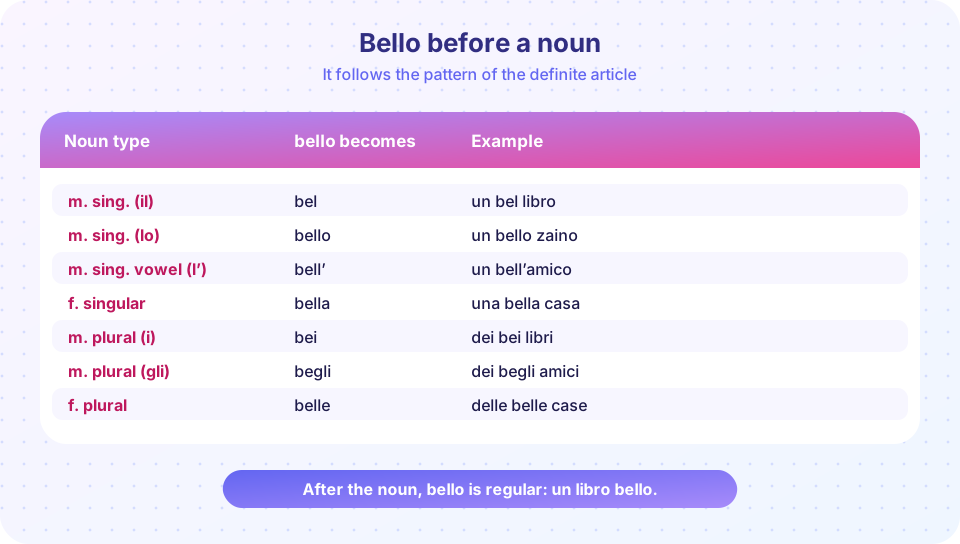
- un bel libro, un bello zaino (backpack), *un **bell'*amico, una bella casa
- dei bei libri, dei begli amici, delle belle case
When bello stands after the noun or after essere, it is a regular -o adjective: un libro bello, la casa è bella, i libri sono belli.
Buono follows the pattern of un/uno/una:
- un buon caffè, un buon amico, un buono studente (before s + consonant), una buona idea
- plural: dei buoni libri, delle buone idee
After the noun or after essere, buono is regular: Il caffè è buono. La pizza è buona. I libri sono buoni. Notice: buono (good, for things) differs from bene (well, an adverb): Il caffè è buono. Sto bene.
Quantity words that agree
Molto (a lot of, many), poco (little, few), troppo (too much, too many) and tanto (so much, so many) agree with the noun when used as adjectives: molta acqua (a lot of water), molti libri (many books), poche persone (few people), troppe case (too many houses). When they modify an adjective or verb, they are adverbs and do not change: La casa è molto bella. (The house is very beautiful.)
Common misconceptions
"Adjectives never change in Italian, as in English." They always agree with the noun: la casa rossa, not la casa rosso.
"Adjectives always go after the noun, or always before." The normal place is after, but short common ones (bello, buono, grande, piccolo, nuovo, vecchio) often go before.
"Blu and rosa take -a or -i." They are invariable: due case blu, camicie rosa.
"The adjective agrees with the nearest noun." It agrees with the noun it describes, and with the masculine plural for a mixed group.
"I am cold" translates as sono freddo. Describing a person with freddo means "unfriendly". To say you feel cold, use avere: ho freddo.
"Simpatico means sympathetic." It means nice, likeable. Sympathetic is comprensivo.
Try it
First, run the adjective inflector. It prints the four forms (masculine and feminine, singular and plural) of any adjective in the list. Study the patterns for bianco, simpatico and vecchio, then add your own adjectives.
Press Run (or Ctrl + Enter) to see the result here.
Program input · what you'd type while the program runs
Type the answers before you press Run, one per line. Each time the program reads a line (with input()), it gets the next line from this box.
Second, learn the colors. Say the Italian color aloud and think of an object that has it.
Third, make the adjective agree. Each sentence needs the right form in brackets.
Check your understanding
Quick check · 6 questions
of 6 answered You scored / 6 · perfect!
-
1. Which phrase is correct?
Casa is feminine singular, so the adjective is rossa. -
2. What is the plural of 'il libro interessante'?
Adjectives in -e make their plural in -i for both genders. -
3. How do you say 'a beautiful friend' (m.) with the vowel noun 'amico'?
Before a vowel, bello shortens to bell'. -
4. Which adjective never changes?
Rosa (pink) is invariable. Rosso has four forms and verde has two. -
5. Where do adjectives of color normally go?
Descriptive adjectives and colors usually follow the noun: una macchina rossa. -
6. Marco and Anna are tired. Which sentence is correct?
A mixed group takes the masculine plural: stanchi.
Summary
- Adjectives agree with their noun: four forms for -o adjectives (rosso, rossa, rossi, rosse), two for -e adjectives (grande, grandi), one for invariable ones (blu, rosa, viola).
- The usual position is after the noun; short common adjectives (bello, buono, grande, nuovo, vecchio) often go before it, and word order can change the meaning.
- After essere, the adjective agrees with the subject: La casa è grande.
- A mixed group takes the masculine plural.
- Bello before a noun follows the article pattern (bel, bello, bell', bella, bei, begli, belle); buono follows un/uno/una (buon, buono, buona).
Track your progress
Create a free account to tick off lessons and pick up where you left off on any device.
of Italian for Beginners lessons completed