Review Chapter 2: Italian vowels, consonant rules, double letters, stress and accents, greetings, introductions and numbers, with a ten-question test.
You can now read Italian aloud, greet people, introduce yourself and count to a hundred. This review collects everything from Chapter 2 on one page, gives you a table to check your memory, and tests you with a longer quiz.
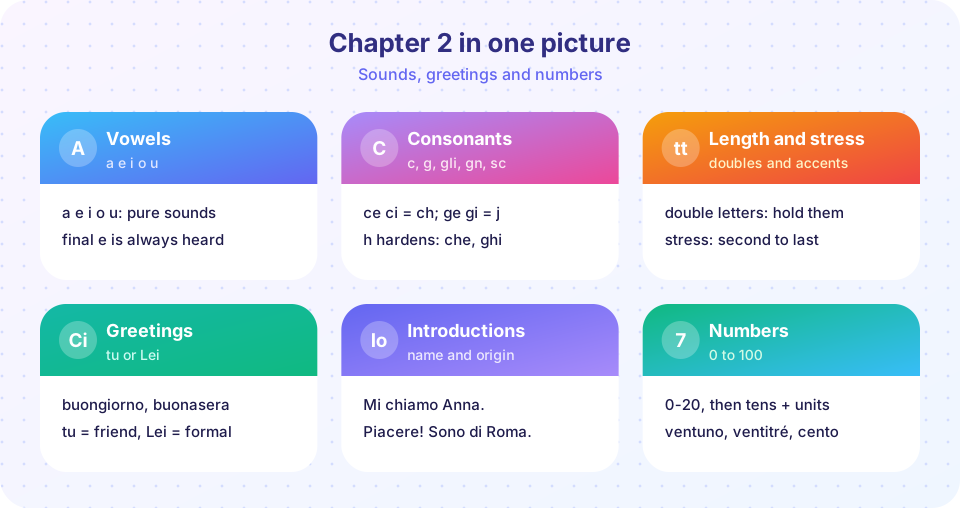
Chapter 2 in one picture: six building blocks of spoken Italian.
21 native letters (+ j k w x y in foreign words). Five pure vowels; e and o can be open or closed. Never drop a final vowel. Spell aloud with city names: A come Ancona.
c and g are soft before e and i, hard before a, o, u. ch and gh keep them hard. gli = /ʎ/, gn = /ɲ/, sce/sci = /ʃ/. h is silent. Hold double consonants: pala / palla.
Most words are stressed on the second to last syllable. A written accent shows last-syllable stress: città, caffè, perché. Accents separate e / è, da / dà, si / sì.
Read this dialogue aloud twice: once for rhythm, once for accuracy. Pay attention to the double consonants in Buongiorno, bello, Roma and tutto, to the soft c in piacere and ciao, and to the stress marks in è and città.
Anna: Buongiorno! Mi chiamo Anna. E Lei?
Paolo: Buongiorno, Anna. Io sono Paolo. Piacere!
Anna: Piacere mio! Di dov'è?
Paolo: Sono di Roma, una bella città. E Lei?
Anna: Sono di Torino. Quanti anni ha?
Paolo: Ho trentatré anni. E Lei?
Anna: Ho ventotto anni. Arrivederci, Paolo!
Paolo: Arrivederci, Anna. Buona giornata!
Translation: Anna: Good morning! My name is Anna. And you? Paolo: Good morning, Anna. I am Paolo. Nice to meet you! Anna: My pleasure! Where are you from? Paolo: I am from Rome, a beautiful city. And you? Anna: I am from Turin. How old are you? Paolo: I am thirty-three. And you? Anna: I am twenty-eight. Goodbye, Paolo! Paolo: Goodbye, Anna. Have a nice day!
Notice that this conversation uses Lei, because the two people have just met.
First, match the most important greetings and phrases.
Chapter 2 match
<style>*{box-sizing:border-box}body{margin:0;padding:14px;font-family:system-ui,'Segoe UI',Arial,sans-serif;background:linear-gradient(135deg,#faf5ff,#eff6ff);color:#1e1b4b}.wrap{max-width:640px;margin:0 auto}.card{background:#fff;border-radius:20px;box-shadow:0 10px 24px rgba(67,56,202,.15);padding:18px}.big{font-size:30px;font-weight:700;color:#312e81;text-align:center;min-height:44px;margin:14px 0 4px}.sub{font-size:16px;color:#64748b;text-align:center;min-height:22px}.row{display:flex;gap:8px;flex-wrap:wrap;justify-content:center;margin-top:14px}button{font:inherit;font-weight:600;border:0;border-radius:999px;padding:9px 16px;cursor:pointer;color:#fff;background:linear-gradient(135deg,#6366f1,#a78bfa)}button.alt{background:#eef2ff;color:#3730a3}button.ok{background:linear-gradient(135deg,#10b981,#14b8a6)}button:disabled{opacity:.5;cursor:default}.meta{font-size:14px;color:#6366f1;text-align:center;margin-bottom:4px}.opt{display:block;width:100%;text-align:left;margin:8px 0;background:#eef2ff;color:#1e1b4b;border-radius:14px;padding:11px 14px}.opt.good{background:#d1fae5;color:#064e3b}.opt.bad{background:#fee2e2;color:#7f1d1d}.fb{min-height:24px;margin-top:10px;font-weight:600;text-align:center}input[type=text]{font:inherit;width:100%;padding:11px 14px;border:2px solid #c7d2fe;border-radius:14px;margin-top:10px;background:#fff;color:#1e1b4b}table{border-collapse:collapse;width:100%;margin-top:10px}td,th{padding:8px 10px;text-align:left;border-bottom:1px solid #e0e7ff;font-size:16px}th{color:#4f46e5;font-size:14px;text-transform:uppercase;letter-spacing:.04em}.mt{margin-top:10px}</style><divclass="wrap"><divclass="card"><divclass="meta"id="meta">Click an Italian word, then its English meaning.</div><divstyle="display:flex;gap:14px"><divid="L"style="flex:1"></div><divid="R"style="flex:1"></div></div><divclass="fb"id="fb"></div><divclass="row"><buttonclass="alt"id="re">Shuffle again</button></div></div></div><script>constP=[["buongiorno","good morning"],["buonasera","good evening"],["arrivederci","goodbye"],["piacere","nice to meet you"],["scusi","excuse me (formal)"],["per favore","please"]];const$=id=>document.getElementById(id);let selL=null,matched=0;functionsh(a){a=a.slice();for(let i=a.length-1;i>0;i--){const k=Math.floor(Math.random()*(i+1));[a[i],a[k]]=[a[k],a[i]];}return a;}functionbuild(){$('L').innerHTML='';$('R').innerHTML='';selL=null;matched=0;$('fb').textContent='';sh(P.map((_,i)=>i)).forEach(i=>{const b=document.createElement('button');b.className='opt';b.textContent=P[i][0];b.dataset.i=i;b.onclick=()=>{if(b.disabled)return;[...$('L').children].forEach(x=>x.style.outline='');b.style.outline='3px solid #6366f1';selL=b;};$('L').appendChild(b);});sh(P.map((_,i)=>i)).forEach(i=>{const b=document.createElement('button');b.className='opt';b.textContent=P[i][1];b.dataset.i=i;b.onclick=()=>{if(b.disabled||!selL)return;if(selL.dataset.i===b.dataset.i){selL.classList.add('good');b.classList.add('good');selL.disabled=true;b.disabled=true;selL.style.outline='';selL=null;matched++;$('fb').style.color='#047857';$('fb').textContent=matched===P.length?'All matched. Bravo!':'Match!';}else{b.classList.add('bad');setTimeout(()=>b.classList.remove('bad'),500);$('fb').style.color='#b91c1c';$('fb').textContent='No, try another one.';}};$('R').appendChild(b);});}$('re').onclick=build;build();</script>
Second, type the Italian. This drill revisits words with accents and double letters.
Translate and spell
<style>*{box-sizing:border-box}body{margin:0;padding:14px;font-family:system-ui,'Segoe UI',Arial,sans-serif;background:linear-gradient(135deg,#faf5ff,#eff6ff);color:#1e1b4b}.wrap{max-width:640px;margin:0 auto}.card{background:#fff;border-radius:20px;box-shadow:0 10px 24px rgba(67,56,202,.15);padding:18px}.big{font-size:30px;font-weight:700;color:#312e81;text-align:center;min-height:44px;margin:14px 0 4px}.sub{font-size:16px;color:#64748b;text-align:center;min-height:22px}.row{display:flex;gap:8px;flex-wrap:wrap;justify-content:center;margin-top:14px}button{font:inherit;font-weight:600;border:0;border-radius:999px;padding:9px 16px;cursor:pointer;color:#fff;background:linear-gradient(135deg,#6366f1,#a78bfa)}button.alt{background:#eef2ff;color:#3730a3}button.ok{background:linear-gradient(135deg,#10b981,#14b8a6)}button:disabled{opacity:.5;cursor:default}.meta{font-size:14px;color:#6366f1;text-align:center;margin-bottom:4px}.opt{display:block;width:100%;text-align:left;margin:8px 0;background:#eef2ff;color:#1e1b4b;border-radius:14px;padding:11px 14px}.opt.good{background:#d1fae5;color:#064e3b}.opt.bad{background:#fee2e2;color:#7f1d1d}.fb{min-height:24px;margin-top:10px;font-weight:600;text-align:center}input[type=text]{font:inherit;width:100%;padding:11px 14px;border:2px solid #c7d2fe;border-radius:14px;margin-top:10px;background:#fff;color:#1e1b4b}table{border-collapse:collapse;width:100%;margin-top:10px}td,th{padding:8px 10px;text-align:left;border-bottom:1px solid #e0e7ff;font-size:16px}th{color:#4f46e5;font-size:14px;text-transform:uppercase;letter-spacing:.04em}.mt{margin-top:10px}</style><divclass="wrap"><divclass="card"><divclass="meta"id="meta"></div><divclass="big"style="font-size:24px"id="p"></div><divclass="sub"id="h"></div><inputtype="text"id="in"autocomplete="off"autocapitalize="off"spellcheck="false"placeholder="Type your answer in Italian"><divclass="row"><buttonid="chk">Check</button><buttonclass="alt"id="nx">Next</button></div><divclass="fb"id="fb"></div></div></div><script>constITEMS=[["thank you","grazie"],["good morning","buongiorno"],["city","città"],["coffee","caffè"],["seven","sette"],["twenty-one","ventuno"],["thirty-three","trentatré"],["I am Marco (use mi chiamo)","mi chiamo marco"],["nice to meet you","piacere"]];let i=0,score=0,tried=false;const$=id=>document.getElementById(id);conststrip=s=>s.normalize('NFD').replace(/[\u0300-\u036f]/g,'');constnorm=s=>s.trim().toLowerCase().replace(/\s+/g,' ');functionshow(){const it=ITEMS[i];$('meta').textContent='Item '+(i+1)+' of '+ITEMS.length+' | score: '+score;$('p').textContent=it[0];$('h').textContent=it[2]||'';$('in').value='';$('fb').textContent='';tried=false;$('in').focus();}functioncheck(){const it=ITEMS[i];const a=norm($('in').value);if(!a)return;const ok=norm(it[1]).split('|');if(ok.includes(a)){if(!tried)score++;$('fb').style.color='#047857';$('fb').textContent='Correct: '+it[1].split('|')[0];tried=true;}elseif(ok.map(strip).includes(strip(a))){$('fb').style.color='#b45309';$('fb').textContent='Right letters, but check the accent: '+it[1].split('|')[0];tried=true;}else{$('fb').style.color='#b91c1c';$('fb').textContent='Not yet. Try again, or press Next to see the answer.';tried=true;}$('meta').textContent='Item '+(i+1)+' of '+ITEMS.length+' | score: '+score;}$('chk').onclick=check;$('in').onkeydown=e=>{if(e.key==='Enter')check();};$('nx').onclick=()=>{if(!$('fb').textContent.startsWith('Correct')){$('fb').style.color='#475569';$('fb').textContent='Answer: '+ITEMS[i][1].split('|')[0]+' (press Next again to continue)';if(!$('nx').dataset.s){$('nx').dataset.s='1';return;}}$('nx').dataset.s='';i=(i+1)%ITEMS.length;show();};show();</script>
Third, test your ear for the rules.
Rules from Chapter 2
<style>*{box-sizing:border-box}body{margin:0;padding:14px;font-family:system-ui,'Segoe UI',Arial,sans-serif;background:linear-gradient(135deg,#faf5ff,#eff6ff);color:#1e1b4b}.wrap{max-width:640px;margin:0 auto}.card{background:#fff;border-radius:20px;box-shadow:0 10px 24px rgba(67,56,202,.15);padding:18px}.big{font-size:30px;font-weight:700;color:#312e81;text-align:center;min-height:44px;margin:14px 0 4px}.sub{font-size:16px;color:#64748b;text-align:center;min-height:22px}.row{display:flex;gap:8px;flex-wrap:wrap;justify-content:center;margin-top:14px}button{font:inherit;font-weight:600;border:0;border-radius:999px;padding:9px 16px;cursor:pointer;color:#fff;background:linear-gradient(135deg,#6366f1,#a78bfa)}button.alt{background:#eef2ff;color:#3730a3}button.ok{background:linear-gradient(135deg,#10b981,#14b8a6)}button:disabled{opacity:.5;cursor:default}.meta{font-size:14px;color:#6366f1;text-align:center;margin-bottom:4px}.opt{display:block;width:100%;text-align:left;margin:8px 0;background:#eef2ff;color:#1e1b4b;border-radius:14px;padding:11px 14px}.opt.good{background:#d1fae5;color:#064e3b}.opt.bad{background:#fee2e2;color:#7f1d1d}.fb{min-height:24px;margin-top:10px;font-weight:600;text-align:center}input[type=text]{font:inherit;width:100%;padding:11px 14px;border:2px solid #c7d2fe;border-radius:14px;margin-top:10px;background:#fff;color:#1e1b4b}table{border-collapse:collapse;width:100%;margin-top:10px}td,th{padding:8px 10px;text-align:left;border-bottom:1px solid #e0e7ff;font-size:16px}th{color:#4f46e5;font-size:14px;text-transform:uppercase;letter-spacing:.04em}.mt{margin-top:10px}</style><divclass="wrap"><divclass="card"><divclass="meta"id="meta"></div><divid="q"style="font-size:19px;font-weight:700;margin:8px 0"></div><divid="opts"></div><divclass="fb"id="fb"></div><divclass="row"><buttonid="next"disabled>Next question</button></div></div></div><script>constITEMS=[{"q":"How do you say 'ghiaccio' (ice) at the start?","options":["j-","g (hard)","sh-"],"a":1,"why":"Gh keeps the g hard: GYAHT-cho."},{"q":"What is 'sete' without the double letter?","options":["seven","thirst","six"],"a":1,"why":"Sete is thirst and sette is seven."},{"q":"What does 'Come si chiama?' ask?","options":["How are you?","Where are you from?","What is your name? (formal)"],"a":2,"why":"Come si chiama? is the formal way to ask someone's name."},{"q":"Which number is 'ventitré'?","options":["13","23","33"],"a":1,"why":"Venti is 20 and tré is 3, so 23."}];let i=0,score=0,done=false;const$=id=>document.getElementById(id);functionshow(){const it=ITEMS[i];done=false;$('meta').textContent='Question '+(i+1)+' of '+ITEMS.length+' | score: '+score;$('q').textContent=it.q;$('opts').innerHTML='';$('fb').textContent='';$('next').disabled=true;
it.options.forEach((o,k)=>{const b=document.createElement('button');b.className='opt';b.textContent=o;b.onclick=()=>pick(k,b);$('opts').appendChild(b);});}functionpick(k,b){if(done)return;done=true;const it=ITEMS[i];const bs=$('opts').children;if(k===it.a){score++;b.classList.add('good');$('fb').textContent='Correct! '+it.why;}else{b.classList.add('bad');bs[it.a].classList.add('good');$('fb').textContent='Not quite. '+it.why;}$('meta').textContent='Question '+(i+1)+' of '+ITEMS.length+' | score: '+score;$('next').disabled=false;$('next').textContent=i===ITEMS.length-1?'See result':'Next question';}$('next').onclick=()=>{if(i===ITEMS.length-1){$('q').textContent='Finished: '+score+' out of '+ITEMS.length;$('opts').innerHTML='';$('fb').textContent=score===ITEMS.length?'Perfetto!':'Try again to improve your score.';$('next').textContent='Start again';i=-1;score=0;$('next').onclick=()=>{$('next').onclick=null;location.reload();};return;}i++;show();};show();</script>