


















Lesson 45 of 45 · Projects and Practice
Where to Go Next in Food Science
Plan your next steps after food science: neighboring subjects such as microbiology, biochemistry, nutrition science, statistics and thermodynamics, career paths, and a study-plan tool.
You have followed food from the field to the factory, the plate and the label. You learned how heat treatments are calculated, why emulsions separate, how people perceive flavor and texture, how nutrients are measured and described, and how new foods are made safe and legal. This final lesson shows how those ideas connect to other subjects on this site, which direction to follow depending on your interests, what jobs use food science, and how to keep what you have learned.
What you will learn
- See how neighboring subjects deepen each part of food science.
- Choose a next subject based on your goals.
- Learn about careers that use food science.
- Build a study plan and a revision routine.
Key terms
Interdisciplinary: drawing on more than one field; food science combines chemistry, biology, physics, engineering, statistics and law.
Food technologist: a professional who develops, improves or controls food products and processes.
Quality assurance (QA): the system that makes sure a food meets its specifications and safety rules.
Sensory scientist: a specialist who designs and analyzes tests of how people perceive food.
Regulatory affairs: the function that makes sure products, labels and claims meet the law.
The neighbors
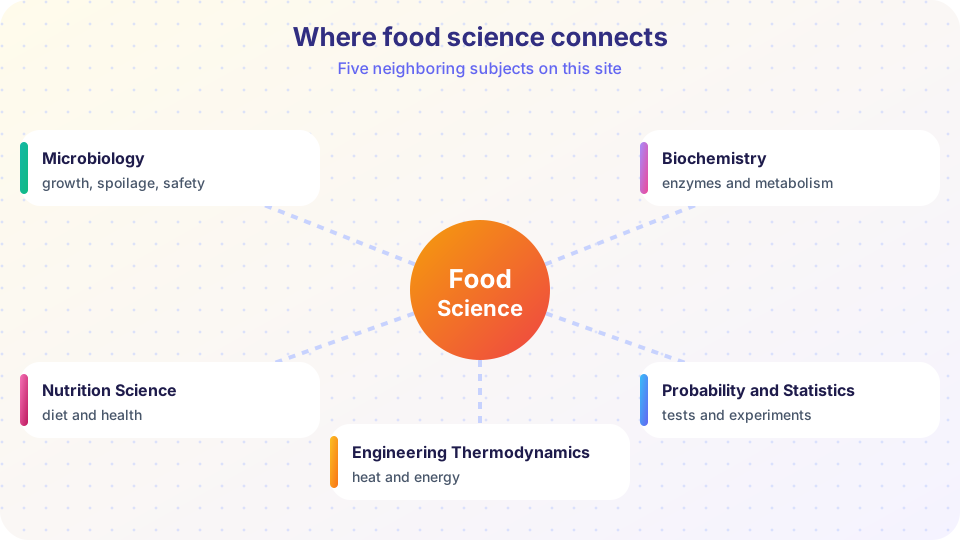
| If you enjoyed... | Study next | Why |
|---|---|---|
| D and z values, spoilage, HACCP hazards | Microbiology | The organisms behind spoilage and food poisoning, how they grow and how they are controlled |
| Maillard browning, enzymes, vitamins, digestion | Biochemistry | The molecules and reactions that make food change and nourish |
| Energy, nutrients, labels, claims | Nutrition Science | How the body uses nutrients and how diet relates to health |
| Triangle tests, p-values, panels, experiments | Probability and Statistics | The mathematics of uncertainty, confidence and experiment design |
| Heat transfer, pasteurizers, dryers, scale-up | Engineering Thermodynamics | Energy, heat, work and the machines that process food |
How the subjects fit together
Think of food science as a hub. Biology (microbiology, biochemistry) explains what happens in the food: why it spoils, why it ferments, why vitamins degrade. Physics and engineering (thermodynamics, heat transfer, rheology) explain how to change it with heat, cold, pressure and shear. Chemistry explains structure and reactions at the molecular level. Statistics tells you whether your measurements and tests mean anything. Law and ethics decide what you are allowed to do and say. Moving toward biology deepens the why of safety and spoilage; moving toward engineering deepens the how of making things at scale; moving toward statistics sharpens your ability to prove a claim.
Careers that use food science
- Product developer (R&D): creates and improves recipes, runs prototypes and pilot trials.
- Quality assurance and food safety manager: runs HACCP plans, audits suppliers, investigates complaints and handles recalls.
- Process engineer: designs and optimizes heating, cooling, drying and packaging lines.
- Sensory and consumer scientist: plans panels and analyzes the data.
- Regulatory affairs specialist: handles labels, claims, novel food applications and approvals.
- Nutrition scientist or dietitian-linked roles: analyzes composition and supports labeling and reformulation.
- Technical sales and supplier roles: ingredient companies need scientists to support customers.
Many people also move between these roles. A good all-round skill set includes some chemistry, some biology, some mathematics and clear writing.
How to keep what you learned
- Rework problems. Return to the practice problems after a week, a month and three months.
- Explain it out loud. Try to explain why milk is homogenized or why HTST preserves quality without notes.
- Look at real labels. Pick three foods in your kitchen and work out the energy from the grams, the %DV and the order of ingredients.
- Mind the assumptions. Whenever you use a formula, say what it assumes.
- Review in rounds: one day, one week, one month after learning (spaced repetition), using the glossary and the cheat sheet.
Common misconceptions
"Food science is just cooking." Cooking is part of it, but the field also covers chemistry, microbiology, engineering, sensory science, nutrition and law.
"I need to master everything first." Interleave: study microbiology after the heat chapter and thermal processing will make more sense.
"Food science tells me what to eat." It explains how foods work and how claims are made. Personal dietary advice comes from a qualified professional who knows your situation.
Try it
Pick your interests and see a suggested order for your next subjects. It is a simple guide, not career advice.
Second, a study-plan calculator: how many hours per week do you need to reach a goal by a date? The hours are your own estimates.
Press Run (or Ctrl + Enter) to see the console output here.
No output.
Check your understanding
Quick check · 3 questions
of 3 answered You scored / 3 · perfect!
-
1. Which neighboring subject best deepens your understanding of spoilage organisms and HACCP hazards?
Microbiology studies the organisms that spoil food and cause illness. -
2. Which career mainly runs HACCP plans and supplier audits?
QA and food safety managers run HACCP plans, audits and recalls. -
3. What is spaced repetition?
Reviewing after a day, a week and a month strengthens long-term memory.
Summary
- Food science is a hub linking biology, chemistry, physics and engineering, statistics and law.
- Neighboring subjects here: Microbiology, Biochemistry, Nutrition Science, Probability and Statistics and Engineering Thermodynamics.
- Careers include R&D, quality and food safety, process engineering, sensory science and regulatory affairs.
- Keep what you learned by reworking problems, explaining aloud, reading real labels and reviewing in rounds.
- This course gave you the science behind foods; for personal diet decisions, consult a qualified professional.
Back to the course: Food Science
Track your progress
Create a free account to tick off lessons and pick up where you left off on any device.
of Food Science lessons completed