


















Lesson 31 of 45 · Sensory Science
Chapter 6 Review: Sensory Science
Review chapter 6 in one picture: taste and smell receptors, chemesthesis, rheology and texture, and sensory tests with statistics, plus a test chooser and a 9-question quiz.
This chapter followed food from the plate to the brain and back to the laboratory. You learned how receptors detect molecules and forces, how texture can be measured, and how designed tests turn opinions into evidence. Use the summary picture and table below to check yourself, then try the test chooser and the quiz.
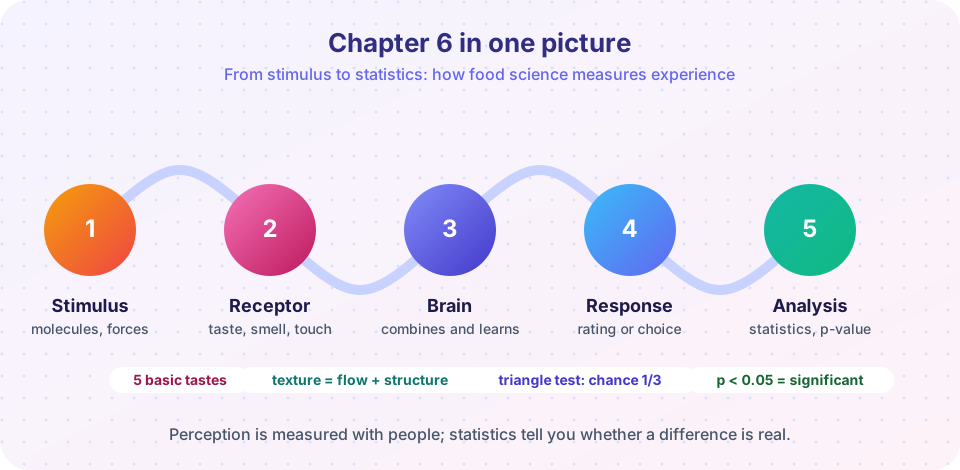
What you will learn
- Recap the main facts about taste, smell, texture and testing.
- Choose a suitable test for a given product question.
- Check your understanding with a mixed 9-question quiz.
Key terms
Retronasal smell: aroma reaching the nose from the mouth during eating.
Chemesthesis: chemical irritation, cooling or burning detected by pain and temperature nerves.
Shear-thinning: viscosity falls as shear rate rises.
Triangle test: three samples, two alike; chance level is 1/3.
Significance level (α): the false-alarm probability you accept, commonly 0.05.
Recap table
| Topic | Key facts | Lesson |
|---|---|---|
| Flavor | Taste + smell + touch + sight + sound; retronasal smell gives most variety | Overview |
| Thresholds | Detection threshold; Weber's law: JND ≈ k × intensity | Overview |
| Basic tastes | Sweet (T1R2+T1R3), umami (T1R1+T1R3), salty (ENaC), sour (OTOP1), bitter (TAS2Rs) | Taste and smell |
| Smell | About 400 receptor types; combinatorial code | Taste and smell |
| Chemesthesis | Capsaicin (TRPV1), menthol (TRPM8), carbonation, astringency | Taste and smell |
| Stevens | ψ = k S^n; n above 1 expansive, below 1 compressive | Taste and smell |
| Viscosity | η = τ / γ̇ in Pa·s; Newtonian vs shear-thinning | Texture |
| Yield stress | Herschel-Bulkley: τ = τ₀ + K γ̇^n | Texture |
| TPA | Hardness, cohesiveness (A₂/A₁), springiness | Texture |
| Test families | Discrimination, descriptive, affective | Testing |
| Triangle test | p = 1/3; 30 panelists need 15 correct | Testing |
Common misconceptions
"The tongue detects flavor." The tongue detects the five tastes; most of what we call flavor is aroma.
"One viscosity number describes a food." It depends on shear rate and temperature.
"A non-significant result proves no difference." It shows lack of evidence; power depends on panel size.
Try it
Choose a question about a product and see which family of test is most suitable and why. This is a teaching guide; real projects often combine tests.
A summary tool for hedonic data: enter counts of consumers choosing each point on the 9-point scale and see the mean and the share giving 7 or higher ("top-3-box"). The counts below are made up for the example.
Press Run (or Ctrl + Enter) to see the console output here.
No output.
Check your understanding
Quick check · 9 questions
of 9 answered You scored / 9 · perfect!
-
1. Which sense supplies most of the variety of flavors?
Thousands of aroma compounds, detected through the nose, create most of the variety. -
2. A Weber fraction is 0.25. By how much must a stimulus of 40 units rise to be just noticeable?
JND = k × intensity = 0.25 × 40 = 10 units. -
3. Which receptor responds to the cooling of menthol?
TRPM8 is a cold-sensing channel activated by menthol; TRPV1 responds to capsaicin and heat. -
4. A fluid becomes less viscous as it is stirred faster. It is:
Falling apparent viscosity with rising shear rate is shear-thinning. -
5. In TPA, cohesiveness equals:
Cohesiveness is the ratio of the area under the second compression to the area under the first. -
6. A triangle test has 18 panelists and the critical count is 10. 9 choose correctly. What do you conclude?
9 is below the critical value, so you cannot reject the hypothesis of no difference. -
7. Which test measures consumer liking?
The hedonic scale is an affective test of liking. -
8. Why should sample codes be random three-digit numbers?
Random codes hide identity so labels and positions do not bias the answer. -
9. Which of these is chemesthesis?
Chili burn is felt by pain and temperature nerves (TRPV1), not by taste buds.
Summary
- Flavor combines taste, smell, touch, sight and sound; smell supplies the variety.
- Five tastes have distinct receptors; chili, menthol and carbonation are chemesthesis.
- Rheology describes texture: viscosity depends on shear rate, yield stress and viscoelasticity matter, and TPA links curves to sensory words.
- Choose discrimination, descriptive or affective tests to match the question; use a large enough panel.
- Statistics (p-value, power, binomial) tells you whether an observed result is more than luck.
- Chapter 7 moves from experience to nutrition: what food provides and how labels describe it.
Track your progress
Create a free account to tick off lessons and pick up where you left off on any device.
of Food Science lessons completed