


















Lesson 4 of 45 · Getting Started
What food is made of: components and proximate analysis
Learn the major components of food, how proximate analysis splits a food into water, ash, protein, fat and carbohydrate, and how to calculate energy.
Open any food composition table and you will see the same few columns: water, protein, fat, carbohydrate, fiber, minerals (ash) and a handful of vitamins. These columns are the vocabulary of food science. Nearly everything a food does, from the way it browns to the way it spoils, can be traced to how much of each component it contains and how those components are arranged.
This lesson introduces the components, explains the standard laboratory approach for measuring them (proximate analysis), and shows how to turn a composition into an energy value. Later chapters examine each component in depth: water, carbohydrates, proteins and fats get a lesson each in Chapter 2.
What you will learn
- Name the major and minor components of food and what each does.
- Describe the steps of proximate analysis and the idea of "by difference".
- Convert protein, fat and carbohydrate grams to kilocalories and kilojoules.
- Explain why composition values are approximate and vary.
Key terms
Macronutrient: protein, fat and carbohydrate (large amounts, give energy). Ash: the mineral residue left after burning food at high temperature. Crude protein: nitrogen content multiplied by a conversion factor. Atwater factors: average energy values per gram: 4 kcal for protein and available carbohydrate, 9 kcal for fat. Moisture: water content, usually measured by drying.
The components
Water is the main component of most fresh foods: about 96% in cucumber, 87% in milk, 75% in chicken breast. It is the solvent in which reactions happen, it carries flavor, and its availability decides how fast microbes grow. Chapter 2 gives it a full lesson.
Carbohydrates include sugars (glucose, fructose, sucrose, lactose), starch and dietary fiber (cellulose, pectin, gums). Starch is the main energy store in cereals, potatoes and legumes. Fiber is carbohydrate that humans digest little or not at all.
Proteins are chains of amino acids. They provide the structure of meat, egg white and the gluten network in bread dough, and they supply the nitrogen and essential amino acids the body needs.
Lipids (fats and oils) are mostly triglycerides: a glycerol backbone with three fatty acids. They carry fat-soluble vitamins (A, D, E, K), give richness and mouthfeel, and are the most concentrated energy source.
Minerals (ash) such as sodium, potassium, calcium, iron and zinc. They affect nutrition, taste (salt) and sometimes texture (calcium sets pectin gels).
Vitamins and micronutrients are present in tiny amounts but essential. Some, like vitamin C, are easily destroyed by heat and oxygen.
Minor components: pigments (chlorophyll, carotenoids, anthocyanins), flavor compounds, enzymes, acids, and additives. Small in quantity, large in effect.
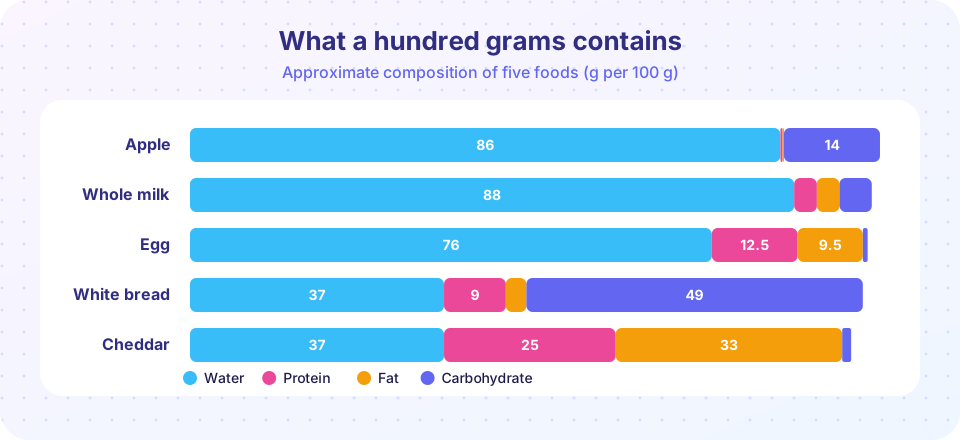
| Food (approximate, per 100 g) | Water g | Protein g | Fat g | Carbohydrate g |
|---|---|---|---|---|
| Apple | 86 | 0.3 | 0.2 | 14 |
| Whole milk | 88 | 3.3 | 3.3 | 4.7 |
| Egg | 76 | 12.5 | 9.5 | 0.7 |
| White bread | 37 | 9 | 3 | 49 |
| Cheddar cheese | 37 | 25 | 33 | 1.3 |
These are rounded, typical values. Real foods vary with variety, season, feed, growing conditions and processing, which is why databases list ranges or "typical values" and why a label may differ slightly from a table.
Proximate analysis
How do you find out what a food contains? The classical method, called proximate analysis (or Weende analysis), applies a sequence of simple tests that together account for nearly all of the food's mass. They are "proximate" because they measure groups of compounds, not individual molecules.
- Moisture. Weigh a sample, dry it in an oven (commonly about 105 °C for several hours, or in a vacuum oven at a lower temperature for sugary or heat-sensitive samples), weigh again. The mass lost is mostly water:
moisture % = (initial − dry mass) / initial × 100. - Ash. Burn the dried sample in a furnace at about 500-600 °C until only mineral residue is left, then weigh it.
- Crude protein. Measure the nitrogen (Kjeldahl digestion or the Dumas combustion method) and multiply by a factor. Because proteins are roughly 16% nitrogen, the general factor is
6.25(100/16). Some foods use other factors, for example around 5.7 for wheat and 6.38 for dairy. The result is called crude because non-protein nitrogen is counted too. - Crude fat. Extract the dried sample with an organic solvent (traditionally in a Soxhlet apparatus) and weigh what dissolves. Other methods (acid hydrolysis, Mojonnier) suit dairy and bakery products better.
- Carbohydrate by difference. Do not measure it directly:
carbohydrate = 100 − (moisture + ash + protein + fat).
"By difference" is clever and convenient. It also means that every error in the other four measurements ends up in the carbohydrate number, and that fiber is included unless measured separately by its own methods. Modern labels often report sugars, starch and fiber from dedicated tests.
Common misconceptions
"Carbohydrate content is measured directly." In basic proximate analysis it is calculated by difference. "Crude protein is the exact protein content." It is an estimate from nitrogen, which can be inflated if the food contains other nitrogen compounds (the 2008 melamine scandal in milk powder exploited exactly this weakness). "Nutrition tables are exact." They are averages with natural variation.
Worked example: a proximate analysis
Suppose a lab dried a 5.00 g sample of biscuit dough and found that it weighed 4.60 g afterwards, then ashed a dry sample and found 1.1% ash on the original weight basis, found 7.5% protein and 22% fat by the methods above. (These are invented numbers to show the method.)
- Moisture = (5.00 − 4.60) / 5.00 × 100 = 8.0%.
- Carbohydrate by difference = 100 − (8.0 + 1.1 + 7.5 + 22) = 61.4%.
From composition to energy
The body obtains energy from protein, fat, carbohydrate and (for adults who drink) alcohol. The Atwater system assigns average values per gram after allowing for incomplete digestion:
| Component | kcal per g | kJ per g |
|---|---|---|
| Protein | 4 | 17 |
| Available carbohydrate | 4 | 17 |
| Fat | 9 | 37 |
| Alcohol (ethanol) | 7 | 29 |
| Fiber (varies by regulation) | about 2 | about 8 |
One kilocalorie is 4.184 kilojoules. Fat has more than twice the energy per gram of protein or carbohydrate, which is why foods rich in fat (nuts, cheese, oil) are energy dense and foods rich in water (cucumber, soup) are not.
Take cheddar from the table: 25 × 4 + 1.3 × 4 + 33 × 9 = 100 + 5.2 + 297 = 402 kcal per 100 g. Over 70% of that energy comes from fat even though fat is only a third of the mass.
Why composition matters to everything else
Composition predicts behavior. A food that is 90% water and has a neutral pH spoils fast and needs refrigeration. A food that is mostly fat with almost no water (butter oil, chocolate) resists bacteria but can go rancid by oxidation. A food rich in protein and reducing sugars browns when heated by the Maillard reaction. A food high in starch thickens when heated in water. Each of these threads gets a full chapter later.
Try it
Press Run (or Ctrl + Enter) to see the result here.
Program input · what you'd type while the program runs
Type the answers before you press Run, one per line. Each time the program reads a line (with input()), it gets the next line from this box.
Press Run (or Ctrl + Enter) to see the result here.
Program input · what you'd type while the program runs
Type the answers before you press Run, one per line. Each time the program reads a line (with input()), it gets the next line from this box.
Press Run (or Ctrl + Enter) to see the result here.
Program input · what you'd type while the program runs
Type the answers before you press Run, one per line. Each time the program reads a line (with input()), it gets the next line from this box.
Check your understanding
Quick check · 5 questions
of 5 answered You scored / 5 · perfect!
-
1. In basic proximate analysis, how is carbohydrate usually found?
Carbohydrate is calculated by difference, so errors in the other measurements are carried into it. -
2. Why is crude protein multiplied by 6.25?
Proteins average about 16 percent nitrogen, so nitrogen times 6.25 estimates protein. -
3. How much energy does 10 g of fat provide using Atwater factors?
Fat provides 9 kcal per gram, so 10 g gives 90 kcal. -
4. Ash in a food represents...
After organic matter is burned away at high temperature, the mineral residue is the ash. -
5. Why might a nutrition table differ slightly from a lab result for one apple?
Natural variation in variety, ripeness and growing conditions means any single sample differs from the average.
Summary
- Foods are built from water, carbohydrate, protein, fat, minerals and vitamins, plus minor pigments, flavors and enzymes.
- Proximate analysis measures moisture, ash, crude protein and crude fat, then finds carbohydrate by difference.
- Atwater factors turn grams of macronutrients into energy: 4, 4 and 9 kcal per gram for protein, carbohydrate and fat.
- Composition values are typical, not exact, and composition predicts how a food behaves.
Track your progress
Create a free account to tick off lessons and pick up where you left off on any device.
of Food Science lessons completed