


















Lesson 11 of 45 · Food Chemistry
Lipids: fatty acids, rancidity and emulsions
Learn how fats and oils are built, why saturation sets melting point, how oxidation causes rancidity, and how emulsifiers keep oil and water mixed.
Fats and oils make food feel rich, carry flavor, crisp a fried potato and keep a cake tender. They are also why a bottle of walnut oil smells like old paint after a few months, why chocolate melts in your mouth but not in your hand and why a vinaigrette separates while mayonnaise does not. The same few chemical ideas explain all of these.
This lesson builds a triglyceride from its parts, shows how the shape of a fatty acid sets the melting point, explains oxidation (the main reason fats spoil) and then moves to emulsions, where fat and water are persuaded to share a container.
What you will learn
- Describe a triglyceride and the differences among saturated, monounsaturated and polyunsaturated fatty acids.
- Explain why melting point depends on chain length and double bonds.
- Outline the steps of lipid autoxidation and how to slow it.
- Explain what an emulsion is, why creaming happens and how emulsifiers work.
Key terms
Triglyceride: glycerol with three fatty acids attached, the main form of fat in food. Saturated fatty acid: a chain with no carbon-carbon double bonds. Unsaturated: one or more double bonds. Cis and trans: the geometry around a double bond (cis bends the chain, trans stays nearly straight). Autoxidation: oxygen reacting with fat through free radicals. Emulsifier: a molecule with a water-loving and a fat-loving end. HLB: hydrophilic-lipophilic balance, a 0-20 scale for emulsifiers.
Triglycerides and fatty acids
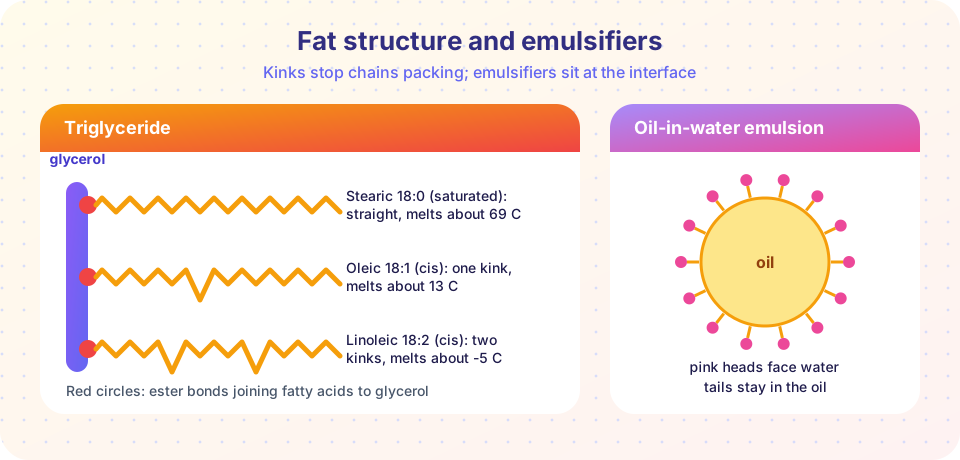
A fatty acid is a hydrocarbon chain, typically 4 to 22 carbons long, with a carboxylic acid group at one end. Three fatty acids attach to a glycerol backbone through ester bonds to make a triglyceride. Most of the fat in food, from olive oil to butter to beef tallow, is triglyceride; the type of fat depends on which fatty acids are present.
- Saturated fatty acids have no double bonds: palmitic acid (16 carbons) and stearic acid (18) are common. The chains are straight and pack neatly, so these fats tend to be solid at room temperature (butter, lard, palm and coconut fat).
- Monounsaturated fatty acids have one double bond: oleic acid (18:1) is dominant in olive oil.
- Polyunsaturated fatty acids have two or more: linoleic (18:2, an omega-6) and alpha-linolenic (18:3, an omega-3). The notation 18:2 means 18 carbons and 2 double bonds. Fish oils contain the long omega-3 acids EPA and DHA.
Natural double bonds are usually cis, which puts a bend in the chain. Industrial partial hydrogenation of vegetable oils (adding hydrogen to harden them) can create trans double bonds, which keep the chain nearly straight. Trans fats raise LDL cholesterol and lower HDL cholesterol, and many countries have restricted or banned industrially produced trans fat. Small amounts also occur naturally in ruminant fats.
Melting and crystals
Fats are mixtures, so they melt over a range, not at a point. Pure fatty acids show the trend:
| Fatty acid | Approximate melting point |
|---|---|
| Palmitic (16:0) | 63 °C |
| Stearic (18:0) | 69 °C |
| Oleic (18:1 cis) | about 13-14 °C |
| Linoleic (18:2) | about −5 °C |
| Alpha-linolenic (18:3) | about −11 °C |
Longer chains melt higher; each cis double bond lowers the melting point sharply because the bend prevents tight packing. That is why olive and sunflower oil are liquid and coconut and palm oil are soft solids. Cocoa butter is special: it is rich in just a few triglycerides, so it can crystallize into one stable form (form V) that melts at about 34 °C, just below body temperature. Chocolate makers temper chocolate (melting, cooling and rewarming through a controlled schedule) to seed these crystals, giving a glossy surface with a clean snap. Badly stored chocolate shows a grey "bloom" when fat crystals change form or migrate.
Oxidation: why fats go rancid
The enemy of fats is oxygen. Autoxidation is a chain reaction involving free radicals, atoms or molecules with an unpaired electron. It has three stages:
- Initiation. Heat, light, metal traces (iron, copper) or enzymes pull a hydrogen from a fatty acid next to a double bond, making a lipid radical
L•. - Propagation. The radical reacts with oxygen to form a peroxy radical
LOO•, which pulls hydrogen from another fatty acid, forming a hydroperoxideLOOHand a new radical. The chain keeps going, each cycle making one more hydroperoxide. - Termination. Radicals meet and combine into stable products.
Hydroperoxides themselves are nearly odorless, but they break down into aldehydes, ketones and other volatile compounds with the stale, painty, fishy or cardboard smells of rancidity. These products also can damage vitamins and proteins and are why oxidized oil is undesirable.
Polyunsaturated fatty acids oxidize fastest because the hydrogen between two double bonds is especially easy to remove. The rates increase roughly an order of magnitude with each extra double bond in the early steps (very approximately, oleic : linoleic : linolenic is often quoted near 1 : 10 : 20 or more). That is why oils rich in omega-3 (flax, fish, walnut) need cold, dark, airtight storage and why frying oils rich in oleic acid last longer.
Ways to slow it:
- Exclude oxygen: sealed, nitrogen-flushed packs, full containers, vacuum packing.
- Keep cool and dark: reaction rates rise with temperature, and light starts radicals.
- Add antioxidants: natural tocopherols (vitamin E), rosemary extract, ascorbyl palmitate; synthetic BHA, BHT and TBHQ in some products. Antioxidants donate a hydrogen to the radical and stop the chain.
- Chelators such as citric acid or EDTA bind pro-oxidant metals.
- Choose stable fats: high-oleic sunflower and canola oils are bred for stability.
A separate process, hydrolytic rancidity, occurs when lipase enzymes or moisture and heat split fatty acids from glycerol; free butyric acid gives spoiled butter its sharp smell. Frying also breaks down oil through oxidation, hydrolysis and polymerization, creating foam, darker color and off-flavors, which is why oil should be filtered and replaced. Smoke points depend on the oil, its refining and its free fatty acid content: refined oils are typically smokable at about 200-240 °C, extra virgin olive oil at roughly 190-210 °C and butter at about 150 °C (approximate ranges).
Emulsions
An emulsion is a mixture of two liquids that do not mix, one dispersed as tiny droplets in the other. Oil droplets in water make an oil-in-water (O/W) emulsion: milk, cream, mayonnaise, salad dressing, most sauces. Water droplets in oil make a water-in-oil (W/O) emulsion: butter and margarine. The liquid in droplets is the dispersed phase and the surrounding liquid the continuous phase. Emulsions are thermodynamically unstable, because oil and water prefer to separate and lower their contact area, so they need help.
Emulsifiers are molecules with a head that likes water and a tail that likes fat. They sit at the droplet surface, lower the interfacial tension and form a barrier that stops droplets merging (coalescence). Food emulsifiers include lecithin (egg yolk, soy), mono- and diglycerides, polysorbates, and proteins such as casein, which also act as emulsifiers. The HLB scale (0-20) indicates the balance: low HLB values (about 3-6) favor water-in-oil emulsions and high values (about 8-18) favor oil-in-water ones.
Why emulsions separate
Droplets that are lighter than the continuous phase rise: this is creaming, as in raw milk where cream floats to the top. Stokes' law gives the speed of a small droplet:
v = 2 r² (ρ_water − ρ_oil) g / (9 η)
where r is the droplet radius, ρ the densities, g = 9.81 m/s² and η the viscosity of the continuous phase. The key message is that velocity depends on the square of the radius: halving the droplet size makes creaming four times slower. That is exactly why milk is homogenized, forced through a narrow valve at high pressure to shatter fat globules from about 5 µm to below 1 µm, so the cream no longer separates in the carton. Thickening the continuous phase (higher viscosity η) also helps, which is how gums stabilize dressings.
Besides creaming, emulsions can fail by flocculation (droplets clump but stay separate), coalescence (droplets merge) and breaking (complete separation). Heating, freezing, acid, high salt or too little emulsifier can trigger them. Mayonnaise needs just enough egg yolk lecithin and proteins to hold up to about 70-80% oil by weight, because the droplets are packed so tightly that they form a gel-like structure; whisk in oil too fast and the emulsion breaks.
Common misconceptions
"Saturated fats are solid and unsaturated fats are liquid, always." It is a tendency: palm oil is semi-solid yet contains much unsaturated fat, and cocoa butter is solid though rich in oleic acid. "Rancid fat is harmless because it only smells bad." Oxidation products reduce quality and can be harmful at high levels; discard obviously rancid oil. "Emulsifiers are additives that don't occur naturally." Egg yolk lecithin and milk proteins are natural emulsifiers. "Oil and vinegar mix if you shake hard enough." They form a temporary emulsion that separates again without an emulsifier.
Try it
Press Run (or Ctrl + Enter) to see the result here.
Program input · what you'd type while the program runs
Type the answers before you press Run, one per line. Each time the program reads a line (with input()), it gets the next line from this box.
Press Run (or Ctrl + Enter) to see the result here.
Program input · what you'd type while the program runs
Type the answers before you press Run, one per line. Each time the program reads a line (with input()), it gets the next line from this box.
Press Run (or Ctrl + Enter) to see the result here.
Program input · what you'd type while the program runs
Type the answers before you press Run, one per line. Each time the program reads a line (with input()), it gets the next line from this box.
Press Run (or Ctrl + Enter) to see the result here.
Program input · what you'd type while the program runs
Type the answers before you press Run, one per line. Each time the program reads a line (with input()), it gets the next line from this box.
Check your understanding
Quick check · 6 questions
of 6 answered You scored / 6 · perfect!
-
1. Why is oleic acid liquid at room temperature while stearic acid is solid?
The cis double bond bends the chain, so molecules pack loosely and melt at a lower temperature. -
2. Which stage of autoxidation makes hydroperoxides and keeps the chain going?
In propagation, peroxy radicals take a hydrogen from another fatty acid, forming a hydroperoxide and a new radical. -
3. Which of these oils is likely to be most stable against oxidation?
High-oleic oils have few polyunsaturated acids, which are the most oxidation-prone. -
4. Milk is homogenized to...
Creaming speed varies with the square of droplet radius, so smaller globules stay suspended. -
5. Butter is which kind of emulsion?
Butter has water droplets dispersed in a continuous fat phase. -
6. What is a main reason industrial trans fats were restricted?
Trans fatty acids from partial hydrogenation have adverse effects on blood lipids.
Summary
- Fats are mostly triglycerides; saturated chains pack neatly (solid), cis double bonds kink chains (liquid).
- Autoxidation is a radical chain (initiation, propagation, termination); polyunsaturated oils oxidize fastest and need oxygen, light and metal control and antioxidants.
- Emulsions are droplets of one liquid in another, stabilized by emulsifiers such as lecithin and proteins.
- Creaming follows Stokes' law, so smaller droplets (homogenization) and thicker liquids slow separation.
Track your progress
Create a free account to tick off lessons and pick up where you left off on any device.
of Food Science lessons completed