


















Lesson 5 of 45 · Getting Started
Lab basics: measuring moisture, pH, Brix and uncertainty
Learn core food-analysis skills: sampling, accuracy versus precision, replicate statistics, and how moisture, pH, water activity and Brix are measured.
A food scientist's most useful habit is to ask "how do you know?". The answer is almost always a measurement, and the quality of a measurement depends on three things: how the sample was chosen, how the instrument was used and how the result is reported. This lesson gives you the basic toolbox. You will not carry out these tests in the lesson (and nothing here is presented as a measured result of ours), but you will understand what each one does, why its steps exist and how to judge a reported number.
Most routine food measurements are simple in principle: weigh something, dry it, dissolve it, shine light through it, put an electrode in it. The skill lies in doing them consistently and knowing their limits.
What you will learn
- Distinguish accuracy, precision, bias and random error.
- Describe how moisture, pH, water activity and Brix are measured.
- Calculate a mean, standard deviation and coefficient of variation from replicates.
- Explain why sampling and calibration matter as much as the instrument.
Key terms
Replicate: a repeat measurement on the same sample. Standard deviation (SD): a measure of spread among replicates. Coefficient of variation (CV): SD divided by the mean, as a percentage. Calibration: checking an instrument against known standards. Brix: grams of sucrose per 100 g of solution (reported as °Bx).
Sampling: the step you cannot fix later
An analytical result describes the portion you tested, not the whole batch. If the portion is not representative, no instrument can rescue the answer. A truck of grain does not have the same moisture everywhere; a loaf is drier at the crust; the surface of a cheese differs from its core. Good sampling plans take several portions from different places, combine them, mix well (or grind), and split a test portion from the mixture. Sample handling also matters: a sample that is left open dries, one left warm grows bacteria, and one that is stored badly oxidizes. Label everything, record the time and keep it cool and sealed until analysis.
Accuracy, precision and error
Imagine throwing darts. If all darts land close together but far from the bullseye, the throws are precise but not accurate. If they scatter around the bullseye, they are accurate on average but imprecise. A food lab wants both.
- Random error makes repeated measurements differ a little in an unpredictable way. It shows up as spread, which we estimate with replicates.
- Systematic error (bias) pushes all results the same way: a balance that reads 0.5 g high, an electrode that was not calibrated, a thermometer that is off by 2 °C. Replicates do not reveal bias; calibration against a known standard does.
The standard summary for replicates is the mean x̄ and the sample standard deviation s:
s = √( Σ(xᵢ − x̄)² / (n − 1) )
and the coefficient of variation CV = s / x̄ × 100%. A CV of a few percent is typical for routine chemical tests, but acceptable values depend on the method and the level being measured.
The last two lines show the key lesson: a bias moves the mean and leaves the spread unchanged, so you cannot spot it by looking at replicates.
Moisture
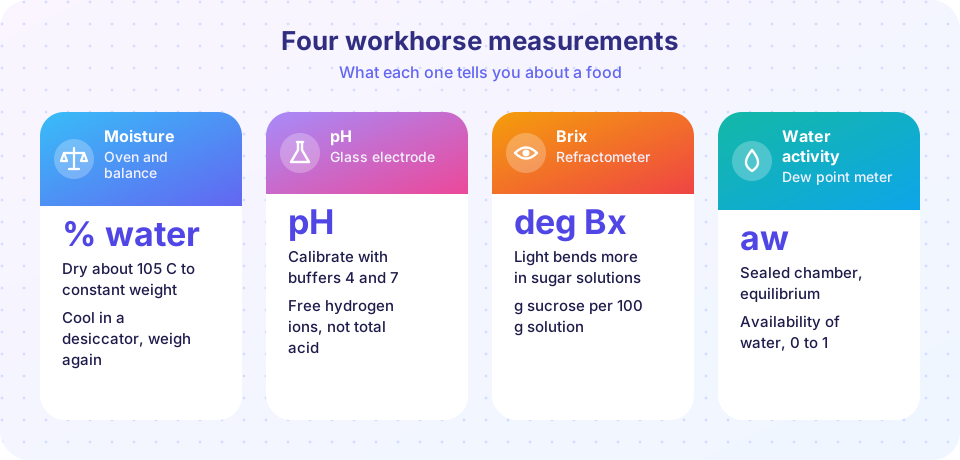
Oven drying is the reference method for many solid foods. Dry a weighed sample at a fixed temperature (commonly around 100-105 °C at atmospheric pressure, lower under vacuum for sugary products) until the weight stops changing. The loss is reported as moisture. Cautions: other volatile compounds (alcohol, essential oils) evaporate and count as "moisture"; heat-sensitive samples can decompose; and dried samples absorb water from the air very quickly, so they are cooled in a desiccator before weighing. Faster alternatives use infrared moisture balances or microwave drying, and Karl Fischer titration measures water specifically by chemistry, which suits low-moisture and high-fat foods.
pH and titratable acidity
pH is the negative base-10 logarithm of the hydrogen ion activity: pH = −log₁₀[H⁺] (approximately, in dilute solutions). Pure water at 25 °C is 7, lemon juice about 2, milk about 6.7, and tomato about 4.3-4.9. Each pH unit is a ten-fold change in H⁺, so a pH 3 food is a hundred times more acidic than a pH 5 food in terms of hydrogen ions.
A pH meter uses a glass electrode. It must be calibrated before use with at least two buffers that bracket the expected value (commonly pH 4.00 and 7.00, plus 10.00 for alkaline samples), the electrode must be kept moist and rinsed between samples, and temperature should be noted because buffers and samples both change with it.
pH alone does not tell you how much acid a food contains, only how many hydrogen ions are free. Titratable acidity (TA) measures total acid by adding a base of known concentration until a target pH (often 8.2) or an indicator color change is reached, and expresses the result as grams of a reference acid (citric for fruit, lactic for dairy). Two juices may have the same pH but different TA, and the one with more TA tastes more sour.
Brix and refractometry
When light passes from air into a sugar solution it bends. The more dissolved solids, the more it bends. A refractometer reads that bending (the refractive index) and converts it to degrees Brix (°Bx): grams of sucrose in 100 g of solution. A reading of 12 °Bx means the solution behaves like 12 g of sucrose in 88 g of water. It is accurate for pure sucrose solutions and an estimate of total soluble solids for juices, jams and syrups, which also contain acids and other dissolved compounds. Many instruments adjust for temperature automatically.
Water activity
Water activity (aw) tells you how available the water is. It is measured by sealing a sample in a small chamber and letting it come to equilibrium with the air above it. Modern meters use a chilled-mirror dew point sensor (the temperature at which dew forms on a cooled mirror gives the vapor pressure) or a capacitance sensor. Water activity depends on temperature, so the temperature is recorded. Chapter 2 explains what the number means and why it is among the strongest predictors of microbial growth and shelf life.
Calibration and good practice
- Calibrate before each run (pH meters, balances, refractometers, water activity meters have standards: buffers, certified weights, distilled water, saturated salt solutions).
- Blank and control samples: a blank shows contamination from reagents or containers; a control sample of known composition tells you whether the method works.
- Replicate at least in duplicate or triplicate; report the mean and the spread.
- Record instrument, date, operator, temperature and any deviation. Without records, a result cannot be checked.
- Report with sensible digits. Do not write 12.3456% if the method is only good to 0.1.
Common misconceptions
"A more expensive instrument is always right." An uncalibrated instrument can be precise and wrong. "pH tells you the total acid." It does not; titratable acidity does. "°Brix equals percent sugar in any food." It is grams of sucrose equivalent in 100 g of solution; other dissolved solids contribute. "Dry the sample longer to be sure." Overdrying can decompose the food and lose volatile non-water compounds, so you follow the method's time and temperature.
Try it
Press Run (or Ctrl + Enter) to see the result here.
Program input · what you'd type while the program runs
Type the answers before you press Run, one per line. Each time the program reads a line (with input()), it gets the next line from this box.
Press Run (or Ctrl + Enter) to see the result here.
Program input · what you'd type while the program runs
Type the answers before you press Run, one per line. Each time the program reads a line (with input()), it gets the next line from this box.
Check your understanding
Quick check · 6 questions
of 6 answered You scored / 6 · perfect!
-
1. A thermometer is always 2 degrees too high but gives consistent readings. This is mainly a problem of...
A constant offset is bias. Replicates will agree with each other, so only calibration reveals it. -
2. What does the coefficient of variation express?
CV is SD divided by the mean times 100, a relative measure of spread. -
3. A juice at 12 degrees Brix contains approximately...
Brix is grams of sucrose equivalent per 100 g of solution. -
4. Why are dried samples cooled in a desiccator before weighing?
A dried sample is thirsty and picks up water quickly from humid air, which would make the final weight too high. -
5. Two juices have the same pH but different titratable acidity. Which tastes more sour?
TA measures the total acid reserve; more total acid generally means a more sour taste at the same pH. -
6. How many times more hydrogen ions does pH 3 have than pH 5?
Two pH units is a factor of 10 squared, or 100.
Summary
- Good analysis starts with representative, well-handled samples.
- Replicates reveal random error; calibration reveals bias; report a mean and a spread.
- Moisture is found by drying (or Karl Fischer), pH by a calibrated glass electrode, Brix by refractometry and water activity by a dew point or capacitance meter.
- pH, titratable acidity, Brix and water activity each tell a different story about a food.
Track your progress
Create a free account to tick off lessons and pick up where you left off on any device.
of Food Science lessons completed