


















Lesson 10 of 45 · Food Chemistry
Proteins in food: structure, denaturation, gels and Maillard browning
Understand protein structure, denaturation by heat and acid, why eggs set and milk curdles, how gluten forms, and how the Maillard reaction makes flavor.
Proteins do the clever work in food. An egg white sets from a clear liquid into a white solid when heated, milk turns into cheese when acid or an enzyme is added, flour and water become an elastic dough, and a seared steak develops a brown, savory crust. All of these changes come from the same fact: proteins are long chains that fold into specific shapes, and those shapes are easy to disturb.
This lesson starts with the structure of a protein, then shows what happens when the structure is disturbed: denaturation. You will meet the main egg and milk proteins and the gluten of wheat, and you will finish with the Maillard reaction, the best-known chemistry in the kitchen, along with its less welcome by-product acrylamide.
What you will learn
- Describe amino acids, peptide bonds and the four levels of protein structure.
- Explain denaturation and list what causes it.
- Relate egg, milk and gluten behavior to protein chemistry.
- Describe the Maillard reaction, its controlling factors, and acrylamide.
Key terms
Amino acid: the building block of proteins (20 common ones). Peptide bond: the covalent link between two amino acids. Isoelectric point (pI): the pH at which a protein has no net charge and is least soluble. Denaturation: loss of native folded structure without breaking peptide bonds. Coagulation or aggregation: denatured proteins sticking together. Maillard reaction: reaction between a reducing sugar and an amino group that makes brown pigments and flavor.
Building a protein
Every amino acid has the same backbone (an amino group, a carboxyl group and a hydrogen on a central carbon) and a different side chain. Twenty side chains are common in food proteins; some are charged, some are water-loving (polar), some are oily (hydrophobic). Nine are essential for adults, meaning the body cannot make them: histidine, isoleucine, leucine, lysine, methionine, phenylalanine, threonine, tryptophan and valine.
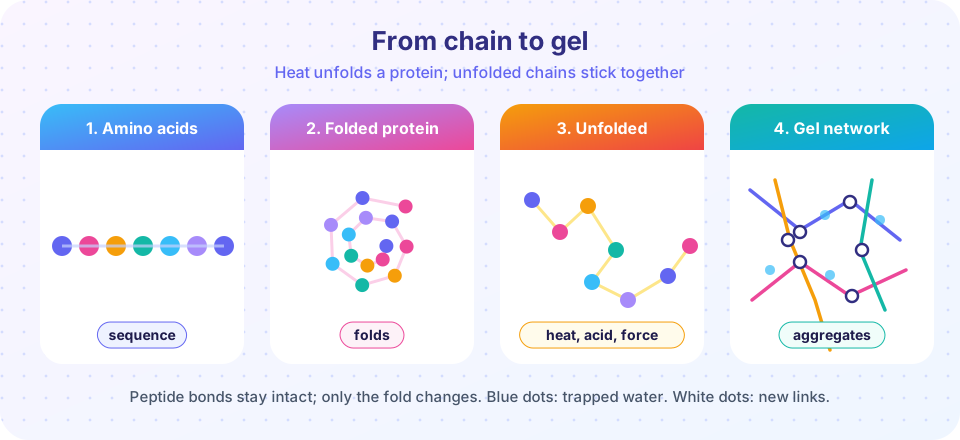
Amino acids link through peptide bonds, with loss of water, into chains of anywhere from a few dozen to thousands of units. Structure is described at four levels:
- Primary: the sequence of amino acids.
- Secondary: local shapes such as α-helices and β-sheets, held by hydrogen bonds.
- Tertiary: the overall 3D fold, stabilized by hydrophobic packing, hydrogen bonds, salt bridges and, in some proteins, sulfur-sulfur (disulfide) bonds.
- Quaternary: how several chains assemble into one functional unit.
The fold buries oily side chains in the interior and leaves water-loving ones on the surface, so a native protein is soluble. The forces involved are weak, which is exactly why mild treatments can disturb them.
Denaturation
Denaturation unfolds a protein without breaking its peptide bonds. The amino acid sequence is unchanged; the shape is lost. Typical causes in food:
- Heat (the usual cause; each protein has its own temperature).
- Acid or alkali change charges and break salt bridges (lemon juice "cooks" fish in ceviche; acid curdles milk).
- Mechanical force: whisking or kneading stretches chains (whipped egg white foam).
- Salt and alcohol, which disrupt water structure and hydrogen bonds.
- Freezing and drying can also damage some proteins.
After unfolding, hydrophobic regions are exposed. Chains collide and stick together, forming an aggregate. If the protein concentration is high enough, the aggregates join into a continuous network that traps water, a gel. That is how heat sets an egg. Slow, gentle heating tends to give fine, smooth networks (silky custard); fast, hot heating gives coarse, rubbery or curdled ones (scrambled, grainy custard).
At the isoelectric point the protein carries no net charge, so molecules no longer repel each other and aggregate easily. For milk's main protein, casein, the pI is around pH 4.6, which is why souring milk with acid (yogurt, buttermilk, fresh cheese) makes the casein clump together.
Food proteins you will meet
Egg. Egg white is about 10% protein in water. Its main proteins include ovotransferrin (begins to coagulate around 62 °C) and ovalbumin (about 80 °C), so egg white goes gradually from clear to opaque to firm as the temperature rises, setting over a range from roughly 60 to 80 °C. Yolk proteins set at roughly 65-70 °C. Adding sugar, milk or acid raises the temperature at which a custard sets, so bakers heat custards to 80-85 °C or more. Egg foams (meringue) depend on denatured proteins forming a film around air bubbles; any fat contamination prevents it, because fat displaces protein from the bubble surfaces.
Milk. Milk proteins are about 80% casein (assembled into micelles, which are tiny particles stabilized by a surface layer of κ-casein) and about 20% whey proteins (such as β-lactoglobulin, which denatures around 70-80 °C). Heating denatures whey proteins and forms the skin on hot milk; it does not curdle casein, which is very heat stable. Cheese-making cuts κ-casein with the enzyme chymosin (rennet) to make the micelles stick together into a curd, while yogurt relies on bacterial acid dropping the pH toward 4.6.
Meat. Muscle fibers are bundles of myosin and actin. Heating shrinks and firms them, squeezing out juice; connective tissue collagen needs long, moist cooking (tough cuts) because it only dissolves into gelatin at temperatures above about 70 °C over time. Overcooked lean meat turns dry because of water lost with the protein contraction.
Gluten. Flour from wheat contains two protein groups, gliadins and glutenins. When water is added and the dough is kneaded they form gluten: glutenins link by disulfide bonds into long elastic chains, gliadins let the network flow. The network traps gas from yeast so that bread rises. Salt, kneading time and flour protein content (about 10-13% in bread flour) change the strength. People with celiac disease must avoid gluten; this is a medical issue, not a preference.
The Maillard reaction
In 1912 the French chemist Louis-Camille Maillard noticed that mixing sugars and amino acids and heating them produced brown compounds. This Maillard reaction is now known to underlie the crust of bread, the sear on meat, roasted coffee, toasted nuts, chocolate, beer malt and the golden color of fries.
Simplified, it runs in three stages: (1) a reducing sugar (glucose, fructose, lactose, maltose; not sucrose) combines with a free amino group of an amino acid, lysine especially, or a protein; (2) this rearranges and breaks into reactive intermediates; (3) the intermediates condense into hundreds of flavor and aroma compounds and brown pigments called melanoidins.
What speeds it up:
- Temperature: it happens slowly even at room temperature (a stored milk powder slowly turns yellow) and very quickly above about 140 °C. Roughly, each 10 °C rise doubles or triples the rate.
- Water activity: fastest at intermediate values (about 0.6-0.8). A wet surface stays near 100 °C by evaporating water, which is why steaming does not brown and why a dry, hot pan sears. Patting meat dry helps.
- pH: favored by alkaline conditions; a pinch of baking soda browns onions and pretzels faster.
- Reactants: reducing sugars and free amino acids. Lysine is damaged in the process, so heavily browned protein foods lose some nutritional value.
A related but different change is enzymatic browning: when a cut apple or avocado turns brown, polyphenol oxidase enzymes make quinones from phenolic compounds with oxygen. It needs no heating and can be slowed with acid (lemon juice), blanching (heat destroys the enzyme) or excluding oxygen.
Acrylamide
At higher temperatures, usually above about 120 °C, the amino acid asparagine can react with reducing sugars and form acrylamide. In 2002 Swedish researchers reported acrylamide in many fried and baked starchy foods: potato chips and fries, breakfast cereals, bread crust and roasted coffee. Acrylamide causes cancer in rodents, and health agencies recommend reducing it as far as reasonably achievable, so manufacturers use lower frying temperatures, asparaginase enzyme treatments, potato varieties with fewer reducing sugars and storage practices that avoid cold-induced sweetening. At home, aiming for golden rather than dark brown is a sensible rule.
Protein quality and nutrition
A protein's nutritional value depends on its amino acid pattern and digestibility. Egg, milk and meat proteins supply all nine essential amino acids in good proportions. Many plant proteins are low in one essential amino acid (cereals in lysine, legumes in methionine), but eating cereals and legumes together complements them. Scores such as PDCAAS and DIAAS rate protein quality; Chapter 7 returns to them.
Common misconceptions
"Cooking destroys protein." It changes shape; the amino acids remain, and digestibility often improves. "Searing seals in juices." Searing makes flavor by Maillard browning; it does not seal anything, and meat loses water either way. "Browning is always bad." Controlled Maillard browning makes flavor; only excessive browning raises acrylamide and bitterness. "Gluten is in all grains." It is in wheat, barley and rye; rice and maize do not contain it.
Try it
Press Run (or Ctrl + Enter) to see the result here.
Program input · what you'd type while the program runs
Type the answers before you press Run, one per line. Each time the program reads a line (with input()), it gets the next line from this box.
Press Run (or Ctrl + Enter) to see the result here.
Program input · what you'd type while the program runs
Type the answers before you press Run, one per line. Each time the program reads a line (with input()), it gets the next line from this box.
Press Run (or Ctrl + Enter) to see the result here.
Program input · what you'd type while the program runs
Type the answers before you press Run, one per line. Each time the program reads a line (with input()), it gets the next line from this box.
Check your understanding
Quick check · 6 questions
of 6 answered You scored / 6 · perfect!
-
1. Denaturation of a protein does what?
Denaturation disrupts folding, not the peptide bonds. -
2. Why does acid curdle milk?
Near pH 4.6 casein has no net charge, so micelles aggregate. -
3. Which sugar does NOT take part directly in Maillard browning as a reducing sugar?
Sucrose has no free reducing group unless it is first split into glucose and fructose. -
4. What is acrylamide formed from?
Asparagine reacts with reducing sugars above about 120 °C. -
5. Why does steaming not brown food?
Browning needs high temperature and low surface water activity. -
6. Which two protein groups form gluten?
Gliadins and glutenins hydrate and form the elastic gluten network.
Summary
- Proteins are amino acid chains with four levels of structure; weak forces hold the fold in place.
- Denaturation by heat, acid, force or salt unfolds proteins; aggregates can form gels (egg, yogurt, cheese).
- Casein is acid-sensitive near pH 4.6 and heat stable; whey proteins denature at about 70-80 °C; gluten comes from gliadins and glutenins.
- The Maillard reaction needs reducing sugars and amino groups, is fast when hot and dry, and can form acrylamide.
Track your progress
Create a free account to tick off lessons and pick up where you left off on any device.
of Food Science lessons completed