


















Lesson 8 of 45 · Food Chemistry
Water and water activity in food
Understand hydrogen bonds, free and bound water, how water activity is defined and measured, sorption isotherms and why sugar, salt and drying preserve food.
A slice of bread and a bowl of soup both hold a lot of water, yet bread can sit on a counter for days while soup spoils in hours. A raisin is about 15% water yet resists microbes better than a cucumber that is 96% water. Raw honey is 17% water and can last for years. The amount of water does not explain these differences. What matters is how freely that water can take part in reactions and microbial growth. Food scientists measure that with water activity.
In this lesson you will meet the water molecule and its hydrogen bonds, learn to define water activity and what typical values mean, see how sugar and salt lower it, and learn how isotherms connect water content to water activity. This is one of the most useful ideas in the whole course. Chapters 3 and 4 use it constantly.
What you will learn
- Describe the polarity and hydrogen bonding of water and why it dissolves many food compounds.
- Define water activity and say what typical foods and microbes need.
- Predict the effect of sugar on
awwith the Norrish equation. - Explain a sorption isotherm and why drying and humidity matter.
Key terms
Polar molecule: a molecule with a positive and a negative end (water). Hydrogen bond: a weak attraction between a hydrogen on one molecule and an oxygen or nitrogen on another. Water activity (aw): the vapor pressure of water over a food divided by that of pure water at the same temperature. Equilibrium relative humidity (ERH): the humidity of the air in equilibrium with the food; aw = ERH / 100. Sorption isotherm: a curve of moisture content versus aw at constant temperature.
The water molecule
A water molecule, H₂O, is bent: the two hydrogens sit about 104.5° apart, with oxygen at the apex. Oxygen pulls electrons harder than hydrogen does, so the oxygen end is slightly negative and the hydrogens slightly positive. This makes water polar.
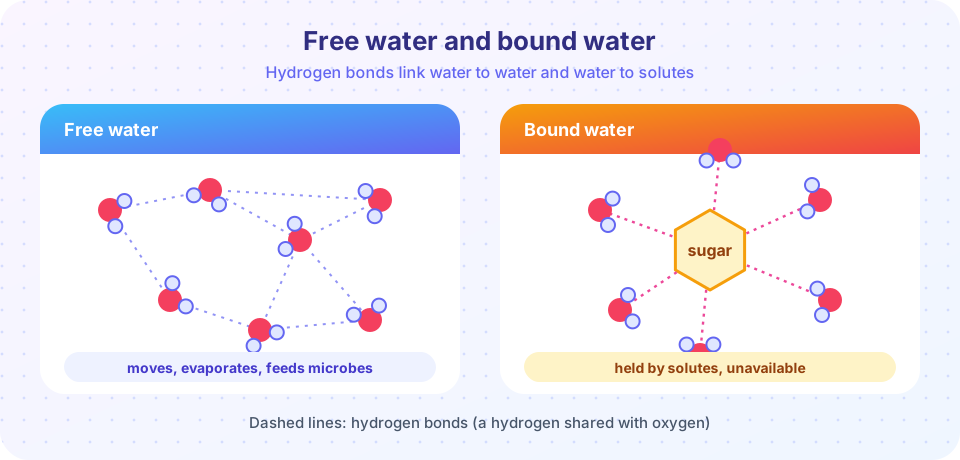
Polar molecules attract each other. The slightly positive hydrogen of one water molecule is drawn toward the slightly negative oxygen of another, forming a hydrogen bond. Each bond is weak (roughly a twentieth as strong as a covalent bond) but a liter of water holds an enormous number of them, constantly forming and breaking. This explains why water has an unusually high boiling point (100 °C at sea level) for such a small molecule, why it absorbs a lot of heat (specific heat about 4.18 kJ per kg per kelvin) and why it dissolves sugars, salts and many proteins: it forms hydrogen bonds with them too, surrounding each dissolved particle in a shell of water molecules.
Free water, bound water
In a food, some water is held tightly: attached to polar groups on proteins and starch, tied up by dissolved sugar and salt, or trapped in tiny capillaries. This is bound water. It does not freeze readily, does not evaporate easily and is unavailable to microbes. The remainder is free water, which behaves like ordinary liquid water and supports reactions and growth. There is no sharp line between the two; the picture is a continuum, which is why a single number is useful.
Defining water activity
Put a food in a sealed container at constant temperature and wait. Water molecules leave the food and enter the air until the humidity of the air stops changing. The ratio of the water vapor pressure over the food (p) to the vapor pressure over pure water (p₀) is the water activity:
aw = p / p₀
Equivalently, aw = ERH / 100, where ERH is the equilibrium relative humidity of the air in percent. Pure water has aw = 1.00. Everything dissolved or adsorbed lowers it. Because aw depends on temperature, it is always reported at a stated temperature (often 25 °C).
Typical values (approximate):
| Food | Approx. aw |
|---|---|
| Fresh meat, fish, vegetables, milk | 0.98-0.99 |
| Bread | 0.93-0.97 |
| Aged hard cheese | 0.85-0.95 |
| Jam, marmalade | 0.75-0.85 |
| Honey | about 0.55-0.65 |
| Dry pasta, crackers | 0.3-0.5 |
| Milk powder | 0.2 or below |
What microbes need
Every organism has a minimum aw for growth. Approximate limits, which vary with the strain, temperature and pH:
| Group | Approx. minimum aw |
|---|---|
| Most bacteria | 0.91 |
| Clostridium botulinum (types A and B) | about 0.94 |
| Staphylococcus aureus (aerobic) | about 0.86 |
| Most yeasts | 0.88 |
| Most molds | 0.80 |
| Halophilic (salt-loving) bacteria | about 0.75 |
| Xerophilic (dry-loving) molds and osmophilic yeasts | 0.61-0.65 or so |
Below about 0.60, no microbial growth is known to occur. This is why dry foods, jams, honey and salted fish keep: the microbes cannot get the water they need even though the food contains some.
Water activity also steers chemical reactions. Lipid oxidation is slowest at intermediate aw (about 0.2-0.4, where water covers surfaces and protects fats) and faster in very dry and in moist foods. The Maillard reaction is fastest at intermediate values (about 0.6-0.8) because there is enough water for mobility but not so much that reactants are diluted. Enzymes need water to work and slow sharply below about 0.6-0.7.
How solutes lower water activity
Dissolved molecules attract water, reducing the number of free water molecules that can escape. In an ideal solution, Raoult's law says aw equals the mole fraction of water. Sugar solutions deviate from the ideal, so empirical corrections are used. The Norrish equation is a handy one for non-electrolytes:
aw = xw × exp(K × xs²)
where xw and xs are the mole fractions of water and solute and K is a constant for the solute (about −6.47 for sucrose). Mole fractions use moles: grams divided by molar mass (18.015 g/mol for water, 342.3 g/mol for sucrose).
Worked example: a 50% sucrose syrup (50 g sucrose, 50 g water). Moles of sucrose = 50 / 342.3 = 0.146; moles of water = 50 / 18.015 = 2.776. Total = 2.922, so xs = 0.0500, xw = 0.950. Then aw = 0.950 × exp(−6.47 × 0.0025) = 0.950 × 0.984 = 0.935. A 50% syrup is not safe against most yeasts. A 65% syrup gives about 0.87, and jams reach 0.80-0.85 because fruit solids, acids and salts add to the effect of the sugar, which is why jam needs a lot of sugar. Salt is even more effective per gram, because it splits into two ions (Na⁺ and Cl⁻), and its molar mass is small; a saturated salt solution has aw of about 0.75.
Sorption isotherms
If you take a dry food and expose it to increasingly humid air, it takes up water. The curve of equilibrium moisture content against aw at a fixed temperature is the sorption isotherm. It is S-shaped for most foods:
- Region I (low aw, about 0 to 0.25): water is tightly bound in a thin layer on polar sites (the monolayer). The monolayer moisture content (often 3-10 g water per 100 g solids, depending on the food) is a good target for dry storage because reactions are slowest there.
- Region II (about 0.25 to 0.6): further layers build up; water dissolves small solutes and starts to plasticize the food.
- Region III (above about 0.6): water behaves as a solvent, so reactions and microbial growth accelerate.
Absorbing and releasing do not follow the same path: the curve measured while drying lies above the curve while rewetting. This hysteresis means a food's history matters. The practical consequence is that two foods with the same moisture content can have different aw, and that a dry product left in humid air picks up water until it reaches equilibrium, often becoming stale or caked.
Controlling water activity in practice
You can lower aw three ways: remove water (drying, evaporation, freeze-drying), add solutes (sugar in jam, salt in cured fish and ham, glycerol in some soft biscuits) or bind water with hydrocolloids. Foods called intermediate moisture foods (jerky, dried fruit, soft cookies, some pet foods) sit around 0.6-0.85 and are shelf stable through a mix of low aw, acidity and preservatives. Packaging then prevents the product from picking up moisture from the air. Chapter 4 shows how these methods combine.
Common misconceptions
"Water content and water activity are the same." Honey (17% water) has much lower aw than cucumber (96% water); content measures how much, activity measures availability. "Below 0.6 means sterile." Microbes cannot grow, but spores and some cells can survive for years, and they grow again if the food absorbs moisture. "Freezing removes water." Freezing locks it in ice; aw of frozen foods is still low but depends on temperature.
Try it
Press Run (or Ctrl + Enter) to see the result here.
Program input · what you'd type while the program runs
Type the answers before you press Run, one per line. Each time the program reads a line (with input()), it gets the next line from this box.
Press Run (or Ctrl + Enter) to see the result here.
Program input · what you'd type while the program runs
Type the answers before you press Run, one per line. Each time the program reads a line (with input()), it gets the next line from this box.
Press Run (or Ctrl + Enter) to see the result here.
Program input · what you'd type while the program runs
Type the answers before you press Run, one per line. Each time the program reads a line (with input()), it gets the next line from this box.
Press Run (or Ctrl + Enter) to see the result here.
Program input · what you'd type while the program runs
Type the answers before you press Run, one per line. Each time the program reads a line (with input()), it gets the next line from this box.
Check your understanding
Quick check · 6 questions
of 6 answered You scored / 6 · perfect!
-
1. Which statement about water activity is correct?
aw = p/p0, between 0 and 1 for foods. It depends on temperature and is not the same as water content. -
2. A jam has an aw of 0.80. Which group is most likely limited by this?
Most bacteria already stop at about 0.91; most molds stop around 0.80, so a jam at 0.80 relies on other hurdles for the rest. -
3. What does the Norrish equation estimate?
Norrish corrects Raoult's law for non-ideal behavior of solutes such as sugars. -
4. In the sorption isotherm, region I water is...
At very low aw water forms a tightly held monolayer on polar sites. -
5. Lipid oxidation is typically slowest at...
Water covers surfaces and protects fats at intermediate aw, giving a minimum; oxidation rises on both sides. -
6. Two foods have the same moisture content but different aw. What does that tell you?
Binding by solutes and structure differs between foods, so equal water content can give different availability.
Summary
- Water is polar and forms hydrogen bonds, which makes it the universal solvent in food.
- Water activity measures availability:
aw = p / p₀ = ERH / 100, at a stated temperature. - Most bacteria need
awabove about 0.91, most molds above about 0.80, and nothing grows below roughly 0.6. - Sugar, salt and drying lower
aw; sorption isotherms link moisture content toawand show hysteresis.
Track your progress
Create a free account to tick off lessons and pick up where you left off on any device.
of Food Science lessons completed