


















Lesson 29 of 45 · Sensory Science
Texture and Rheology
Understand food texture: viscosity, shear-thinning and yield stress, viscoelasticity, gels, and instrumental tests such as texture profile analysis, linked to what people feel.
Think of a crisp apple, a creamy yogurt, a chewy caramel and a runny soup. Their flavors may be similar; their textures are what make you reach for one rather than another. Texture is the set of mechanical, geometric and surface properties of a food that you feel with your mouth, lips, fingers and teeth. It is also the part of quality that is most easily destroyed by processing and storage, and the most difficult to describe in words. Rheology, the science of how materials flow and deform, supplies the numbers. This lesson connects the two: what you feel, and what an instrument can measure.
What you will learn
- Define stress, strain, shear rate and viscosity, with units.
- Recognize Newtonian, shear-thinning, shear-thickening and yield-stress behavior.
- Explain viscoelasticity, gels and thixotropy in everyday foods.
- Read a texture profile analysis curve and link it to sensory words.
Key terms
Viscosity (η): resistance to flow; shear stress divided by shear rate, in pascal seconds (Pa·s).
Shear rate (γ̇): how fast layers of fluid slide past each other, in reciprocal seconds (1/s).
Yield stress (τ₀): the minimum stress needed before a material flows; below it, it behaves like a solid.
Viscoelastic: showing both viscous (liquid-like) and elastic (solid-like) responses.
Thixotropy: a viscosity that falls while a material is stirred and recovers slowly at rest.
What texture is, and how it is described
The classic framework by Alina Szczesniak sorted texture words into three groups:
- Mechanical characteristics: hardness, cohesiveness, viscosity, elasticity, adhesiveness, and the derived properties brittleness, chewiness and gumminess.
- Geometrical characteristics: particle size, shape and orientation, such as grainy, gritty, fibrous, flaky or crumbly.
- Other characteristics: moisture and fat content as felt, for example juicy, oily or greasy.
Sensory panels use these words as scales. A trained panel might rate "crispness" from 0 to 15 with an anchor food at each point. Instrumental measurements give the same idea in physical units. Good practice is to measure both, and to check that the instrument number agrees with the panel's rating, because the mouth does not behave like a simple instrument: a person chews, adds saliva, warms the food and shears it at changing rates.
Rheology basics: stress, strain, viscosity
Imagine a fluid between two plates. You slide the top plate with a force per unit area, the shear stress τ (pascals, Pa). The fluid layers slide past one another at a shear rate γ̇ (1/s), the speed gradient across the gap. The ratio is the viscosity:
η = τ / γ̇ (units: Pa·s; 1 mPa·s = 0.001 Pa·s)
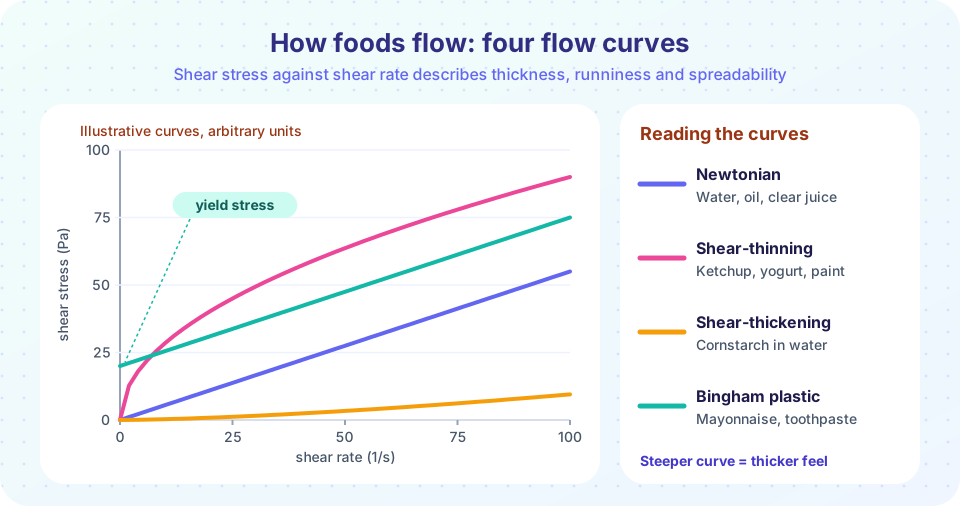
A Newtonian fluid has a constant viscosity at all shear rates, so stress is proportional to rate: the straight line through the origin on the chart. Water (about 1 mPa·s at 20 °C), milk (a few mPa·s), clear juices and oils are close to Newtonian, and honey is Newtonian at a viscosity thousands of times higher. For scale, the usual order of magnitudes at room temperature:
| Food | Viscosity (order of magnitude) |
|---|---|
| Water | about 0.001 Pa·s |
| Whole milk | a few 0.001 Pa·s |
| Olive oil | roughly 0.05 to 0.1 Pa·s |
| Honey | roughly 2 to 10 Pa·s, depending on type and temperature |
Non-Newtonian foods
Most interesting foods are not Newtonian, because their structure changes when they are stirred.
Shear-thinning (pseudoplastic). The apparent viscosity falls as shear rate rises. Long molecules untangle and align, or particles line up. Ketchup, yogurt, cream soups and many sauces behave this way. A power law describes many of them:
τ = K × γ̇^n (n < 1 for shear-thinning, K is the consistency index)
Shear-thinning is exactly what you want in a sauce: thick on the plate so it does not run, thin when you pour, spread or swallow. When n is greater than 1 the fluid is shear-thickening: viscosity rises with shear rate. A concentrated starch-in-water paste can behave this way, which is why you can punch it and it feels solid, but dip a finger slowly and it flows.
Yield stress. Mayonnaise, toothpaste, thick tomato paste and whipped cream behave like a solid until the stress exceeds a threshold, then flow. Add a yield stress to the power law and you get the Herschel-Bulkley model:
τ = τ₀ + K × γ̇^n
When n is 1 this reduces to the Bingham plastic model. The yield stress explains why mayonnaise stays on a knife and why peanut butter stays in the shape of the spoon.
Thixotropy. Shake a bottle of ketchup and the first pour is fast, because stirring has broken down its structure, which then rebuilds slowly. The viscosity depends on the history of stirring, not just on the current shear rate.
Viscoelasticity, gels and gums
Many foods are neither liquids nor solids. A gelatin dessert wobbles, snaps back, and eventually flows over long times. Such materials are viscoelastic. Rheologists measure this with small, oscillating strains and report two moduli: the storage modulus G′, the elastic, solid-like part, and the loss modulus G″, the viscous, liquid-like part. If G′ is larger than G″ across the tested range, the sample behaves as a gel: a network of polymer chains or particles that traps water.
Food gels come from several sources: gelatin (protein, melts near body temperature, so it melts in your mouth), pectin (fruit, needs sugar and acid), starch (swells and sets on cooling), agar and carrageenan (seaweed) and milk proteins (yogurt, cheese). Thickeners such as xanthan gum raise viscosity at tiny concentrations and are strongly shear-thinning, which keeps salad dressings suspended without a heavy mouthfeel. The same structural ideas link back to emulsions and Stokes' law: thickening the continuous phase slows creaming.
Measuring texture with instruments
- Viscometers and rheometers measure flow curves and moduli.
- Penetrometers and compression tests push a probe into the sample and record force against distance. Fruit firmness and cheese hardness are measured this way.
- Warner-Bratzler shear cuts a core of cooked meat and records the peak force, a standard measure of tenderness.
- Texture profile analysis (TPA) compresses a bite-sized piece twice, imitating two chews, and extracts several parameters from the force-time curve.
In TPA, hardness is the peak force in the first compression. Cohesiveness is the ratio of the area under the second compression to the area under the first (A₂ / A₁): how well the food holds together between bites. Springiness is how much of its height the food recovers, and adhesiveness is the negative force area as the probe pulls away. Chewiness is derived from hardness, cohesiveness and springiness, usually for solid foods.
Crispness is special: it combines a sharp force drop pattern with sound, so acoustic recordings are used together with the force curve.
Common misconceptions
"Thick means high in fat or calories." Thickness can come from tiny amounts of gum or starch. Many low-fat products are thickened to give the mouthfeel of fat.
"Viscosity is a single number for a food." For non-Newtonian foods, viscosity depends on shear rate, so a number without the shear rate is almost meaningless.
"Texture is only about the mouth." Fingers, lips, teeth, sound and sight all contribute, and the same food can feel different at different temperatures.
Try it
The first run compares apparent viscosity of five fluids across shear rates. The values are illustrative round numbers, not measurements of a specific product. The marked line is about 50 1/s, a shear rate often used as a rough estimate for stirring in the mouth.
Press Run (or Ctrl + Enter) to see the result here.
Program input · what you'd type while the program runs
Type the answers before you press Run, one per line. Each time the program reads a line (with input()), it gets the next line from this box.
Second, an idealized texture profile analysis. Drag the sliders to change hardness and cohesiveness and see how the two-bite force curve changes. It is a model of the curve's shape, not a recording from a real sample.
Check your understanding
Quick check · 5 questions
of 5 answered You scored / 5 · perfect!
-
1. A fluid has constant viscosity at all shear rates. What is it called?
A Newtonian fluid has stress proportional to shear rate, so its viscosity does not change. -
2. Why is it useful for ketchup to be shear-thinning?
Shear-thinning gives a thick resting state and a thinner flowing state. -
3. Which material needs a yield stress before it flows?
Mayonnaise is a concentrated emulsion with a network that holds its shape until the stress exceeds the yield stress. -
4. In a TPA curve, cohesiveness is the ratio of:
Cohesiveness = A2/A1, how much of the first bite's work remains in the second. -
5. If G′ is larger than G″ across the tested range, the sample is best described as:
A storage modulus above the loss modulus means solid-like, elastic behavior: a gel.
Summary
- Texture is the mechanical, geometric and surface properties felt in the mouth; rheology measures them in physical units.
- Viscosity is stress divided by shear rate (Pa·s); Newtonian fluids have one value, most foods do not.
- Shear-thinning, shear-thickening, yield stress (Herschel-Bulkley, Bingham) and thixotropy describe real non-Newtonian foods.
- Viscoelastic gels have G′ above G″; gelatin, pectin, starch, agar and milk proteins form food gels.
- TPA turns two chews into hardness, cohesiveness, springiness and adhesiveness.
- Always report a viscosity with its shear rate and temperature.
Next: Sensory testing methods
Track your progress
Create a free account to tick off lessons and pick up where you left off on any device.
of Food Science lessons completed